

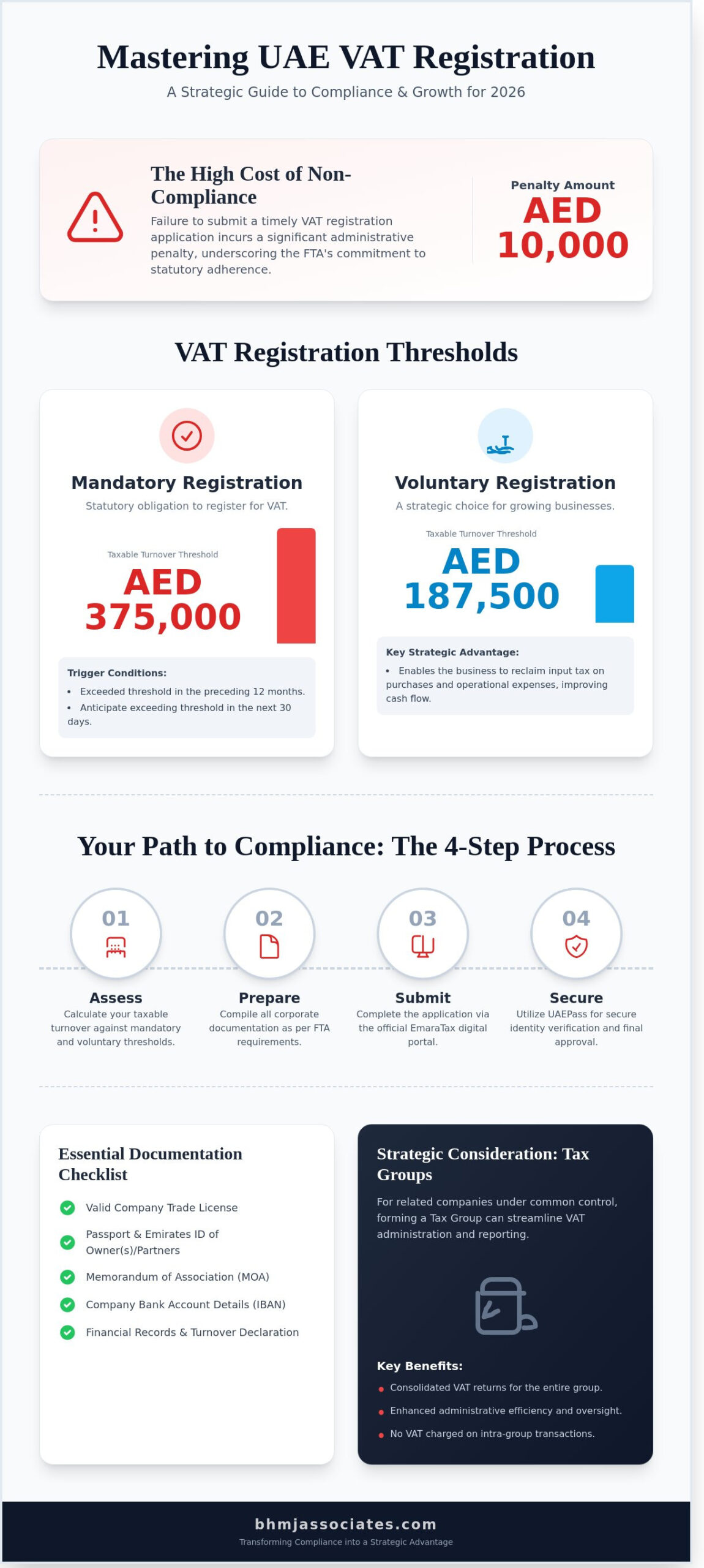
The imposition of an AED 10,000 administrative penalty for the failure to submit a timely application underscores the Federal Tax Authority’s uncompromising commitment to fiscal governance and statutory adherence within the Emirates. It’s recognized that the transition toward comprehensive tax transparency often presents significant administrative hurdles for corporate leadership, particularly when quantifying taxable turnover across complex revenue streams or navigating the technical intricacies of the EmaraTax portal. By engaging with this authoritative analysis, you’ll master the intricate nuances of vat registration uae, ensuring your enterprise maintains its fiduciary integrity while adhering to the revised 2026 regulatory framework. This guide provides a meticulous examination of mandatory thresholds, the integration of UAEPass for secure identity verification, and the specific documentation required to facilitate a seamless compliance trajectory for your organization. We’ll examine how to transform a mandatory legal requirement into a strategic advantage, establishing a robust foundation for your organization’s long-term fiscal sustainability and corporate development within the competitive Middle Eastern market.
Key Takeaways
- Determine your organization’s statutory obligations by analyzing the mandatory registration threshold of AED 375,000 and the strategic opportunities presented by voluntary registration at AED 187,500.
- Assess the structural benefits of Tax Group registration to facilitate consolidated reporting and enhance administrative oversight for entities under common control.
- Master the technical procedures for vat registration uae by ensuring all corporate documentation aligns with the precise requirements of the EmaraTax platform and the UAEPass protocol.
- Mitigate regulatory risk by adhering to a comprehensive documentary checklist designed to satisfy the rigorous compliance standards of the Federal Tax Authority.
- Leverage professional tax advisory to transform statutory requirements into a strategic advantage, ensuring your fiscal operations are managed with technical precision and ethical integrity.
The Regulatory Framework of VAT Registration in the UAE
The implementation of Value Added Tax on January 1, 2018, signaled a transformative shift in the taxation system in the United Arab Emirates, establishing a structured fiscal environment governed by the Federal Tax Authority (FTA). As we look toward the 2026 economic landscape, the 5% standard rate remains a cornerstone of the nation’s revenue diversification strategy, ensuring sustainable growth across non-oil sectors. For entities pursuing vat registration uae, understanding the definition of taxable supplies is paramount; these encompass all goods and services supplied in the UAE that aren’t specifically exempt. Federal Decree-Law No. 8 of 2017 mandates that businesses maintain comprehensive financial records for a minimum of five years. This statutory requirement facilitates transparency and provides the necessary documentation for potential FTA inspections. It’s a rigorous standard that demands meticulousness in bookkeeping, as the burden of proof for compliance rests entirely on the taxable person. The 5% levy is integrated into the price of goods and services, yet its impact on the broader economic landscape is managed through strategic exemptions designed to support social welfare and financial stability. By 2026, the UAE aims to have further refined these regulations to reflect its status as a global hub for trade and innovation, making early compliance a prerequisite for long-term viability.
The Role of the Federal Tax Authority
The FTA serves as the central body responsible for the administration, collection, and enforcement of federal taxes, operating with a mandate to ensure rigorous compliance across all commercial sectors. Central to this mission is the EmaraTax portal, a sophisticated digital interface that streamlines all tax-related transactions from registration to filing. By leveraging detailed audit trails, the FTA monitors corporate activities to identify discrepancies and uphold the integrity of the tax regime. Our partnership with clients focuses on ensuring their internal systems align with these digital requirements, thereby mitigating risks associated with late filings or incorrect data entry. This digital-first approach ensures that the UAE remains a transparent and highly regulated market for international investors.
VAT Principles for National Enterprises
Distinguishing between taxable, zero-rated, and exempt supplies is a vital component of fiscal governance. While the standard 5% rate applies to most commercial activities, certain sectors like international transport and specific healthcare services are zero-rated, whereas residential buildings and some financial services are exempt. Determining the “Place of Supply” is a complex exercise that dictates whether a transaction falls within the UAE’s taxing jurisdiction. Initiating the vat registration uae process early offers a distinct strategic advantage, as it enables businesses to reclaim input tax on capital expenditures and operational costs. This proactive approach adds value by optimizing cash flow and ensuring that the organization adheres to its fiduciary responsibilities from the outset.
Evaluating Mandatory and Voluntary Registration Thresholds
Determining your business’s liability for vat registration uae requires a meticulous assessment of both historical and projected financial data. The statutory framework established by the Federal Tax Authority mandates that any resident person must register if their taxable supplies and imports exceeded AED 375,000 over the preceding 12-month period. This isn’t merely a retrospective exercise. Businesses must also register if they anticipate their taxable turnover will exceed this AED 375,000 threshold within the next 30 days. For smaller, growing enterprises, the voluntary registration threshold is set at AED 187,500. This lower limit allows businesses to reclaim input tax on their operational expenses, which often provides a strategic liquidity advantage during early-stage development. Choosing to register voluntarily demonstrates a commitment to transparency and robust corporate governance.
Calculating Your Taxable Turnover
Accurate calculation of taxable turnover is the cornerstone of regulatory compliance. This figure includes all standard-rated supplies, currently set at 5%, and zero-rated supplies, such as specific international transportation services or exports of goods outside the GCC. You must also facilitate the inclusion of the value of goods and services imported into the UAE that are subject to the reverse charge mechanism. It’s critical to exclude exempt supplies, such as certain financial services or residential buildings, because these don’t contribute to the registration threshold. Similarly, the disposal of capital assets shouldn’t be included in this specific calculation. The methodology involves a rolling 12-month review where the turnover is assessed at the end of every month. Managing these variables requires a disciplined approach to accounting that mirrors international standards.
Consequences of Non-Compliance
Failing to adhere to these statutory timelines results in immediate financial repercussions. The FTA imposes a fixed penalty of AED 10,000 for late registration applications. Beyond the immediate fine, delayed compliance often triggers a deeper audit of a company’s fiduciary practices, which can damage long-term relationships with stakeholders and financial institutions. It’s also possible that a business will be forced to pay VAT on sales concluded during the period of non-compliance, effectively reducing profit margins by 5% on historical transactions. Utilizing the Federal Tax Authority registration portal efficiently requires precise documentation and an exhaustive understanding of the law. Engaging with a trusted financial advisor ensures that your submission is accurate and timely, safeguarding your firm’s reputation for corporate governance while providing a sense of security. Proactive monitoring of the 30-day forecast is the only reliable method to avoid these administrative costs and maintain your status as a disciplined entity.
Strategic Considerations: Tax Groups vs. Individual Registration
The decision to pursue a Tax Group registration or maintain individual status is a pivotal choice that impacts a conglomerate’s long-term fiscal health. Under the provisions of Federal Decree-Law No. 8 of 2017, the Federal Tax Authority (FTA) allows related parties to consolidate their tax obligations. This arrangement views multiple legal entities as a single taxable person for the purpose of vat registration uae. To qualify, each entity must maintain a permanent place of establishment or a fixed establishment within the Emirates. Control is defined by the ability to direct the financial and operating policies of another entity, typically established through a 50 percent or greater ownership stake or significant voting rights.
Entering such an agreement requires a deep understanding of joint and several liability. While the group operates as a single entity for reporting, every member remains individually responsible for the total tax debt of the group. If one subsidiary fails to meet its obligations, the FTA may legally recover the full outstanding amount from any other member within the group. This statutory reality necessitates rigorous internal governance and transparent financial reporting across all subsidiaries to mitigate collective risk. Bin Hamad Mathew Joseph and Associates Chartered Accountants views this structural alignment not merely as a compliance exercise but as a vital partnership that fosters value addition through enhanced fiscal oversight.
Benefits of Tax Grouping
Forming a Tax Group offers a strategic advantage by eliminating VAT on transactions between group members. These intra-group supplies are treated as being outside the scope of VAT, which prevents the unnecessary outflow of cash that occurs when one subsidiary bills another. It’s a mechanism that optimizes working capital for diversified holdings. Additionally, the compliance burden is significantly reduced. Instead of managing multiple filings, the group utilizes a single Tax Registration Number (TRN) and submits one consolidated return. This centralization allows for a more efficient allocation of internal accounting resources and ensures a unified approach to tax planning.
The Application Process for Groups
The application for a Tax Group requires a designated representative member to lead the process. This member facilitates all communication with the FTA and assumes responsibility for the submission of returns and payments. Documentation must include audited financial statements, share certificates, and organizational charts that demonstrate common control. Adding a new member or removing an existing one requires a formal amendment request to the FTA, which is typically processed within 20 business days of submission. Adhering to these statutory timelines ensures that the group’s vat registration uae status remains compliant with evolving corporate structures as the business expands.
The Meticulous Process: A Comprehensive Documentary Checklist
Achieving successful vat registration uae demands a rigorous approach to documentation that transcends mere administrative filing. Since the Federal Tax Authority (FTA) migrated to the EmaraTax platform on December 5, 2022, the integration of the UAEPass has become a mandatory prerequisite for secure authentication and digital signature capabilities. Every corporate entity must ensure that its primary authorized signatory possesses the requisite legal standing, often verified through a formal Power of Attorney or specific designation within the company’s founding documents. Precision in this initial phase prevents the administrative delays that often plague incomplete applications; it’s essential to treat the preparation as a pre-audit exercise.
Corporate and Identification Documents
The foundation of your application rests upon the validity of your Trade License or Certificate of Incorporation, which must accurately reflect your current commercial status and activities. You’ll need to provide clear, high-resolution copies of passports and Emirates IDs for all beneficial owners and the designated authorized signatory to satisfy KYC requirements. The Articles of Association or Partnership Agreements are scrutinized to verify the fiduciary structure and the specific powers granted to those representing the firm during the registration process. Detailed documentation ensures that the FTA can map the legal responsibility of the entity with absolute certainty.
Financial and Activity Evidence
The FTA requires a granular description of your business activities alongside empirical evidence of your financial trajectory. This involves providing detailed schedules of turnover for the previous 12 months or projections for the subsequent 30 days to confirm you’ve crossed the mandatory threshold of AED 375,000. Supporting documentation, such as executed contracts, purchase orders, or formal invoices, serves as the evidentiary basis for your vat registration uae submission. For entities engaged in cross-border trade, providing a valid Customs Code and identifying the relevant Customs Authority is essential for seamless tax integration and future import-export compliance. This level of detail facilitates a smoother approval process by removing ambiguity regarding your tax obligations.
Bank and Contact Information
Accuracy in providing your International Bank Account Number (IBAN) is vital, as this facilitates the efficient processing of any future tax refunds or statutory adjustments. Your application must include the precise physical address of your registered office to ensure all official FTA correspondence reaches your governance team without interruption. Such meticulous attention to detail projects an image of a disciplined and organized partner in the eyes of the regulatory authorities. The Tax Registration Number (TRN) serves as a unique 15-digit identifier that remains the cornerstone of your business’s legal identity for all subsequent tax-related filings and compliance obligations.
To ensure your documentation adheres to the highest standards of regulatory precision, you can partner with our advisory team for a comprehensive pre-submission audit.
Facilitating Compliance through Professional Tax Advisory
Navigating the intricacies of vat registration uae requires a depth of technical knowledge that extends well beyond basic data entry. Partnering with seasoned chartered accountants ensures that a business aligns its fiscal architecture with the Federal Tax Authority (FTA) requirements from the inception of the process. BHMJ Associates provides a structured framework where every application undergoes a rigorous validation process to prevent administrative delays or outright rejection. This professional oversight is vital because the FTA frequently issues requests for clarification that require immediate and technically sound responses to avoid application backlogs.
The BHMJ Approach to Tax Governance
Our methodology begins with a meticulous examination of all financial records and historical transaction data before any submission reaches the FTA portal. We act as your formal representative, managing all correspondence and resolving queries with the authority to maintain your firm’s impeccable standing. This role as a guardian of regulatory standards means we adhere to the highest ethical benchmarks, ensuring that your corporate governance remains robust. We don’t just process paperwork; we verify that your underlying accounting structures support the data being reported.
Registration is merely the preliminary phase of a long-term fiduciary journey. Sustained compliance demands accurate quarterly or monthly VAT return filings, where errors lead to administrative penalties starting at AED 1,000 for first-time offenses. These costs escalate quickly for subsequent delays or incorrect reporting. To mitigate these risks, we facilitate the implementation of advanced ERP solutions such as Zoho Books and Odoo. These platforms automate tax reporting and ensure that every tax invoice generated complies with the Executive Regulations of the VAT Law, reducing the margin for human error in high-volume environments.
Value Addition for Sustainable Growth
Effective tax advisory transcends mere box-ticking. It integrates VAT compliance into your broader corporate strategy to optimize cash flow and operational efficiency. Through proactive tax planning, BHMJ Associates identifies opportunities to enhance shareholder value while maintaining a conservative risk profile. Our firm views this relationship as a strategic partnership designed to secure the longevity of your enterprise through rigorous financial oversight. Contact our experts today to facilitate your VAT registration and ensure total compliance.
Securing Regulatory Compliance and Strategic Growth for 2026
Navigating the complexities of Decree-Law No. 8 of 2017 requires a meticulous approach to financial governance. Businesses must accurately assess their taxable supplies against the mandatory threshold of AED 375,000 or the voluntary threshold of AED 187,500 to ensure timely adherence to the law. The 2026 fiscal landscape demands rigorous attention to the Federal Tax Authority’s documentary requirements and a strategic evaluation of tax group structures to optimize administrative efficiency. Successfully managing vat registration uae protocols isn’t merely a statutory obligation; it’s a fundamental component of sustainable corporate development within the Emirates. As Statutory Audit Specialists with authorized Federal Tax Authority representation, BHMJ Associates provides the fiduciary oversight necessary to facilitate seamless IFRS compliance. Our firm’s expertise ensures that every aspect of your tax strategy aligns with the most current regulatory standards. Partner with BHMJ Associates for Expert VAT Advisory to fortify your enterprise against risks and leverage professional governance for long-term success. We look forward to facilitating your business’s continued growth in this evolving regulatory environment.
Frequently Asked Questions
What is the mandatory VAT registration threshold in the UAE for 2026?
The mandatory vat registration uae threshold remains established at AED 375,000 for the 2026 fiscal period, requiring any resident business to register if its taxable supplies and imports exceeded this specific value during the previous 12-month duration. It’s vital that your organization maintains meticulous records to ensure that you adhere to these statutory requirements immediately upon crossing the financial limit. BHMJ Associates provides the necessary governance to facilitate this transition smoothly and maintain your firm’s professional standing.
Can a business register for VAT voluntarily if it does not meet the threshold?
A business can opt for voluntary registration if its taxable supplies or taxable expenses exceed the AED 187,500 threshold, providing a strategic advantage for growing enterprises. This proactive approach allows smaller entities to recover input tax on their business expenditures, which serves as a value addition for long-term corporate development. By implementing these standards early, a partnership with our firm ensures that your entity maintains a disciplined financial structure while preparing for future mandatory compliance obligations.
How long does the FTA typically take to process a VAT registration application?
The Federal Tax Authority typically requires 20 business days to process a completed application, although this duration depends heavily on the precision and accuracy of the submitted documentation through the EmaraTax portal. Our advisory team emphasizes that any discrepancies in the trade license or the provided financial statements can extend this period significantly. Ensuring that every detail aligns with statutory requirements is essential for a seamless approval process that doesn’t disrupt your ongoing commercial operations.
What are the penalties for late VAT registration in the UAE?
A fixed administrative penalty of AED 10,000 is imposed by the authorities on any business that fails to submit its vat registration uae application within the 30-day statutory timeframe. This significant fine highlights the necessity for disciplined financial oversight and a commitment to regulatory compliance within the UAE’s fiscal landscape. We work in partnership with our clients to ensure all documentation is submitted accurately to avoid such liabilities and reinforce your reputation as a compliant participant.
Is it possible to register for VAT without a UAEPass account?
It’s not possible to access the EmaraTax portal for registration purposes without a verified UAEPass account, as this digital identity serves as the primary gateway for all tax-related governance in the Emirates. This integration ensures a high level of security and fiduciary responsibility for every entity operating within the jurisdiction. Business owners must facilitate the creation of a corporate UAEPass to ensure they can implement their tax obligations through the official government channels.
Do I need to register for VAT if my business only exports goods outside the UAE?
Businesses that exclusively export goods outside the UAE must still register if their taxable turnover exceeds the AED 375,000 threshold, as exports are categorized as zero-rated supplies under the law. While the tax rate applied is 0%, these transactions are included in the calculation of the mandatory registration limit under current statutory frameworks. This requirement allows exporters to reclaim input VAT paid on local costs, providing a strategic advantage in managing their overall operational expenditure.
What is a Tax Registration Number (TRN) and how is it used?
A Tax Registration Number (TRN) is a unique 15-digit identifier issued by the FTA to verify that a business is officially registered for VAT purposes within the United Arab Emirates. This number must be clearly displayed on all tax invoices and credit notes to ensure compliance with the Executive Regulations of the Federal Decree-Law on VAT. It serves as a vital tool for the firm to facilitate transparent transactions and maintain a reliable audit trail for all fiscal activities.
Can I apply for VAT de-registration if my turnover falls below the threshold?
You can apply for VAT de-registration if your taxable turnover has not exceeded AED 187,500 in the previous 12 months or if the business ceases to make taxable supplies entirely. The application must be submitted through the EmaraTax portal within 20 business days of becoming eligible for de-registration to avoid late application penalties. Our firm assists in this transition to ensure that all fiduciary duties are met and that the entity remains in good standing with the authorities.

Article by
Joseph Mathew
Joseph is a finance and audit professional currently serving as an Audit Manager at Bin Hamad and Mathew Joseph and Associates Chartered Accountants Est., a role he has held since 2022. With a strong background in accounting, compliance, and financial analysis, he brings a detail-oriented and analytical approach to auditing engagements across a range of industries.
In his position at BHMJ Associates, Joseph is responsible for leading audit assignments, overseeing audit teams, and ensuring that financial statements comply with applicable standards and regulatory requirements. He works closely with clients to assess internal controls, identify risks, and provide practical recommendations that enhance financial transparency and operational efficiency.
Known for his professionalism and commitment to accuracy, Joseph has developed a reputation for delivering high-quality audit outcomes within tight deadlines. His ability to interpret complex financial data and communicate insights clearly makes him a valuable advisor to both clients and colleagues.
Joseph continues to build his expertise in auditing and financial management, staying updated with evolving industry standards and best practices, while contributing to the growth and reputation of his firm.
Disclaimer
The content shared and published by Bin Hamad and Mathew Joseph and Associates Chartered Accountants Est. is intended solely for general informational and educational purposes. While every effort is made to ensure the accuracy, completeness, and timeliness of the information provided, the firm makes no guarantees or warranties, express or implied, regarding its reliability or suitability for any particular purpose.
All posts, articles, insights, and commentary do not constitute professional advice, including but not limited to accounting, auditing, tax, legal, or financial advice. Readers are advised to seek appropriate professional consultation before making any decisions based on the information provided.
Bin Hamad and Mathew Joseph and Associates Chartered Accountants Est. shall not be held liable for any direct, indirect, incidental, or consequential loss or damage arising from the use of, or reliance on, the content shared through its platforms.
Any views or opinions expressed in posts are those of the respective authors and do not necessarily reflect the official policy or position of the firm.
By accessing and using this content, you acknowledge and agree to the terms of this disclaimer.