

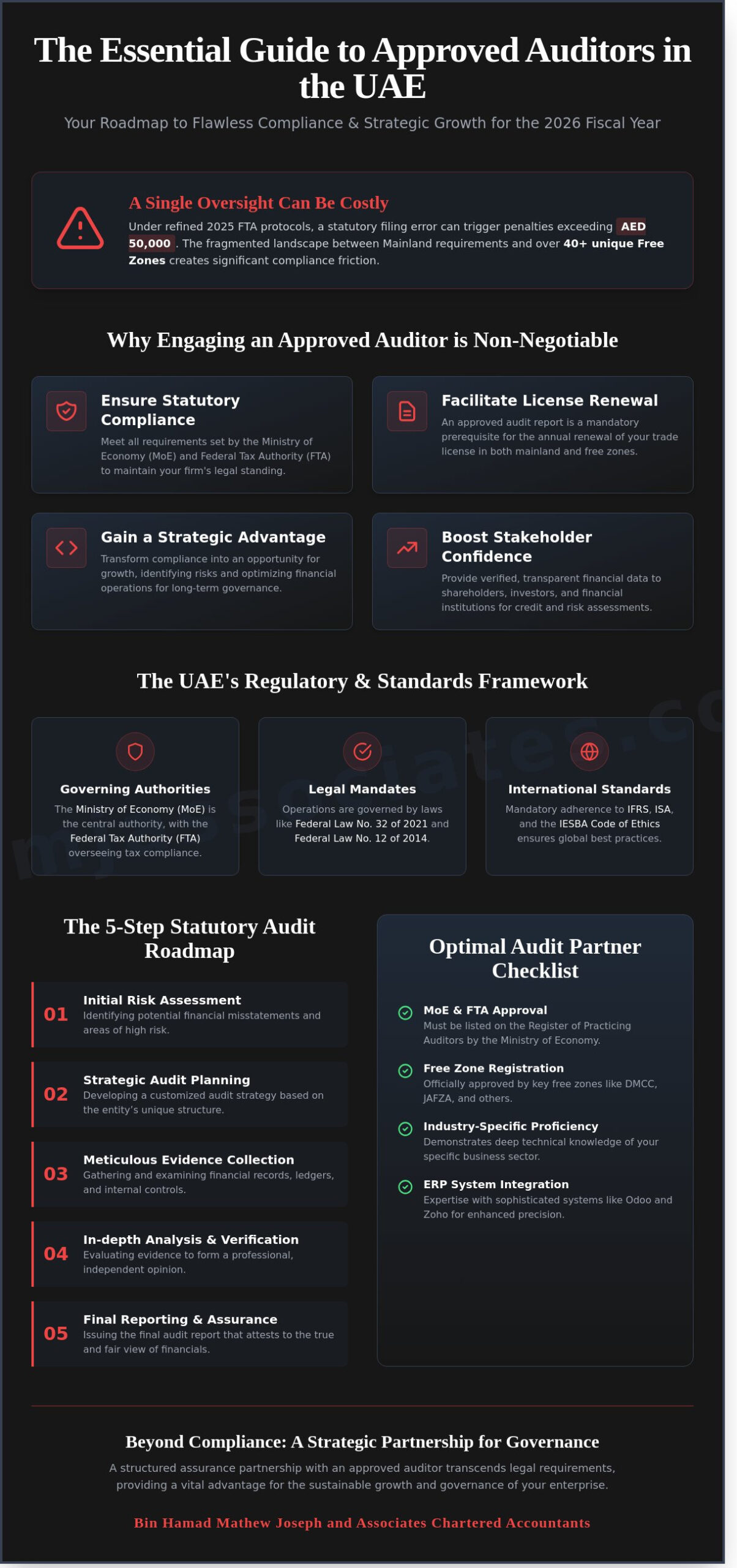
Could a single oversight in your statutory filing trigger a penalty exceeding AED 50,000 under the Federal Tax Authority’s refined 2025 enforcement protocols? You likely recognize that maintaining rigorous financial transparency is the bedrock of corporate longevity, yet the fragmented landscape between mainland requirements and the unique mandates of more than 40 free zones often creates significant operational friction. Securing the services of the most qualified approved auditors in the UAE isn’t merely a box-ticking exercise for compliance; it’s a vital component of your firm’s governance and long-term stability. We, Bin Hamad Mathew Joseph and Associates Chartered Accountants, will provide the framework you need to address these regulatory complexities, ensuring your enterprise avoids the disruption of poorly executed audits while fulfilling its fiduciary duties. You’ll learn how to identify a partner who adds genuine value to your financial operations, moving methodically from selection criteria to the successful implementation of a robust audit strategy for the 2026 fiscal year.
Key Takeaways
- Recognize the fundamental necessity of engaging approved auditors in Dubai to ensure unwavering statutory compliance and the successful facilitation of your entity’s annual trade license renewal.
- Gain comprehensive insights into the regulatory framework governed by the Ministry of Economy and the Federal Tax Authority to evaluate the standing and eligibility of your professional advisory partners.
- Identify critical selection benchmarks, such as industry-specific technical proficiency and the integration of sophisticated ERP systems like Odoo and Zoho, to enhance audit precision and operational efficiency.
- Master the strategic roadmap of a statutory audit, moving methodically from initial risk assessment to meticulous evidence collection, to safeguard your firm’s fiduciary integrity.
- Discover how a structured assurance partnership transcends mere legal requirements to provide a strategic advantage for the sustainable growth and long-term governance of your enterprise.
The Strategic Significance of Engaging Approved Auditors in Dubai
The presence of approved auditors in Dubai serves as a cornerstone for the UAE’s sophisticated financial infrastructure, facilitating a level of transparency that bolsters investor confidence across all sectors. These professionals don’t merely verify financial statements; they provide a strategic advantage by ensuring that an entity’s fiscal health aligns with both local regulations and global benchmarks. While many organizations previously viewed rigorous auditing as a voluntary measure for internal clarity, the regulatory environment is shifting toward a mandatory governance framework. By 2026, the UAE Ministry of Economy expects a higher threshold of corporate accountability, transforming the way private enterprises manage their statutory obligations. This evolution safeguards the interests of shareholders and ensures that financial institutions have access to reliable, verified data for credit assessments and risk management.
Mandatory Compliance for Free Zones and Mainland Entities
Economic zones such as the Dubai Multi Commodities Centre (DMCC) and the Jebel Ali Free Zone (JAFZA) maintain exclusive lists of registered audit firms to ensure high standards of reporting. Engaging a firm that isn’t on these specific approved lists can lead to the immediate rejection of annual filings, resulting in administrative penalties or the non-renewal of trade licenses. UAE banks, governed by Central Bank circulars, strictly require audit reports from recognized firms before approving credit facilities or maintaining corporate accounts. This adherence to strict protocols ensures that every financial document submitted to government bodies possesses the necessary legal weight to facilitate seamless business operations. Following the implementation of UAE Federal Law No. 32 of 2021, the requirement for approved auditors in Dubai has become even more critical for mainland companies seeking to maintain their legal standing.
The Fiduciary Responsibility of the Auditor
Approved auditors must maintain absolute independence and objectivity to protect the integrity of the financial examination process. They operate under a rigorous framework that includes International Standards on Auditing and International Financial Reporting Standards (IFRS), which are mandatory for all mainland companies under the UAE Companies Law. This commitment to ethics prevents conflicts of interest and ensures that the auditor’s primary loyalty remains with the truth of the financial records. The meticulous examination of ledgers and internal controls adds significant value to a partnership, as it identifies potential risks before they escalate into systemic failures. By adhering to these global benchmarks, auditors provide the necessary assurance that financial reports represent a true and fair view of the company’s position.
An approved auditor in the UAE functions as a legally bound steward who protects the interests of all stakeholders by verifying that a company’s financial disclosures are accurate, transparent, and compliant with statutory mandates.
Understanding the Regulatory Framework for Audit Approval
The Ministry of Economy (MoE) functions as the central authority governing the auditing profession within the United Arab Emirates, specifically through the implementation of Federal Law No. 12 of 2014. This legal framework establishes the mandatory requirements for practitioners to be listed on the Register of Practicing Auditors, ensuring that only qualified professionals handle sensitive financial data. Maintaining this status isn’t a one-time achievement; it requires continuous adherence to International Standards on Auditing (ISA) and the IESBA Code of Ethics. Firms must demonstrate robust internal quality control systems that undergo periodic review by the MoE to ensure the integrity of the financial ecosystem. This regulatory oversight provides a layer of security for stakeholders who rely on the reports generated by approved auditors in Dubai to make informed investment decisions.
The intersection of statutory requirements and international accounting standards, such as IFRS, creates a complex environment for local entities. These standards are applied to ensure that local business structures, including family-owned conglomerates and subsidiaries of multinational corporations, present a “true and fair” view of their financial position. It’s a process that demands meticulous attention to detail and a deep understanding of how global principles translate into the specific economic context of the UAE. By aligning local practices with international benchmarks, firms provide the transparency required by lenders, investors, and regulatory bodies alike. This alignment is not merely a box-ticking exercise but a fundamental component of corporate governance that protects the interests of all parties involved.
The Impact of UAE Corporate Tax on Audit Requirements
The introduction of Federal Decree-Law No. 47 of 2022 on the Taxation of Corporations and Businesses has elevated the importance of the audit function. Audited financial statements are no longer just a regulatory formality; they’re the primary evidence used to support tax filings. The Federal Tax Authority (FTA) expects a high degree of correlation between the figures reported in tax returns and the audited accounts. As we approach the 2026 fiscal year, we anticipate a significant increase in audit scrutiny. This period marks the transition where the FTA will have a multi-year data set to analyze, making accuracy in early filings paramount for long-term fiscal stability.
Free Zone Authority (FZA) Specific Regulations
Free zone entities must manage a dual-layered regulatory environment. While federal laws apply, individual jurisdictions like the Jebel Ali Free Zone (JAFZA) or the Dubai Development Authority (DDA) maintain their own lists of approved auditors. Selecting approved auditors in Dubai who understand the nuances of these specific zones is a strategic necessity for maintaining operational licenses. BHMJ Associates facilitates seamless compliance across these multiple UAE jurisdictions by leveraging our deep understanding of both federal and local requirements. We view our role not merely as a service provider, but as a fiduciary partner dedicated to the sustainable growth of your enterprise.
Critical Criteria for Selecting the Optimal Audit Partner
Selecting a firm requires more than a cursory review of their licensing; it demands a rigorous evaluation of how their professional methodology aligns with your specific corporate objectives. A generic approach often fails to address the nuances of different sectors. For instance, a firm specializing in general commerce may lack the technical depth required to navigate the complex revenue recognition standards inherent in the UAE’s AED 300 billion real estate market. Engaging approved auditors in Dubai who possess a proven track record in your specific industry ensures that the audit process adds genuine value rather than serving as a mere compliance exercise. This partnership functions as a strategic advantage, facilitating long-term fiscal health through meticulous oversight.
Beyond the Certificate: Qualitative Assessment
A professional partnership rests on the firm’s ability to handle complex statutory audits with precision. You should investigate their history of managing multi-jurisdictional entities or firms with high transaction volumes. During an initial consultation, ask how they address discrepancies in VAT filings or their approach to IFRS 16 lease accounting. Their responses will reveal their professional depth. A multidisciplinary approach is vital, and it’s beneficial when a firm integrates tax advisory and VAT expertise into the audit cycle to prevent future regulatory friction with the Federal Tax Authority (FTA). This comprehensive scrutiny helps you adhere to the highest standards of corporate governance.
Technological Proficiency in Modern Auditing
The transition toward digital governance in the UAE necessitates that approved auditors in Dubai demonstrate high technological proficiency. Modern auditing relies on the seamless extraction of data from ERP systems like Zoho Books and Odoo. This integration reduces the margin for human error and accelerates the evidence collection process. When a firm understands your specific accounting software, they can implement automated verification procedures that enhance the reliability of the financial statements. Consider the following technological advantages:
- Data Integrity: Automated syncing with Odoo ensures that 100% of transactions are verifiable without manual entry errors.
- Efficiency: Digital workflows in Zoho Books can reduce the audit timeline by approximately 25% compared to traditional paper-based methods.
- Security: Professional firms utilize encrypted portals to ensure data confidentiality and compliance with UAE data protection laws.
This technological synergy facilitates a more transparent and efficient audit. It allows your management team to focus on strategic growth rather than administrative bottlenecks. A disciplined partner won’t just request documents; they’ll integrate with your systems to provide a steady, logical flow of information that mirrors the structured nature of international accounting standards.
Navigating the Statutory Audit Process: A Corporate Roadmap
Engaging with approved auditors in Dubai involves a structured methodology that aligns with International Standards on Auditing (ISA). The process begins with planning and risk assessment, where the audit team evaluates the internal control environment to identify areas susceptible to material misstatement. This phase ensures that the audit focus is directed toward high-value transactions and complex accounting treatments, particularly those affected by the UAE Commercial Companies Law No. 32 of 2021. It’s a strategic stage where the auditor and the client establish a mutual understanding of the entity’s operational context.
During the fieldwork phase, auditors perform substantive testing and analytical procedures to verify the accuracy of ledgers and supporting documentation. This meticulous examination includes the verification of assets, liabilities, and equity balances to ensure they reflect the economic reality of the business. This is followed by a rigorous review and quality control phase to confirm that all financial disclosures adhere to International Financial Reporting Standards (IFRS). The cycle concludes with the issuance of the final audit report and a management letter. This letter provides strategic value addition by highlighting operational weaknesses and suggesting remedial actions for corporate governance, transforming a compliance requirement into a catalyst for business growth.
Preparing Your Internal Team for the Audit
Effective preparation facilitates a seamless engagement and minimizes operational downtime for your staff. Your bookkeeping team should maintain a comprehensive audit file that’s ready for inspection at the commencement of the fieldwork. Having these documents organized prevents the 15% to 20% delay often seen in disorganized audits. Essential documentation includes:
- The final trial balance and general ledger for the fiscal year.
- Bank reconciliation statements for all AED accounts held with UAE-based financial institutions.
- Fixed asset registers including detailed depreciation schedules and acquisition invoices.
- VAT returns and FTA (Federal Tax Authority) filing history for the relevant period.
- Legal contracts, lease agreements, and board meeting minutes.
By establishing robust internal controls throughout the year, management ensures that the audit serves as a verification exercise rather than a corrective one. This proactive approach allows your team to remain focused on core operations while the auditors complete their statutory duties with minimal friction.
Understanding the Auditor’s Opinion
The audit report’s conclusion is a critical indicator of a firm’s financial health and transparency. While an unqualified opinion is the gold standard, a qualified opinion suggests specific areas of non-compliance that aren’t pervasive. Adverse opinions or disclaimers of opinion can severely damage a company’s ability to secure financing from UAE banks, where a clean report is often a prerequisite for credit facilities. An unqualified audit opinion serves as a definitive endorsement of a company’s financial integrity, confirming that its records are free from material misstatements and compliant with statutory requirements. This level of assurance is vital for maintaining the trust of shareholders and regulatory bodies in the Dubai International Financial Centre (DIFC) and other jurisdictions.
For businesses seeking to enhance their fiduciary standing and ensure full compliance with UAE regulations, partnering with approved auditors in Dubai provides the necessary expertise to navigate these complex requirements successfully.
BHMJ Associates: Elevating Compliance through Meticulous Assurance
BHMJ Associates operates on a foundation of quiet confidence and unwavering reliability, establishing our firm among the most respected approved auditors in Dubai. We believe the role of a statutory auditor extends beyond the mere verification of figures; it’s a fiduciary commitment to the integrity of the UAE financial ecosystem. Our firm prioritizes meticulousness in every engagement, ensuring that statutory requirements are met with a level of precision that mitigates risk and fosters stakeholder trust. We implement a partnership model that seeks to add strategic value to your enterprise, transforming the audit from a mandatory obligation into a catalyst for robust corporate governance.
Our commitment to international standards, specifically the International Standards on Auditing (ISA) and International Financial Reporting Standards (IFRS), ensures that your financial statements withstand global scrutiny. By adhering to these rigorous frameworks, we facilitate a transparent environment where investors and financial institutions can engage with your business with total certainty. This disciplined approach is what defines our presence in the local market, where we serve as a guardian of regulatory standards and professional ethics.
A Multidisciplinary Approach to Financial Health
The introduction of Federal Decree-Law No. 47 of 2022 regarding Corporate Tax has fundamentally altered the compliance landscape in the United Arab Emirates. BHMJ Associates integrates corporate tax registration and VAT return filing directly with your audit process to ensure total synchronization across all filings. It’s common for discrepancies to arise between VAT returns and audited financial statements; our team eliminates these risks through proactive reconciliation. We provide specialized strategic advisory for the logistics, education, and F&B sectors, where thin margins require absolute financial clarity.
- Logistics: We address complex revenue recognition and asset depreciation schedules.
- Education: We ensure compliance with specific regulatory reporting required by local authorities.
- F&B: Our audits focus on inventory controls and high-volume transaction verification.
To enhance data accuracy, we leverage deep expertise in Zoho and Odoo ERP systems. Approximately 65% of the SMEs we advise have successfully migrated to these platforms to automate their financial reporting. Our team ensures these systems are configured to meet UAE regulatory requirements, providing a seamless bridge between daily operations and the annual audit cycle.
Engage with Bin Hamad Mathew Joseph and Associates
Selecting a seasoned mentor who understands the nuances of UAE financial regulations is a strategic advantage for any growing enterprise. As approved auditors in Dubai, we don’t just identify errors; we provide a roadmap for fiscal sustainability. Our communication rhythm is measured and logical, mirroring the professional audit process itself. We move methodically through your data, refusing to cut corners to ensure your business remains compliant with the evolving landscape of the Ministry of Economy and the Federal Tax Authority.
As the 2026 audit cycle approaches, early engagement is essential for maintaining your corporate standing. Preparing your books and internal controls today prevents the administrative burden often associated with year-end deadlines. We invite you to contact our professional team to discuss your audit requirements. Our practitioners are prepared to facilitate your journey toward regulatory excellence and long-term corporate value through rigorous oversight and ethical partnership.
Fortifying Your Enterprise Resilience for the 2026 Regulatory Landscape
Navigating the complex financial architecture of the United Arab Emirates requires a disciplined approach to governance that extends beyond simple box-ticking exercises. As 2026 approaches, the necessity of engaging approved auditors in Dubai who possess a deep technical command of IFRS and local statutory mandates becomes a non-negotiable priority for maintaining market credibility. It’s essential to select a partner that doesn’t just identify discrepancies but actively facilitates long-term stability through rigorous oversight and adherence to the latest Ministry of Economy guidelines.
BHMJ Associates offers a unique blend of technical precision and strategic insight, providing specialized assistance for firms integrated with Zoho and Odoo platforms. This professional partnership is designed to deliver significant value addition, transforming the audit process into a strategic advantage for your corporate growth. By focusing on meticulous assurance and ethical transparency, we’ll help ensure your business remains compliant and competitive within the UAE’s evolving economic framework.
Secure your business compliance with BHMJ Associates; contact us for a Statutory Audit consultation.
We look forward to safeguarding your professional interests and fostering a relationship built on reliability and shared success.
Frequently Asked Questions
Who are approved auditors in Dubai and why are they necessary?
Approved auditors in Dubai are professional entities registered with the Ministry of Economy or specific free zone authorities to provide independent assurance on financial statements. They’re necessary because they ensure compliance with the UAE Federal Law No. 32 of 2021 on Commercial Companies. These professionals verify that a company’s financial records present a true and fair view, which is essential for maintaining investor confidence and fulfilling regulatory mandates across various jurisdictions.
Is it mandatory for all UAE companies to have their accounts audited?
Statutory audits are mandatory for all public and private joint-stock companies, as well as many entities operating within free zones like the DMCC or JAFZA. Under the UAE Commercial Companies Law, most Mainland companies must also appoint a licensed auditor to review their annual accounts. While some small enterprises might have exemptions based on specific turnover thresholds, the introduction of Corporate Tax has made professional auditing a strategic necessity for almost every business to ensure accurate tax filings.
How often must a company engage an approved auditor for statutory purposes?
Companies must engage an approved auditor to conduct a statutory audit at least once every financial year. This annual requirement ensures that the financial statements are finalized and submitted within the timeframe stipulated by the relevant licensing authority, which is often within 90 to 180 days after the financial year ends. Regular engagement facilitates continuous compliance and allows the firm to provide a value addition through proactive financial oversight and risk mitigation.
What is the difference between an internal audit and a statutory audit?
A statutory audit is a legally mandated examination of financial records performed by external approved auditors in Dubai to provide an independent opinion for stakeholders and regulators. In contrast, an internal audit is a voluntary or board-mandated function focused on evaluating internal controls, operational efficiency, and risk management. While the statutory audit focuses on the accuracy of historical financial data, the internal audit serves as a strategic tool for enhancing organizational governance and long-term sustainability.
Can an approved auditor also provide VAT and Corporate Tax services?
Yes, approved audit firms frequently offer comprehensive VAT and Corporate Tax services, provided they maintain the necessary professional independence required by international ethical standards. These firms assist with tax registration, compliance, and the preparation of returns to ensure adherence to Federal Tax Authority regulations. By integrating tax advisory with audit functions, the firm acts as a disciplined partner, ensuring that all fiscal obligations are met with precision and meticulous attention to detail.
What documents are typically required by approved auditors in Dubai?
Auditors typically require access to the general ledger, trial balance, bank statements, invoices, and legal contracts such as the Memorandum of Association. They also examine payroll records, fixed asset registers, and evidence of VAT compliance to verify the accuracy of the financial position. Providing these documents in a structured manner allows the auditor to implement a methodical review process, ensuring that no aspect of the client’s regulatory responsibilities is overlooked.
How does the 2026 UAE Corporate Tax law affect the audit process?
The implementation of Corporate Tax, which began for many on June 1, 2023, and continues into 2026, requires audited financial statements for businesses with revenues exceeding AED 50,000,000. This regulation increases the demand for rigorous financial oversight to ensure that taxable income is calculated correctly according to the law. Auditors now play a critical role in reconciling accounting profits with taxable profits, serving as a protective advisor against potential non-compliance penalties.
How do I verify if an audit firm is officially approved by the relevant authorities?
You can verify an audit firm’s status by checking the official register of auditors maintained by the UAE Ministry of Economy or the specific free zone authority’s portal. For instance, the DIFC and ADGM maintain public registers of firms authorized to provide audit services within their jurisdictions. Verifying these credentials ensures you’re partnering with a stable, ethical entity that adheres to the high standards of governance expected in the UAE’s financial sector.

Article by
Joseph Mathew
Joseph is a finance and audit professional currently serving as an Audit Manager at Bin Hamad and Mathew Joseph and Associates Chartered Accountants Est., a role he has held since 2022. With a strong background in accounting, compliance, and financial analysis, he brings a detail-oriented and analytical approach to auditing engagements across a range of industries.
In his position at BHMJ Associates, Joseph is responsible for leading audit assignments, overseeing audit teams, and ensuring that financial statements comply with applicable standards and regulatory requirements. He works closely with clients to assess internal controls, identify risks, and provide practical recommendations that enhance financial transparency and operational efficiency.
Known for his professionalism and commitment to accuracy, Joseph has developed a reputation for delivering high-quality audit outcomes within tight deadlines. His ability to interpret complex financial data and communicate insights clearly makes him a valuable advisor to both clients and colleagues.
Joseph continues to build his expertise in auditing and financial management, staying updated with evolving industry standards and best practices, while contributing to the growth and reputation of his firm.
Disclaimer
The content shared and published by Bin Hamad and Mathew Joseph and Associates Chartered Accountants Est. is intended solely for general informational and educational purposes. While every effort is made to ensure the accuracy, completeness, and timeliness of the information provided, the firm makes no guarantees or warranties, express or implied, regarding its reliability or suitability for any particular purpose.
All posts, articles, insights, and commentary do not constitute professional advice, including but not limited to accounting, auditing, tax, legal, or financial advice. Readers are advised to seek appropriate professional consultation before making any decisions based on the information provided.
Bin Hamad and Mathew Joseph and Associates Chartered Accountants Est. shall not be held liable for any direct, indirect, incidental, or consequential loss or damage arising from the use of, or reliance on, the content shared through its platforms.
Any views or opinions expressed in posts are those of the respective authors and do not necessarily reflect the official policy or position of the firm.
By accessing and using this content, you acknowledge and agree to the terms of this disclaimer.