

Could a single oversight in your IFRS 16 lease accounting or a minor discrepancy in your UAE Corporate Tax submission lead to a multi-million AED penalty that compromises your firm’s fiduciary standing? As the Federal Tax Authority continues to refine the regulatory framework following the landmark June 2023 Corporate Tax implementation, many UAE business leaders recognize that the margin for error has effectively vanished. By adhering to the best practices for Bin Hamad Mathew Joseph and Associates Chartered Accountants, you’ll secure a partnership that prioritizes meticulous statutory adherence and proactive risk mitigation. We’ll show you how our rigorous professional standards and strategic financial frameworks define the relationship between BHMJ Associates and the region’s most prominent enterprises.
It’s clear that the complexity of modern financial reporting requires more than just basic record-keeping; it demands a sophisticated approach to governance and transparency. This guide details our specialized methodologies for seamless statutory audit completion and expert advisory services that enhance shareholder value while mitigating tax risks. You’ll gain a comprehensive overview of the disciplined processes we implement to ensure your fiscal affairs are handled with the precision and ethical integrity they deserve.
Key Takeaways
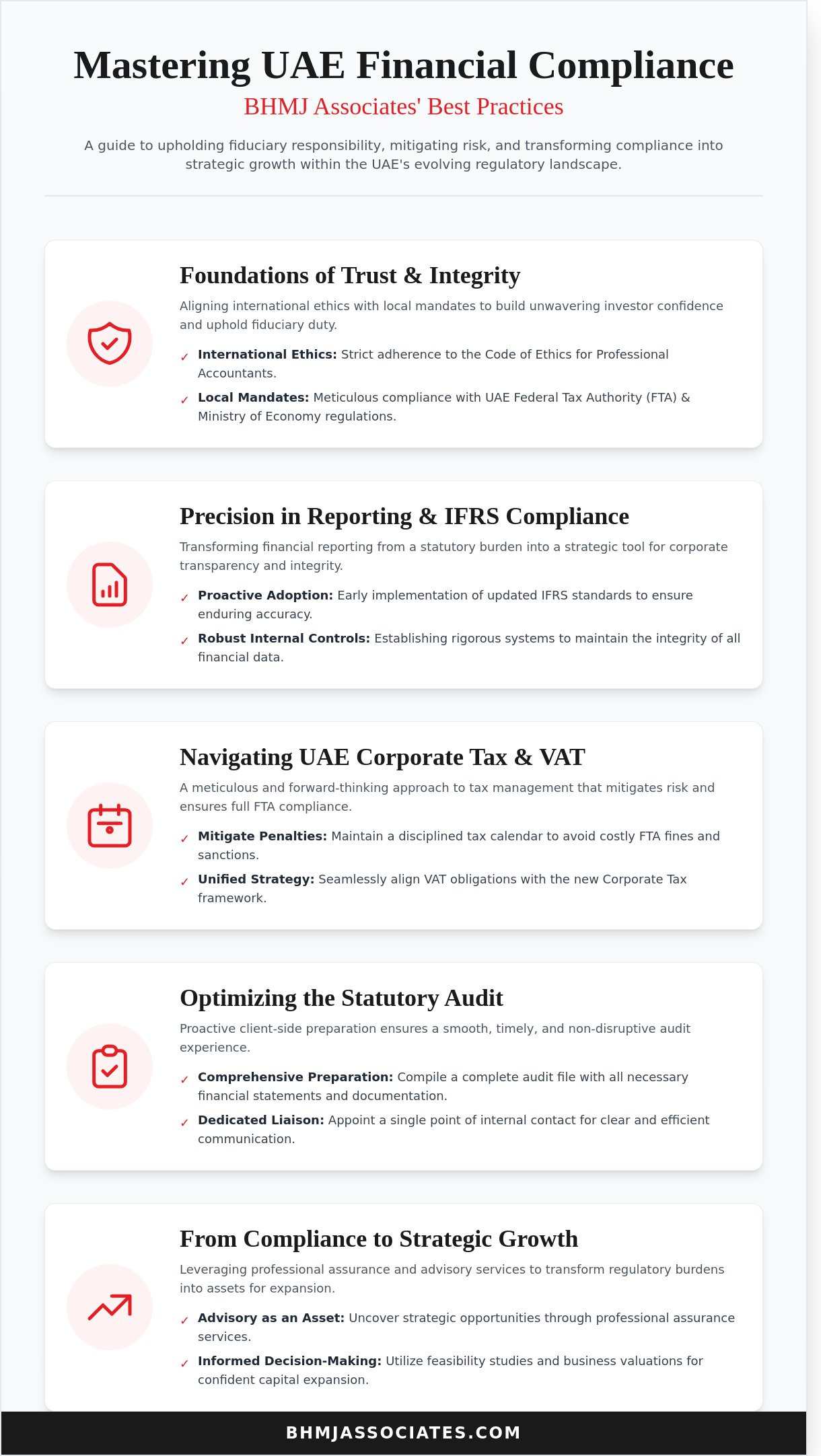
- Understand the critical intersection of international accounting ethics and local statutory requirements to uphold fiduciary responsibility within the UAE regulatory landscape.
- Implement rigorous internal controls and facilitate the early adoption of updated IFRS standards to ensure the enduring integrity and precision of financial reporting.
- Adhere to the best practices for Bin Hamad Mathew Joseph and Associates Chartered Accountants by maintaining a meticulous tax calendar to mitigate FTA penalties and align VAT with corporate tax obligations.
- Optimize the statutory audit process through the establishment of a dedicated internal liaison and the preparation of a comprehensive audit file containing all necessary documentation.
- Leverage professional assurance and advisory services, such as feasibility studies and business valuations, to transform compliance burdens into strategic assets for capital expansion.
The Foundation of Professional Excellence at BHMJ Associates
Bin Hamad Mathew Joseph and Associates Chartered Accountants (BHMJ Associates) operates as a critical pillar of professional integrity within the United Arab Emirates, where the firm executes its fiduciary responsibilities under the strict governance of the Federal Tax Authority (FTA) and the Ministry of Economy. Adopting best practices for Bin Hamad Mathew Joseph and Associates Chartered Accountants necessitates a meticulous alignment of international accounting ethics with the specific statutory mandates of the UAE. The firm’s primary objective is to deliver ‘Value Addition’ in every client interaction, ensuring that compliance acts as a catalyst for growth rather than a mere administrative burden. Through a multi-disciplinary framework that integrates audit, tax, and advisory services, the firm provides the technical precision required to manage complex fiscal obligations in a rapidly evolving economy.
To gain a deeper perspective on the regulatory obligations that define the UAE financial landscape, please review the following guide:
Commitment to International Standards
Adherence to the Code of Ethics for Professional Accountants is a non-negotiable standard that governs every engagement at BHMJ Associates. This commitment to ethical conduct facilitates a level of transparency that’s essential for building trust with global investors, particularly those who demand strict IFRS compliance standards in all financial reporting. The firm prioritizes continuous professional development to ensure its team remains proficient in the latest regulatory changes, such as the implementation of Federal Decree-Law No. 47 of 2022. This technical expertise allows the firm to provide authoritative guidance that protects the client’s reputation and financial standing in an increasingly scrutinized global market.
A Partnership-Driven Advisory Model
The firm’s methodology emphasizes a transition from transactional services to a long-term strategic partnership. This model is designed to reduce operational friction for both mainland companies and free zone entities, which often face unique regulatory hurdles. By maintaining proactive communication, BHMJ Associates identifies potential fiscal risks or governance gaps before they escalate into statutory liabilities. This disciplined approach ensures that best practices for Bin Hamad Mathew Joseph and Associates Chartered Accountants are consistently applied to protect the long-term viability of every client’s enterprise. The firm doesn’t just record history; it helps shape the financial future of its partners through rigorous oversight and strategic foresight.
- Regulatory Precision: Ensuring all filings meet the exact requirements of the UAE Federal Tax Authority.
- Strategic Risk Mitigation: Identifying vulnerabilities in financial workflows before they impact the bottom line.
- Holistic Advisory: Blending tax expertise with corporate governance to facilitate sustainable business scaling.
Best Practices in Financial Reporting and IFRS Compliance
The operational philosophy at BHMJ Associates centers on the principle that financial reporting isn’t merely a statutory burden; it’s a vital instrument for corporate transparency and long-term sustainability. Adhering to the Best practices for Bin Hamad Mathew Joseph and Associates Chartered Accountants requires a proactive stance toward the evolving regulatory environment in the United Arab Emirates. Since the introduction of the UAE Corporate Tax regulations under Federal Decree-Law No. 47 of 2022, the firm has prioritized the early adoption of International Financial Reporting Standards (IFRS) to ensure clients stay ahead of compliance curves. This methodology provides a strategic advantage, allowing businesses to mitigate risks associated with material misstatements before they escalate into legal or fiscal liabilities.
Consistency remains a hallmark of the firm’s advisory services, particularly when managing diverse portfolios that span the logistics and education sectors. In the logistics industry, where asset depreciation and lease accounting under IFRS 16 are complex, the firm implements rigorous internal controls to maintain the integrity of every ledger entry. For educational institutions, the focus shifts to revenue recognition and grant accounting. By standardizing these reporting frameworks, BHMJ Associates ensures that management reports serve as reliable data points for executive decision-making. It’s this level of meticulousness that transforms a standard audit into a value-addition exercise for the enterprise.
Meticulous Bookkeeping and Ledger Management
Transitioning from traditional, reactive record-keeping to real-time financial data management is a core recommendation for modern UAE firms. BHMJ Associates advocates for maintaining clean audit trails where every transaction is supported by digital documentation, reducing the time spent on manual retrieval by approximately 40% during peak audit seasons. Periodic reconciliations, performed monthly rather than annually, are essential to prevent the reporting bottlenecks that often plague businesses in Q4. This disciplined approach ensures that the general ledger remains a “living document” that reflects the current fiduciary health of the organization. A structured review of your current bookkeeping protocols can often reveal significant opportunities for administrative efficiency.
Technological Proficiency with Odoo and Zoho
The firm leverages modern accounting software like Odoo and Zoho to automate compliance workflows and enhance the precision of financial outputs. The BHMJ approach to software implementation isn’t limited to technical configuration; it encompasses comprehensive staff training to ensure that the human element of accounting matches the software’s capability. Within cloud-based environments, the firm prioritizes data security and fiduciary governance, ensuring that sensitive financial information is protected by multi-factor authentication and role-based access controls. By integrating these tools, the Best practices for Bin Hamad Mathew Joseph and Associates Chartered Accountants are successfully digitized, providing clients with a secure, scalable, and highly accurate financial infrastructure that supports rapid corporate growth.
Navigating UAE Tax Compliance: Corporate Tax and VAT Best Practices
Maintaining a meticulous tax calendar is a fundamental pillar of fiscal governance within the United Arab Emirates. It’s a reality that failure to adhere to the Federal Tax Authority (FTA) deadlines results in administrative penalties that often range from 500 AED to 50,000 AED, depending on the specific nature of the non-compliance. BHMJ Associates emphasizes the strategic alignment of VAT return filing with the recently implemented corporate tax registration requirements to ensure a cohesive financial narrative across all statutory submissions. Periodic tax health checks serve as a proactive measure; they identify potential discrepancies in ledger entries before these anomalies escalate into significant statutory liabilities. Professional representation before the FTA isn’t merely a convenience, it’s a strategic safeguard that mitigates the risk of administrative disputes during a formal tax audit. This partnership approach ensures that the firm acts as a protective advisor, securing the client’s long-term sustainability through rigorous financial oversight.
Corporate Tax Strategy for 2026
The implementation of Federal Decree-Law No. 47 of 2022 necessitates a sophisticated understanding of taxable income calculation, particularly as the 9% tax rate applies to adjusted accounting profits exceeding 375,000 AED. Businesses must distinguish between standard accounting profits and taxable income by precisely adjusting for non-deductible expenses and exempt income categories. Adopting the Best practices for Bin Hamad Mathew Joseph and Associates Chartered Accountants involves the creation of rigorous transfer pricing documentation for all intra-group transactions to ensure they meet the arm’s length principle. Organizations should consult the official corporate tax guides to ensure their reporting structures align with the FTA’s expectations for the first full cycle of corporate tax audits. Preparing for these audits requires the maintenance of comprehensive financial records for a minimum of seven years to satisfy statutory record-keeping obligations.
VAT Advisory and Compliance Rigor
Accurate input tax recovery remains a complex area where technical precision is paramount for maintaining cash flow efficiency. Systematic invoice verification ensures that every claim for recovery meets the stringent criteria set forth in the VAT Executive Regulations, specifically regarding the presence of the supplier’s Tax Registration Number (TRN). Verifying the TRN of every vendor in the supply chain is a critical step that prevents the rejection of tax credits by the FTA. For entities operating in specialized sectors such as real estate or international logistics, managing the nuances of VAT deregistration and excise tax complexities requires a deep understanding of industry-specific decrees. These Best practices for Bin Hamad Mathew Joseph and Associates Chartered Accountants facilitate a robust compliance framework that protects the client’s fiduciary interests while providing a distinct value addition through strategic tax optimization. This methodical approach to VAT advisory ensures that no aspect of the client’s tax obligation is overlooked or left to chance.
Optimizing the Audit Process: Client-Side Preparatory Best Practices
Efficiency in the statutory audit cycle depends heavily on the proactive measures taken by the management team before the engagement begins. Establishing a dedicated internal audit liaison remains one of the most effective best practices for Bin Hamad Mathew Joseph and Associates Chartered Accountants. This individual serves as the primary point of contact, ensuring that information requests don’t languish in departmental silos. Clients should compile a comprehensive ‘Audit File’ that centralizes all statutory documents, reducing the time spent on administrative retrieval by approximately 25% during the fieldwork phase. Conducting a rigorous pre-audit review of significant transactions, specifically those involving complex management estimates or high-value contracts, allows for the identification of potential discrepancies before they’re flagged by external examiners. Timely disclosure of all relevant financial events ensures that the auditor’s opinion process moves toward completion without the delays associated with late-stage discoveries.
Internal Control Assessment
Remediating weaknesses in the financial reporting cycle prior to the external audit is a fundamental step in maintaining corporate governance. Effective segregation of duties and robust authorization protocols prevent the concentration of power that often leads to fiduciary breaches. Utilizing internal audit services to fortify the enterprise against fraud helps identify vulnerabilities in systems where a significant portion of errors typically go undetected during routine operations. These proactive measures transform the audit from a reactive compliance exercise into a strategic evaluation of organizational health, which is why adopting the best practices for Bin Hamad Mathew Joseph and Associates Chartered Accountants is vital for long-term stability.
Documentation Readiness for UAE Entities
UAE entities must maintain an organized repository of trade licenses, memorandum of association, and board minutes to facilitate a seamless review process. It’s essential that all fixed asset registers and inventory valuations are current, verified, and reconciled with the physical counts conducted at the end of the fiscal period. BHMJ defines the ‘Ready-for-Audit’ state as a condition where all financial records are fully reconciled, supported by verifiable third-party documentation, and strictly aligned with International Financial Reporting Standards.
To ensure your organization meets these rigorous standards and prepares effectively for the upcoming fiscal review, you can partner with our advisory team for expert guidance on audit readiness.
Strategic Value Addition through Statutory Assurance and Advisory
BHMJ Associates views the audit process as a catalyst for growth rather than a mere regulatory hurdle. By implementing best practices for Bin Hamad Mathew Joseph and Associates Chartered Accountants, the firm extracts actionable intelligence from financial data to optimize capital structures. When a client considers capital expansion, the firm’s feasibility studies provide a rigorous assessment of market viability and projected returns on investment. This analytical depth ensures that decisions involving millions of AED are grounded in empirical evidence. It’s about more than numbers; it’s about strategic foresight.
Financial due diligence plays a critical role in the success of mergers and acquisitions within the UAE market. The firm’s meticulous approach identifies hidden liabilities and verifies asset valuations to protect investors during complex transactions. If a business reaches the end of its lifecycle, the team manages company liquidation with regulatory precision. This process involves settling all outstanding liabilities and ensuring compliance with the UAE Commercial Companies Law, maintaining professional integrity throughout the dissolution. They handle every detail with care.
Management Consultancy and Operational Efficiency
Advisory services at BHMJ Associates convert audit findings into blueprints for operational excellence. The firm analyzes internal workflows to identify bottlenecks that inflate operational costs. By restructuring business frameworks, the firm enhances shareholder value and ensures long-term corporate sustainability. Clients often see a measurable reduction in waste after implementing the firm’s strategic recommendations. This disciplined oversight transforms the finance function into a pillar of stability and growth.
Fiduciary Governance and AML Compliance
Adherence to UAE regulatory frameworks is a cornerstone of the firm’s methodology. The team ensures strict compliance with Anti-Money Laundering (AML) and Ultimate Beneficial Owner (UBO) requirements as mandated by the Ministry of Economy. They guide clients through the complexities of Economic Substance Regulations (ESR) to avoid substantial penalties. Following an engagement, the firm provides a comprehensive management letter. This document serves as a strategic roadmap, highlighting specific areas where the entity can strengthen its internal controls and governance structures. Adopting these best practices for Bin Hamad Mathew Joseph and Associates Chartered Accountants ensures that every client remains resilient in an evolving regulatory environment.
Securing Long-Term Growth Through Strategic Financial Governance
Adopting a meticulous approach to fiscal responsibility is essential for any enterprise operating within the United Arab Emirates’ rigorous regulatory landscape. By adhering to the best practices for Bin Hamad Mathew Joseph and Associates Chartered Accountants, businesses can effectively navigate the transition to Corporate Tax and maintain strict IFRS compliance. Our role as approved auditors for major UAE Free Zones ensures that your statutory requirements are met with the highest level of professional integrity. We’ve observed that organizations leveraging specialized Odoo and Zoho Books implementations often achieve superior transparency in their financial reporting. This technical precision, combined with our expertise in UAE Statutory Audit, facilitates a seamless audit process that identifies opportunities for strategic value addition. It’s clear that a disciplined partnership focused on regulatory excellence provides the stability needed for sustainable expansion. We’re ready to help you transform complex compliance mandates into a distinct competitive advantage for your business. Secure your business’s financial future with BHMJ Associates’ expert advisory. Your journey toward professional excellence and financial clarity starts with a committed, ethical partner by your side.
Frequently Asked Questions
What are the primary best practices BHMJ Associates recommends for UAE Corporate Tax compliance?
The firm advises early registration via the EmaraTax portal and the execution of a comprehensive impact assessment to align with Federal Decree-Law No. 47 of 2022. Best practices for Bin Hamad Mathew Joseph and Associates Chartered Accountants include maintaining accounting records for at least 7 years and ensuring taxable income exceeding AED 375,000 is calculated with precision. These steps mitigate the risk of administrative penalties and ensure all deductible expenses are correctly identified.
How does BHMJ Associates ensure that statutory audits follow international standards?
BHMJ Associates adheres to International Standards on Auditing (ISA) by employing a structured methodology that involves rigorous risk assessment and substantive testing. The process includes a detailed review of internal controls and the verification of assets to ensure compliance with International Financial Reporting Standards (IFRS). This meticulous approach provides stakeholders with the highest level of assurance regarding the accuracy and transparency of the entity’s financial position.
Can BHMJ Associates assist with the implementation of Zoho Books or Odoo?
The firm provides specialized consultancy for the deployment of Zoho Books and Odoo ERP systems to streamline financial reporting and tax compliance. Experts at the firm manage the configuration of the Chart of Accounts and the migration of historical data to ensure the software meets UAE-specific VAT and Corporate Tax requirements. This digital transformation facilitates real-time oversight and strengthens the integrity of the client’s financial data architecture.
What documentation is required to prepare for a statutory audit in the UAE?
Management must provide a complete set of financial records including the trial balance, general ledger, and bank reconciliation statements for all active accounts. Additional requirements include VAT returns, payroll reports processed through the Wages Protection System (WPS), and legal documents such as the Memorandum of Association. Having these files organized before the auditors arrive significantly reduces the time required for field work and helps avoid project delays.
Is it necessary to conduct an internal audit before the year-end external audit?
While not always a legal mandate for every entity, conducting an internal audit is a strategic best practice that identifies control gaps and accounting errors early. This proactive review allows the management team to implement corrective actions before the external auditors begin their assessment. It functions as a vital governance mechanism that enhances the reliability of financial disclosures and provides an extra layer of fiduciary security for shareholders.
How does BHMJ Associates handle VAT return filing for companies in different free zones?
The firm manages VAT compliance by distinguishing between transactions in Designated Zones and those in non-designated Free Zones, as each has unique tax implications. BHMJ Associates ensures that zero-rated exports and inter-zone transfers are documented correctly to prevent the AED 10,000 penalty associated with incorrect filings. This precise categorization is essential for maintaining a clean compliance record with the Federal Tax Authority while optimizing the company’s cash flow.
What is the role of a liquidator report during the company winding-up process?
The liquidator report is a mandatory legal document that confirms a company has settled its debts and distributed its remaining assets according to the UAE Commercial Companies Law. It’s required by licensing authorities like the Department of Economy and Tourism (DET) to finalize the cancellation of a trade license. This report protects the directors’ interests by providing a formal, audited account of the dissolution process, ensuring no legal liabilities remain unaddressed.
What are the benefits of engaging a registered tax agent for FTA representation?
Engaging a registered tax agent provides the business with an authorized intermediary who possesses deep technical knowledge of UAE tax statutes and FTA procedures. This partnership ensures that all communications and voluntary disclosures are handled professionally, which reduces the likelihood of costly errors or audits. By leveraging the agent’s expertise, companies can navigate complex tax landscapes with confidence while focusing their internal resources on strategic business growth.

Article by
Joseph Mathew
Joseph is a finance and audit professional currently serving as an Audit Manager at Bin Hamad and Mathew Joseph and Associates Chartered Accountants Est., a role he has held since 2022. With a strong background in accounting, compliance, and financial analysis, he brings a detail-oriented and analytical approach to auditing engagements across a range of industries.
In his position at BHMJ Associates, Joseph is responsible for leading audit assignments, overseeing audit teams, and ensuring that financial statements comply with applicable standards and regulatory requirements. He works closely with clients to assess internal controls, identify risks, and provide practical recommendations that enhance financial transparency and operational efficiency.
Known for his professionalism and commitment to accuracy, Joseph has developed a reputation for delivering high-quality audit outcomes within tight deadlines. His ability to interpret complex financial data and communicate insights clearly makes him a valuable advisor to both clients and colleagues.
Joseph continues to build his expertise in auditing and financial management, staying updated with evolving industry standards and best practices, while contributing to the growth and reputation of his firm.
Disclaimer
The content shared and published by Bin Hamad and Mathew Joseph and Associates Chartered Accountants Est. is intended solely for general informational and educational purposes. While every effort is made to ensure the accuracy, completeness, and timeliness of the information provided, the firm makes no guarantees or warranties, express or implied, regarding its reliability or suitability for any particular purpose.
All posts, articles, insights, and commentary do not constitute professional advice, including but not limited to accounting, auditing, tax, legal, or financial advice. Readers are advised to seek appropriate professional consultation before making any decisions based on the information provided.
Bin Hamad and Mathew Joseph and Associates Chartered Accountants Est. shall not be held liable for any direct, indirect, incidental, or consequential loss or damage arising from the use of, or reliance on, the content shared through its platforms.
Any views or opinions expressed in posts are those of the respective authors and do not necessarily reflect the official policy or position of the firm.
By accessing and using this content, you acknowledge and agree to the terms of this disclaimer.