

Could a single oversight in your 2026 fiscal filings jeopardize the long-term standing of your enterprise within the Federal Tax Authority’s regulatory ecosystem? With administrative penalties for late corporate tax registration now established at AED 10,000, the margin for error has narrowed significantly for organizations operating across the Emirates. You’re likely aware that the UAE’s transition toward a mature tax jurisdiction requires a level of precision that transcends traditional bookkeeping, a fact that’s becoming increasingly evident as audit frequencies rise. Engaging the specialized expertise of chartered accountants in the UAE is no longer a discretionary choice but a fundamental requirement for maintaining fiduciary integrity and ensuring that every statutory obligation is met with meticulous care.
Bin Hamad Mathew Joseph and Associates Chartered Accountants offers this professional analysis as a comprehensive roadmap for navigating the evolving statutory landscape, ensuring your business adheres to the latest corporate tax mandates while avoiding punitive measures. We’ll examine the strategic integration of advanced accounting platforms such as Odoo and Zoho, demonstrating how transparent reporting facilitates enhanced shareholder value and positions your firm for sustainable growth through 2026 and beyond. By prioritizing rigorous financial oversight, your organization can transform compliance from a regulatory burden into a strategic advantage for long-term development.
Key Takeaways
- Understand how the transition to a robust fiscal regime necessitates the engagement of expert chartered accountants in Dubai to ensure absolute adherence to Federal Tax Authority mandates and national business regulations.
- Gain a comprehensive understanding of the distinctions between statutory, internal, and forensic auditing to safeguard shareholder value and maintain rigorous compliance with the evolving national legal framework.
- Navigate the complexities of the 2026 UAE Corporate Tax thresholds and VAT filing requirements through strategic advisory that prioritizes long-term fiscal sustainability and risk mitigation.
- Evaluate the critical role of digital transformation, specifically the integration of Odoo and Zoho Books, in mitigating the inherent risks associated with manual bookkeeping under the current regulatory landscape.
- Identify the essential criteria for selecting a professional accounting partner, such as Bin Hamad Mathew Joseph and Associates Chartered Accountants, who possess the technical IFRS expertise and industry-specific knowledge required for effective corporate governance and strategic growth.
Table of Contents
- The Evolving Role of Chartered Accountants in the UAE National Regulatory Landscape
- Comprehensive Audit and Assurance: Ensuring Statutory Compliance and Shareholder Value
- Navigating the Complexities of UAE Corporate Tax and VAT Advisory
- Strategic Financial Management: Digital Transformation with Zoho and Odoo
- Criteria for Selecting a Professional Accounting Partner for Long-Term Governance
The Evolving Role of Chartered Accountants in the UAE National Regulatory Landscape
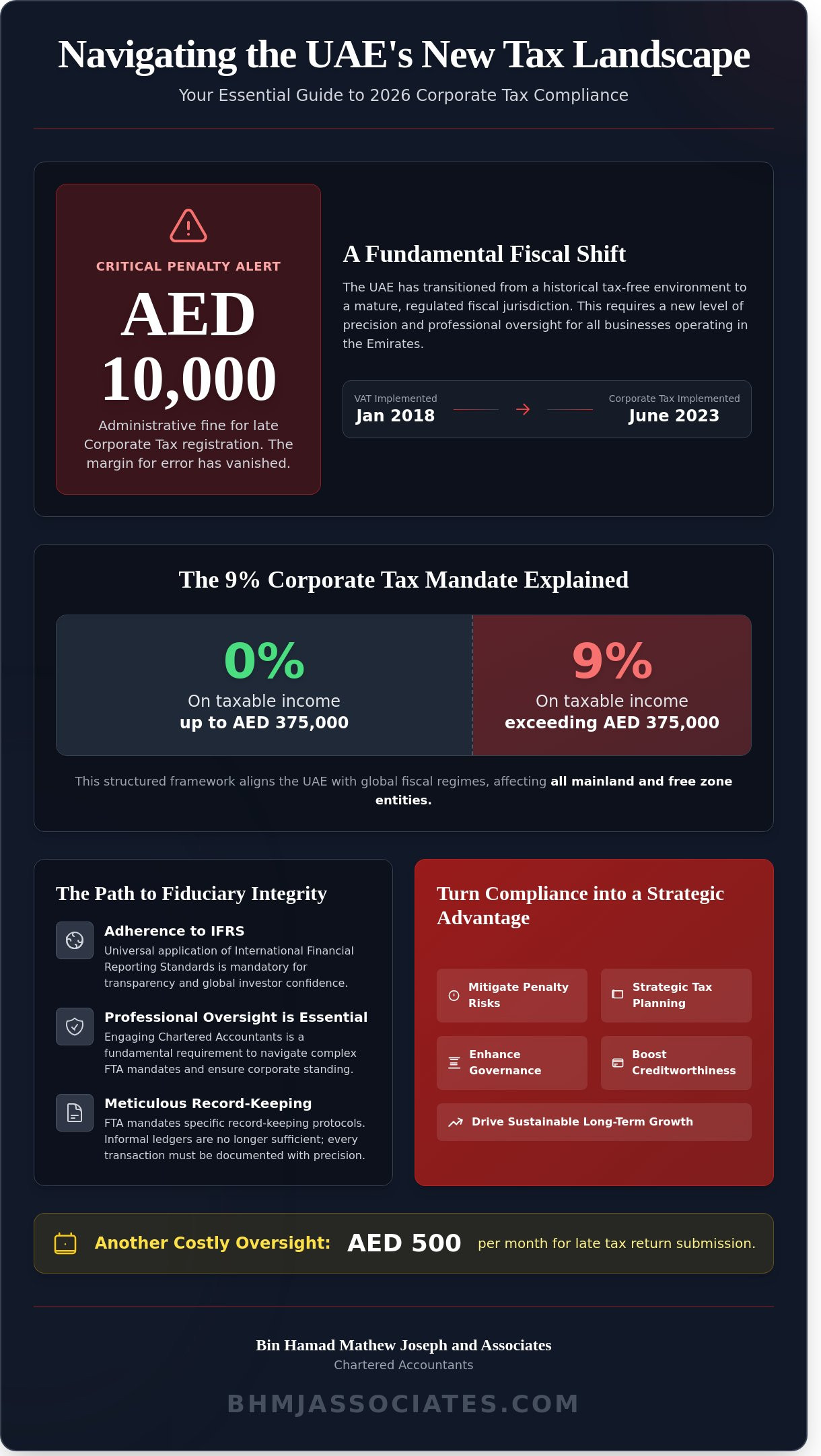
The UAE’s fiscal landscape underwent a definitive transformation starting with the implementation of Value Added Tax on January 1, 2018. This trajectory reached a critical milestone with the introduction of a 9% Federal Corporate Tax on taxable income exceeding AED 375,000 as of June 2023. Such changes signal the end of the historical tax-free environment; they place a rigorous demand on businesses to align with global fiscal regimes. Engaging a Chartered Accountant is now a fundamental requirement for maintaining corporate standing. By 2026, professional accreditation will serve as the primary cornerstone for corporate legitimacy in the region. The Federal Tax Authority (FTA) mandates specific record-keeping protocols that carry significant administrative penalties for non-compliance. These mandates require a level of technical precision that only a qualified professional can provide.
The move toward mandatory statutory reporting now encompasses all mainland and free zone entities. This shift ensures that the UAE remains a competitive, transparent hub for global capital. It’s no longer sufficient to maintain informal ledgers. Every business must now adhere to a structured framework that mirrors the complexity of international markets.
National Compliance Standards and International Financial Reporting
The universal application of International Financial Reporting Standards (IFRS) across the UAE’s diverse economic sectors ensures that financial disclosures remain transparent for international investors. Professional chartered accountants in Dubai facilitate this alignment by translating complex local transactions into standardized global reports. These national regulations influence corporate governance by reinforcing the fiduciary duties of company directors. They ensure every AED 1 of revenue is documented with precision. This transparency is vital for entities seeking to maintain creditworthiness with local and international financial institutions.
The Strategic Importance of Professional Financial Oversight
Financial oversight has transitioned from simple data entry to sophisticated analytical stewardship that drives long-term growth. Expert chartered accountants in Dubai help firms mitigate the risk of administrative penalties; for example, failing to submit a tax return on time can lead to a fine of AED 500 for each month of delay. The accountant serves as a mentor in ensuring enterprise sustainability through rigorous compliance. Their role is to provide a strategic advantage by blending rigid statutory requirements with the aspirational goals of corporate development. This partnership ensures that no aspect of a client’s financial health is left to chance.
- Proactive mitigation of FTA administrative penalties.
- Implementation of IFRS-compliant accounting systems.
- Enhanced corporate governance through independent financial verification.
- Strategic tax planning within the 9% corporate tax framework.
The firm’s approach involves a methodical audit process that mirrors the structured nature of international accounting standards. By prioritizing meticulousness, we ensure that our clients don’t just meet the minimum legal requirements but actually thrive under the new regulatory scrutiny.
Comprehensive Audit and Assurance: Ensuring Statutory Compliance and Shareholder Value
The regulatory environment in the United Arab Emirates demands a meticulous approach to financial reporting, particularly as the nation aligns its standards with international best practices. Engaging chartered accountants in Dubai provides the technical expertise necessary to navigate the complexities of Federal Decree-Law No. 32 of 2021, which governs commercial companies and their reporting obligations. Independent examinations serve as a critical pillar for bankability; financial institutions consistently require audited statements before approving credit facilities or commercial loans. These audits move beyond simple verification, they act as a diagnostic tool that identifies operational bottlenecks and fiscal inefficiencies that might otherwise remain obscured within daily operations. This rigorous oversight distinguishes between external audits, which satisfy legal mandates, and forensic audits, which investigate specific financial discrepancies or potential litigation risks.
Statutory Audit as a Tool for Corporate Growth
A Statutory Audit is a mandatory mechanism for national legal compliance. This process involves a systematic examination of financial statements to ensure that every entry adheres to the International Financial Reporting Standards (IFRS). By providing an unbiased opinion on the “true and fair view” of the company’s fiscal health, auditors enhance the reliability of disclosures for board members and external shareholders. It’s this level of precision that allows a business to demonstrate its integrity to the market. This transparency is vital when seeking to attract private equity or preparing for a potential public offering, as it builds the requisite trust between the enterprise and its investors through verified data.
Internal Audit and Risk Mitigation Strategies
While external audits focus on historical accuracy for third parties, internal audit functions prioritize the fortification of the organization’s future. These professionals design robust internal control systems specifically engineered to prevent financial leakage and mitigate the risk of internal fraud. With the implementation of the 9% levy on taxable income exceeding AED 375,000 under the UAE Corporate Tax regime effective from June 1, 2023, internal audits have become indispensable for preparing for Federal Tax Authority (FTA) inspections. Regular reporting fosters a culture of accountability that safeguards the firm’s fiduciary interests and ensures compliance with VAT regulations. Establishing a strategic partnership with seasoned advisors ensures that these rigorous oversight processes translate into long-term sustainability and value addition for the business.
Navigating the Complexities of UAE Corporate Tax and VAT Advisory
By 2026, the UAE fiscal environment will have matured into a sophisticated ecosystem where the 9% Corporate Tax rate is a permanent fixture for entities generating taxable income exceeding 375,000 AED. This shift necessitates a fundamental change in how chartered accountants in Dubai approach fiscal oversight. It’s a strategic necessity to view Value Added Tax (VAT) and Corporate Tax (CT) as interconnected components of a single financial narrative. The most significant risk facing modern enterprises is the lack of alignment between these two regimes. When VAT returns don’t reconcile with Corporate Tax disclosures, it creates an immediate red flag for the Federal Tax Authority (FTA). Effective tax planning focuses on optimizing liabilities while ensuring every entry adheres to the national legal framework.
The 2026 landscape demands that chartered accountants in Dubai implement rigorous internal controls. Businesses must recognize that the FTA utilizes advanced data analytics to compare quarterly VAT filings against annual Corporate Tax returns. Any deviation in reported revenue or deductible expenses can trigger a comprehensive tax audit. Strategic tax planning involves more than just calculating payments. It requires a proactive evaluation of the corporate structure to identify legitimate exemptions and reliefs provided under the law. This methodical approach transforms tax from a mandatory burden into a manageable component of corporate governance. BHMJ Associates views this compliance journey as a partnership, providing value addition by translating complex statutory requirements into actionable business strategies.
Corporate Tax Registration and Return Filing Procedures
Maintaining an active registration status with the FTA requires more than a one-time application. It demands a continuous audit of internal records to ensure compliance with the UAE Federal Decree-Law on Accounting and Auditing, which sets the standard for professional transparency and ethical conduct. Accurate tax accounting prevents the financial drain of re-assessments and administrative penalties. For multi-entity structures, managing transfer pricing documentation is vital. These documents must justify inter-company transactions at arm’s length to satisfy FTA scrutiny during the 2025 and 2026 filing cycles, ensuring the group’s global tax position remains defensible.
VAT Compliance and Representation Before the Tax Authority
VAT compliance isn’t a periodic chore; it’s a real-time obligation that reflects the integrity of business transactions. Every transaction must be recorded with precision to reflect the actual business flow. A qualified tax agent facilitates this by acting as a bridge between the business and the FTA. They handle the intricacies of VAT de-registration for companies falling below the 187,500 AED voluntary threshold. They also manage complex zero-rated transaction advisory for exporters and logistics firms. This level of technical oversight ensures that the business remains protected during formal audits or clarification requests, maintaining the firm’s reputation for regulatory excellence.
Strategic Financial Management: Digital Transformation with Zoho and Odoo
The implementation of the UAE Corporate Tax Law on 1 June 2023 has rendered traditional, manual bookkeeping methods fundamentally inadequate for maintaining statutory compliance. Organizations that rely on fragmented spreadsheets or physical ledgers face heightened risks of non-compliance and substantial administrative penalties. Transitioning to cloud-based, FTA-compliant software isn’t just a technical upgrade; it’s a strategic necessity for long-term fiscal sustainability. Manual systems lack the audit trails required by the Federal Tax Authority, making it nearly impossible to defend a tax position during a formal audit.
Expert chartered accountants in Dubai facilitate this digital shift by integrating Odoo and Zoho Books into the core financial architecture of a firm. These platforms act as a robust safeguard for data integrity, ensuring that every entry adheres to international accounting standards and local regulations. Real-time financial reporting provides a distinct competitive advantage, allowing executives to access instant data and respond to market shifts with precision. It’s a move away from retrospective accounting toward proactive fiscal management where data is used to predict, rather than just record, financial outcomes.
Automating Compliance Through Modern Accounting Software
Configuring Zoho Books for automated VAT calculation ensures that FTA-ready reporting is generated without the risk of human error. This automation reduces the burden of manual reconciliation during the tax filing period. Odoo implementation allows for the scaling of financial modules as a business grows, integrating procurement, sales, and inventory data into a single source of truth. Professional training for internal staff remains a critical component of this process. The efficacy of any software depends on the user’s ability to maintain rigorous data standards under the supervision of qualified professionals.
Bookkeeping as the Foundation of Management Consultancy
Digital records are the bedrock of sophisticated management consultancy. By transforming standard ledgers into actionable management reports, chartered accountants in Dubai enable informed executive decision-making. These digital ecosystems provide the granular data required for feasibility studies and business valuations, which are essential during corporate restructuring or capital raising. The role of the advisor evolves here, moving from simple record-keeping to overseeing a complex, software-driven financial ecosystem. This oversight ensures that the digital transformation adds tangible value to the enterprise while maintaining a disciplined fiduciary environment.
Strategic growth requires a partner who understands the intersection of technology and regulation. Secure your firm’s digital future with BHMJ Associates and ensure your accounting systems are fully optimized for the UAE’s evolving regulatory landscape.
Criteria for Selecting a Professional Accounting Partner for Long-Term Governance
Selecting a fiscal partner necessitates a rigorous evaluation of technical proficiency in IFRS and UAE-specific tax legislation. Since the implementation of Federal Decree-Law No. 47 of 2022, which introduced the 9% corporate tax rate, the regulatory environment has become significantly more complex. Leading chartered accountants in Dubai must demonstrate an exhaustive understanding of these mandates to ensure statutory compliance across all operations. Industry-specific experience is equally critical; a firm specializing in logistics might overlook the specific inventory valuation requirements inherent to the F&B sector or the complex revenue recognition models required in the education industry. You should prioritize firms that view financial oversight as a fiduciary duty rather than a mere administrative task.
The ‘Value Addition’ test determines whether a firm identifies strategic growth opportunities through data-driven insights or simply records historical figures. A partner who provides a 12% improvement in cash flow through legal tax optimization or working capital management is far more valuable than one who merely submits filings. Professional integrity and ethical standards aren’t negotiable. You must assess whether the firm adheres to the International Code of Ethics for Professional Accountants. This ensures that the advice you receive is objective, transparent, and designed to protect the long-term sustainability of your enterprise.
The BHMJ Associates Approach: Meticulousness and Reliability
BHMJ Associates maintains a disciplined and ethical partnership model that prioritizes long-term client stability. Our methodology facilitates compliance through rigorous oversight, ensuring that every financial statement reflects the highest standards of professional integrity. We support businesses throughout their lifecycle, providing expert guidance during complex restructuring phases or when statutory liquidation becomes a legal necessity. Our role as a protective advisor ensures that your governance framework remains robust against shifting market conditions. We don’t just provide services; we implement a culture of fiscal discipline that protects the sustainability of your enterprise. This meticulous approach has helped our clients maintain a 100% compliance record with the Federal Tax Authority (FTA).
Finalizing the Partnership: Onboarding and Expectations
The onboarding process begins with a clearly defined scope of work covering audit, tax, and bookkeeping retainers. We establish formal communication protocols that include quarterly management reviews to assess fiscal health and adherence to the latest regulatory guidelines. It’s vital to have these expectations documented to avoid ambiguity in fiduciary responsibilities. Establishing a cadence for reporting ensures that no regulatory deadline is missed and every strategic decision is backed by accurate data. We prioritize transparency in our fee structures and deliverables to build a foundation of trust. Contact BHMJ Associates for a professional consultation on your national compliance needs.
- Technical Mastery: Deep knowledge of IFRS and UAE Corporate Tax Law.
- Sector Expertise: Proven track records in logistics, education, and F&B.
- Ethical Alignment: Commitment to the highest standards of professional integrity.
- Strategic Growth: Focus on value addition and financial optimization.
Engaging chartered accountants in Dubai who understand the local market’s nuances is the most effective way to mitigate risk. It’s about building a relationship that evolves with your business. By selecting a partner that combines technical excellence with a strategic mindset, you ensure that your organization is prepared for the future of the UAE economy.
Future-Proofing Your Enterprise Governance for the 2026 Fiscal Cycle
The regulatory environment in the United Arab Emirates is undergoing a significant transformation that demands unwavering precision in financial reporting and tax compliance. As we approach the 2026 fiscal year, the integration of advanced digital tools like Odoo and Zoho Books becomes a fundamental requirement for maintaining the transparency expected by the Federal Tax Authority. Businesses must move beyond reactive accounting and embrace a proactive fiduciary stance that prioritizes IFRS adherence and strategic tax planning. Engaging professional chartered accountants in Dubai ensures that your organization doesn’t just meet statutory obligations but leverages them to enhance shareholder value and operational efficiency. BHMJ Associates specializes in facilitating this high-level governance through meticulous audit processes and specialized implementation of financial technologies. With a proven track record in diverse sectors such as F&B and Logistics, we provide the technical expertise necessary to navigate complex FTA regulations. It’s the right time to transform your compliance requirements into a strategic asset for long-term stability. Secure your enterprise’s financial future with BHMJ Associates and establish a partnership built on integrity and professional excellence. Your sustainable growth in the UAE market starts with rigorous financial oversight.
Frequently Asked Questions
What are the mandatory audit requirements for businesses in the UAE for 2026?
Federal Decree-Law No. 32 of 2021 dictates that all mainland companies and specific Free Zone entities must undergo an annual financial audit. For the 2026 cycle, businesses must submit their audited financial statements to the relevant licensing authority within 4 months of the financial year-end. It’s essential to maintain these records for 5 years to satisfy statutory obligations and ensure transparency for all stakeholders.
How do I ensure my business is fully compliant with the latest UAE Corporate Tax laws?
Registration for Corporate Tax is mandatory via the EmaraTax portal for any entity with taxable income exceeding AED 375,000. Professional chartered accountants in Dubai facilitate compliance by applying IFRS standards to financial records and filing returns within 9 months of the period’s end. Utilizing Small Business Relief under Ministerial Decision No. 73 of 2023 can also optimize your tax position if your revenue stays below AED 3 million.
Can a chartered accountant assist with both VAT and Corporate Tax filing?
A qualified accountant manages both VAT and Corporate Tax to ensure total alignment between different Federal Tax Authority (FTA) submissions. This integrated approach prevents discrepancies between the 5% VAT returns and the 9% Corporate Tax filings. It’s a strategic partnership that simplifies the reconciliation of taxable income and ensures that all fiduciary responsibilities are met through a single, authoritative point of contact.
What is the difference between an internal audit and a statutory audit?
A statutory audit is a legal mandate under the UAE Commercial Companies Law that verifies financial accuracy for external parties. Conversely, an internal audit serves as a voluntary governance mechanism to evaluate risk management and operational efficiency. While statutory audits provide a true and fair view of historical data, internal audits focus on improving internal controls and preventing fraud through continuous monitoring.
Why is it necessary to use FTA-compliant software like Zoho or Odoo?
The FTA requires businesses to maintain digital records that can generate an FTA Audit File (FAF) on demand. Software solutions like Zoho or Odoo automate this process; they reduce manual data entry errors by 85% and ensure that tax calculations align with the latest Executive Regulations. It’s a critical tool for maintaining the integrity of your financial data during a formal tax inspection.
What documents are required for a company liquidation in the UAE?
Liquidation requires a notarized Board Resolution, a liquidator’s acceptance letter, and a comprehensive final audit report. You’ll also need clearance certificates from the FTA, local utility providers, and the Ministry of Labour. For mainland entities, the process includes a mandatory 45 day notice period in two local newspapers to allow creditors to submit any outstanding claims against the company.
How often should a management report be reviewed by a professional accountant?
Management reports should undergo a professional review every 30 days to ensure the business remains on a sustainable growth trajectory. These monthly assessments allow chartered accountants in Dubai to identify budget variances and liquidity risks in real time. Regular oversight transforms raw financial data into a strategic asset, providing the clarity needed for complex corporate development and long-term investment planning.
What are the penalties for non-compliance with UAE financial regulations?
Cabinet Decision No. 75 of 2023 establishes strict penalties, including a fine of AED 10,000 for late Corporate Tax registration. If a business fails to maintain proper financial records, it faces a penalty of AED 20,000 for the first instance, which rises to AED 50,000 for repeat violations. These measures emphasize the government’s commitment to a regulated and transparent financial environment across all Emirates.

Article by
Joseph Mathew
Joseph is a finance and audit professional currently serving as an Audit Manager at Bin Hamad and Mathew Joseph and Associates Chartered Accountants Est., a role he has held since 2022. With a strong background in accounting, compliance, and financial analysis, he brings a detail-oriented and analytical approach to auditing engagements across a range of industries.
In his position at BHMJ Associates, Joseph is responsible for leading audit assignments, overseeing audit teams, and ensuring that financial statements comply with applicable standards and regulatory requirements. He works closely with clients to assess internal controls, identify risks, and provide practical recommendations that enhance financial transparency and operational efficiency.
Known for his professionalism and commitment to accuracy, Joseph has developed a reputation for delivering high-quality audit outcomes within tight deadlines. His ability to interpret complex financial data and communicate insights clearly makes him a valuable advisor to both clients and colleagues.
Joseph continues to build his expertise in auditing and financial management, staying updated with evolving industry standards and best practices, while contributing to the growth and reputation of his firm.
Disclaimer
The content shared and published by Bin Hamad and Mathew Joseph and Associates Chartered Accountants Est. is intended solely for general informational and educational purposes. While every effort is made to ensure the accuracy, completeness, and timeliness of the information provided, the firm makes no guarantees or warranties, express or implied, regarding its reliability or suitability for any particular purpose.
All posts, articles, insights, and commentary do not constitute professional advice, including but not limited to accounting, auditing, tax, legal, or financial advice. Readers are advised to seek appropriate professional consultation before making any decisions based on the information provided.
Bin Hamad and Mathew Joseph and Associates Chartered Accountants Est. shall not be held liable for any direct, indirect, incidental, or consequential loss or damage arising from the use of, or reliance on, the content shared through its platforms.
Any views or opinions expressed in posts are those of the respective authors and do not necessarily reflect the official policy or position of the firm.
By accessing and using this content, you acknowledge and agree to the terms of this disclaimer.