


In 2026, viewing your annual statutory audit as a mere administrative hurdle for license renewal is a strategic oversight that could expose your organization to severe fiscal penalties under the current UAE Corporate Tax regime. You’ve likely found that the mandatory 90-day submission window following your financial year-end is a high-stakes period where the threat of license suspension creates unnecessary pressure on your internal accounting teams. Securing the services of qualified saif zone approved auditors who possess a granular understanding of the Sharjah Airport International Free Zone Authority’s rigorous regulatory framework is essential for maintaining operational continuity and professional integrity.
We understand that aligning your free zone accounts with complex tax legislation requires a meticulous approach to financial reporting and disciplined oversight. This article provides a comprehensive guide on how to navigate SAIFZA requirements and leverage your statutory audit to ensure seamless license renewal and full compliance with Federal Tax Authority mandates. You’ll discover how to transform a mandatory filing into a strategic advantage that yields actionable financial insights while securing your status as a Qualifying Free Zone Person. We will examine the critical intersection of IFRS compliance and tax optimization to ensure your enterprise remains a stable, competitive entity in the Sharjah industrial sector.
Key Takeaways
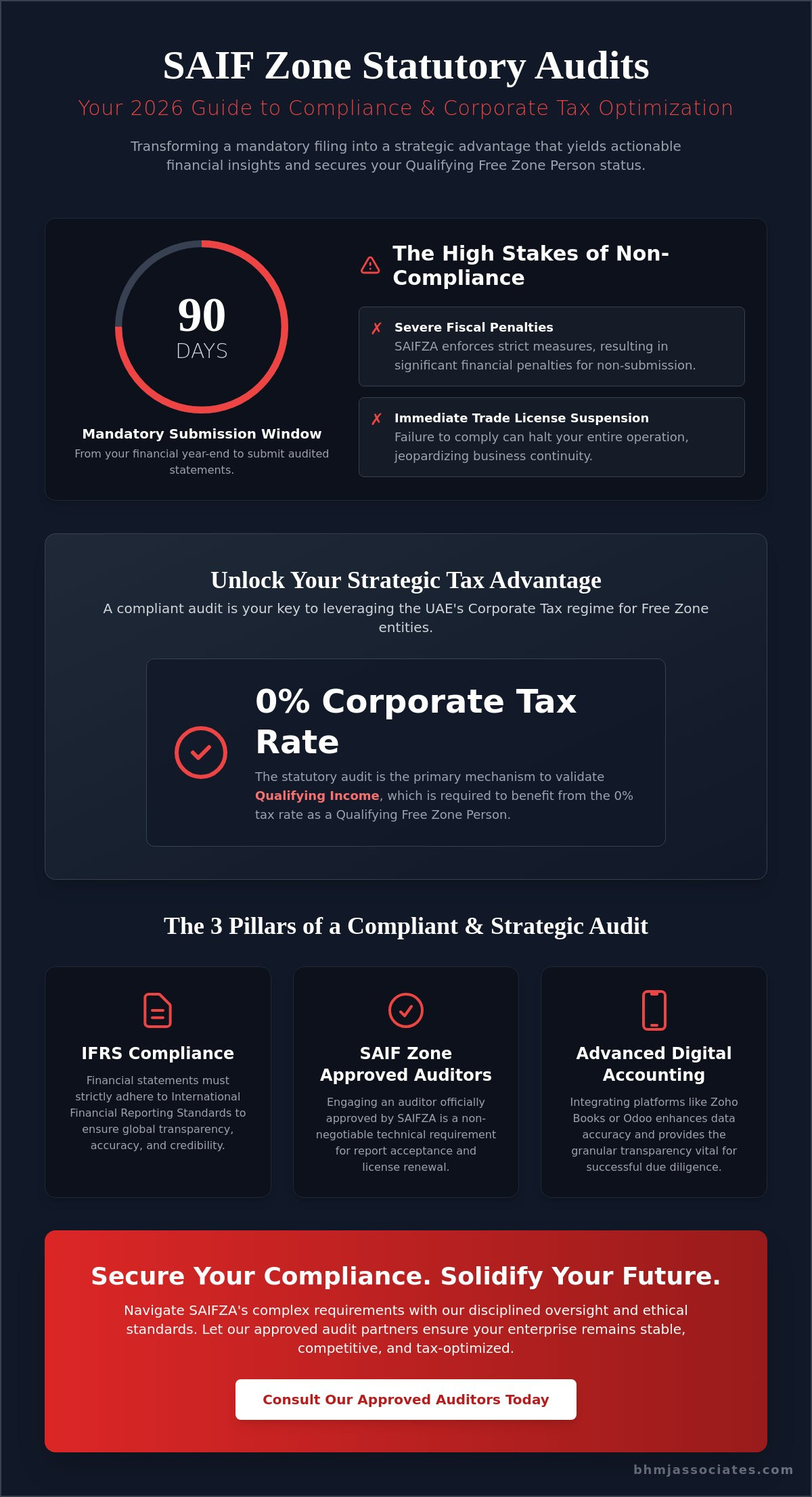
- Understand the specific regulatory mandates established by the Sharjah Airport International Free Zone Authority which require the submission of audited financial statements within ninety days of the fiscal year-end to ensure an uninterrupted trade license renewal process.
- Recognize the technical necessity of engaging saif zone approved auditors to guarantee that your organization’s financial reporting remains in strict alignment with both International Financial Reporting Standards and the evolving local legal frameworks.
- Learn how the statutory audit serves as the primary mechanism for validating Qualifying Income, a process that’s fundamentally required to leverage the 0% corporate tax rate available to qualifying free zone entities in 2026.
- Identify the strategic benefits of integrating advanced digital accounting platforms such as Zoho Books or Odoo, which enhance data accuracy and provide the granular transparency necessary for successful financial due diligence.
- Gain a comprehensive perspective on the criteria for selecting a consultancy partner who demonstrates the disciplined oversight and ethical standards required to manage complex, high-stakes compliance matters effectively.
The Regulatory Framework of Statutory Audits in SAIF Zone
The Sharjah Airport International Free Zone Authority (SAIFZA) operates under a rigorous legal structure that mandates the annual submission of audited financial statements for every entity registered within its jurisdiction. This requirement isn’t merely a procedural formality but a critical component of the Regulatory Framework of Statutory Audits that governs the transparency and fiscal integrity of the free zone. To fulfill this obligation, businesses must engage saif zone approved auditors who are authorized to verify that the company’s financial records are maintained in accordance with the established protocols of the Sharjah government.
To better understand the operational environment of this jurisdiction, watch this helpful video:
Failure to adhere to these statutory requirements carries severe implications for the longevity of a business enterprise. The SAIF Zone Authority enforces strict compliance measures; non-submission often results in significant financial penalties and, more critically, the immediate suspension of the company’s trade license. This legal mechanism ensures that the 8,000 companies currently operating within the zone maintain a standard of financial accountability that mirrors global best practices. It’s a system designed to protect the interests of shareholders, creditors, and the broader UAE economy through disciplined oversight.
Mandatory Submission Timelines and Deadlines
SAIF Zone regulations stipulate that all registered entities must submit their audited financial statements within 90 days from the conclusion of their respective financial years. This window is non-negotiable for the purposes of trade license renewal; the authority requires the audit report as a prerequisite for processing annual renewals. While the SAIFZA authority may consider formal requests for extensions under exceptional circumstances, such petitions must be substantiated with comprehensive documentation and submitted well before the standard deadline to avoid administrative blocks. Delays in this process don’t just risk fines; they can halt your entire operation.
IFRS Compliance in Free Zone Financial Reporting
The mandate for accounts to be prepared according to International Financial Reporting Standards (IFRS) is a foundational element of the SAIF Zone’s commitment to international financial transparency. This requirement is particularly pertinent for the zone’s vast industrial and trading sectors, where complex inventory valuations and revenue recognition protocols must align with specific IFRS benchmarks. It’s the responsibility of saif zone approved auditors to provide reasonable assurance that these financial statements present a fair and accurate view of the company’s fiscal position. By adhering to these rigorous standards, businesses don’t just achieve compliance; they establish a level of financial credibility that’s essential for long term growth and successful financial due diligence.
Criteria and Significance of SAIF Zone Approved Status
The designation of a “SAIF Zone Approved Auditor” represents a critical seal of professional competence, signifying that a firm has undergone extensive scrutiny by the Sharjah Airport International Free Zone Authority. This status isn’t merely a registration; it’s a formal validation of the firm’s capacity to uphold the fiscal standards required within this specialized jurisdiction. When entities seek to engage saif zone approved auditors, they’re essentially prioritizing a level of independent third-party verification that ensures their financial reporting is beyond reproach. This rigorous alignment with authority standards is fundamental to Navigating SAIFZA Compliance, particularly as the UAE’s fiscal landscape becomes increasingly integrated with global reporting norms and federal oversight.
A primary function of this approved status is to maintain absolute transparency between the registered entity and the Free Zone Authority. By mandating that only vetted professionals conduct statutory audits, SAIFZA ensures that every financial disclosure is accurate, ethical, and meticulously prepared. This disciplined approach to financial oversight acts as a guardian of professional ethics, reinforcing the zone’s reputation as a stable, conservative environment for international trade and industrial investment. It’s a system where no aspect of a project’s financial standing is left to chance, providing stakeholders with a sense of security rooted in verified data.
The Vetting Process for Audit Firms
The Authority maintains a disciplined oversight mechanism to ensure that only firms demonstrating extreme attention to detail are permitted to operate within the zone. To achieve and maintain approved status, an audit firm must present evidence of a valid registration with the UAE Ministry of Economy, alongside comprehensive professional indemnity insurance that mitigates risk for all stakeholders involved. Quality control isn’t a one-time event; it involves ongoing monitoring of the firm’s adherence to international standards and technical precision. This methodology ensures that every audit conducted within the zone mirrors the structured nature of rigorous industry frameworks, providing a sense of security to the registrar and the business community alike.
Risks of Appointing Non-Approved Auditors
Choosing an unauthorized professional carries profound operational and legal risks that can compromise the sustainability of a partner’s interests. The SAIF Zone registrar will immediately reject any financial statement that doesn’t bear the signature and seal of an approved firm, leading to an instantaneous halt in the trade license renewal process. This administrative friction often results in costly delays, leaving directors vulnerable to legal liabilities for failing to exercise due diligence in their professional appointments. To avoid such pitfalls, many organizations find that initiating a statutory audit with a verified partner is the most reliable method to ensure their documentation meets every regulatory benchmark without exception.
Statutory Audit and UAE Corporate Tax Compliance in 2026
In the fiscal year 2026, the utility of audited financial statements extends far beyond the administrative requirements of the Sharjah Airport International Free Zone (SAIF). The introduction of federal corporate tax has fundamentally transformed the statutory audit into a prerequisite for accurate corporate tax return filing. For entities operating within this jurisdiction, the engagement of saif zone approved auditors is now a strategic necessity to ensure that the transition from financial reporting to tax base calculations is executed with technical precision. This methodical alignment between financial accounting and tax legislation ensures that no detail is overlooked during the preparation of federal filings.
Tax authorities in 2026 prioritize the principle of substance over form. This requires companies to demonstrate genuine economic activity within the free zone to justify their tax positions. A rigorous statutory audit provides the foundational evidence needed to support these claims, meticulously documenting that the organization’s operations, decision making, and asset management are physically situated in the UAE. This level of scrutiny is essential for maintaining the integrity of the free zone’s tax benefits. It ensures that no aspect of the organization’s fiscal structure remains vulnerable to reclassification by the authorities during a formal review.
Validating Qualifying Free Zone Person Status
To benefit from the 0% corporate tax rate, an entity must maintain its status as a Qualifying Free Zone Person. This status depends heavily on the auditor’s ability to verify that the revenue generated constitutes Qualifying Income as defined by the latest legislation. Saif zone approved auditors play a decisive role in this verification process, conducting a granular analysis of income streams and confirming that transactions with mainland entities are accounted for in strict alignment with transfer pricing regulations. This disciplined oversight ensures that the company’s eligibility for tax exemptions is supported by robust, verifiable data, effectively safeguarding the organization’s financial interests.
Audit as a Shield Against FTA Penalties
The statutory audit serves as a proactive defense mechanism against potential federal tax authority investigations. By identifying and rectifying tax discrepancies before they’re flagged in a return, the audit process provides a layer of security that prevents the imposition of significant non-compliance penalties. Adopting a unified approach that integrates audit assurance with tax advisory allows organizations to align their financial disclosures with their tax strategies. This effectively mitigates risk and ensures that the organization’s growth is built upon a foundation of total regulatory compliance, mirroring the structured nature of rigorous industry frameworks.
Critical Factors in Selecting an Approved Audit Partner
The selection of a professional audit partner should not be viewed as a transactional procurement but as the establishment of a collaborative relationship rooted in technical excellence and mutual accountability. When evaluating saif zone approved auditors, organizations must prioritize firms that demonstrate a granular understanding of the logistics, manufacturing, and international trade sectors that define the Sharjah industrial landscape. This specialized expertise ensures that the audit methodology is tailored to the specific risk profiles and inventory valuation complexities inherent in these industries. A partner who possesses this level of insight doesn’t merely check boxes; they provide a disciplined oversight that reinforces the brand’s role as a guardian of professional standards and ethical reporting.
Efficiency in the modern regulatory environment is inextricably linked to technological integration, where firms that maintain a stable, conservative approach while embracing modern accounting software are better positioned to meet the rigorous 90-day submission window. This balance between competitive fee structures and technical rigor is essential to ensure that the audit process remains thorough without becoming an undue administrative burden on the organization’s internal resources. To ensure your organization meets these rigorous standards with precision, it’s advisable to engage professional statutory audit services from a verified partner who understands the nuances of free zone operations.
Evaluating Technical Proficiency and Software
Professional auditors must demonstrate a sophisticated proficiency in cloud-based accounting systems to facilitate a seamless data exchange that mirrors the structured nature of rigorous industry frameworks. The integration of platforms such as Odoo or Zoho Books allows for real-time data access, which fundamentally transforms the audit from a retrospective exercise into a dynamic investigative process. This digital synergy significantly reduces manual intervention, effectively minimizing the risk of clerical errors while accelerating the overall audit duration. It’s a strategic advantage that provides stakeholders with a sense of security, knowing that their financial data is being analyzed through the lens of extreme attention to detail.
Communication and Collaborative Methodology
A successful audit relationship is characterized by a steady, logical communication rhythm that begins well before the field work commences, ensuring that no aspect of the project is left to chance. The initial planning phase should involve a comprehensive context-setting session where expectations are clearly defined and potential technical hurdles are identified with precision. Beyond the issuance of the statutory report, a seasoned advisor provides proactive insights that support the sustainability and growth of their partners’ interests. This collaborative spirit transforms the audit from a mandatory requirement into a strategic asset for organizational development, offering a thoughtful approach to problem-solving that refuses to cut corners.
Navigating SAIFZA Compliance with BHMJ Associates
BHMJ Associates serves as a disciplined, ethical partner for entities requiring meticulous financial oversight within the Sharjah Airport International Free Zone. Our status as saif zone approved auditors allows us to provide a level of audit assurance that’s strictly aligned with International Financial Reporting Standards and the specific legal requirements of the SAIFZA authority. We’ve built our reputation on the delivery of comprehensive reports that transcend mere regulatory checkboxes, offering instead a thorough investigative process that protects the interests of more than 8,000 companies currently operating within this industrial hub. By maintaining a serious demeanor that reflects the weight of our professional responsibilities, we ensure that your organization remains a stable, compliant entity in an increasingly complex fiscal environment.
Our firm provides a holistic suite of services designed to address the multifaceted needs of free zone enterprises, moving beyond the statutory audit to encompass Corporate Tax Registration and Bookkeeping Services. This integrated approach ensures that every aspect of your financial architecture is constructed with technical precision and a refusal to cut corners. We recognize that the sustainability of your operations depends on the seamless alignment of your internal accounts with the evolving mandates of the Federal Tax Authority, and we position ourselves as a protective advisor committed to your long-term growth.
The BHMJ Audit Methodology
The BHMJ audit methodology is defined by a multi-clause approach that provides thorough financial context and detailed oversight of your organization’s fiscal health. We utilize industry-specific jargon and technical nouns with precision to establish an authoritative record of your financial position, ensuring that no detail is overlooked or left to chance. This rigorous process facilitates a smooth transition from the annual audit to ongoing accounting services in dubai and tax compliance. By leveraging our expertise in Odoo and Zoho Books implementation, we provide the digital infrastructure necessary to maintain real-time transparency and accuracy in your financial reporting, effectively shielding your enterprise from the risks of non-compliance.
Strategic Advantage and Long-Term Partnership
We frame our services not merely as a statutory requirement but as a strategic advantage for organizational development and shareholder value enhancement. Our commitment to the sustainability of your free zone operations is reflected in our measured, steady communication rhythm and our focus on providing actionable financial insights. As a seasoned mentor in the field of high-stakes consultancy, we’re dedicated to fostering long-term relationships built on integrity and professional ethics. We invite you to initiate a formal consultation with our senior advisors to discuss your 2026 compliance planning and ensure your enterprise is prepared for the rigorous demands of the current regulatory landscape.
Securing Your Enterprise’s Fiscal Future in SAIF Zone
Maintaining the fiscal integrity of your Sharjah-based operation requires a disciplined approach to the annual 90-day submission window mandated by the free zone authority. It’s clear that the statutory audit has evolved from a simple license renewal prerequisite into a sophisticated mechanism for validating your status under the 2026 UAE Corporate Tax regime. By engaging saif zone approved auditors who possess specialized expertise in IFRS compliance and modern ERP integration, you ensure that your financial reporting remains beyond reproach. This meticulous oversight provides the necessary transparency to safeguard your organization’s growth while facilitating seamless trade license renewals. As statutory audit specialists, we offer the technical rigor and Odoo or Zoho implementation experience required to navigate these high-stakes regulatory frameworks with absolute precision.
Your commitment to professional ethics and rigorous financial standards is the foundation of a sustainable enterprise. We’re prepared to serve as your protective advisor, ensuring that no aspect of your compliance strategy is left to chance. Consult our SAIF Zone approved auditors for your 2026 statutory requirements to establish a partnership built on integrity and long-term stability. We look forward to supporting your organization’s continued success in the Emirates.
Frequently Asked Questions
Is it mandatory for all companies in SAIF Zone to appoint an approved auditor?
Yes, every entity registered within the Sharjah Airport International Free Zone is legally required to appoint saif zone approved auditors to conduct an annual statutory audit. This mandate ensures that financial statements are verified for accuracy and transparency; it’s a non-negotiable prerequisite for the successful annual renewal of the company’s trade license. Failure to appoint a recognized professional firm can lead to immediate administrative complications and the eventual suspension of operational privileges.
What documents are required to initiate a statutory audit in the free zone?
To initiate the investigative process, companies must provide a comprehensive set of financial records, including the trial balance, general ledgers, bank statements, and year-end reconciliations. Additionally, auditors require access to foundational legal documents such as the trade license, memorandum of association, and copies of all material contracts, sales invoices, and purchase records to verify the fair presentation of the accounts in accordance with local regulations.
Can an auditor from another country conduct my SAIF Zone audit?
No, the SAIF Zone Authority strictly requires that statutory audits be performed by firms that are officially registered and approved by the authority itself. While international firms may maintain global branches, only those specific local offices that have undergone the authority’s rigorous vetting process and maintain a valid UAE Ministry of Economy registration are authorized to issue the required audit certificates.
How does the 2026 UAE Corporate Tax law affect my free zone audit requirements?
The 2026 UAE Corporate Tax legislation has significantly elevated the strategic importance of the statutory audit, as it serves as the primary evidentiary document for validating “Qualifying Income.” Engaging saif zone approved auditors is now essential to ensure that your financial data supports your eligibility for the 0% tax rate; the Federal Tax Authority relies on these audited statements to verify that the entity maintains adequate substance and adheres to complex transfer pricing regulations.
What is the deadline for submitting the audited financial report to SAIFZA?
Entities must submit their audited financial statements to the SAIF Zone Authority within 90 days from the conclusion of their financial year. Adhering to this specific timeline is critical to avoid administrative blocks on the company’s portal and the imposition of financial penalties. Delays in submission don’t just risk fines; they can halt the trade license renewal process and disrupt the continuity of your business operations.
Does SAIFZA accept audit reports prepared under GAAP instead of IFRS?
No, the SAIF Zone Authority mandates that all financial statements be prepared in strict accordance with International Financial Reporting Standards (IFRS). This requirement ensures that financial disclosures meet global benchmarks for transparency and comparability. Any report prepared under alternative frameworks, such as US GAAP, will be rejected by the registrar, potentially leading to significant delays in regulatory compliance and license processing.
How often should a company rotate its approved auditor in the UAE?
While specific rotation mandates for private free zone entities can vary, it’s considered a best practice within the UAE’s professional framework to evaluate and potentially rotate audit firms or lead partners every three to five years. This disciplined approach to auditor rotation ensures that the oversight of your financial interests remains rigorous and unbiased. It prevents the erosion of professional skepticism and reinforces the integrity of the independent third-party verification process.
What happens if my audit report is qualified by the auditor?
A qualified audit report indicates that the auditor has identified material misstatements or limitations in the audit scope, which can trigger immediate scrutiny from the SAIF Zone Authority. Such a qualification may lead to the rejection of the report for license renewal purposes. It could also alert the Federal Tax Authority to financial discrepancies that might result in a formal tax investigation or the loss of your “Qualifying Free Zone Person” tax status.

Article by
Joseph Mathew
Joseph is a finance and audit professional currently serving as an Audit Manager at Bin Hamad and Mathew Joseph and Associates Chartered Accountants Est., a role he has held since 2022. With a strong background in accounting, compliance, and financial analysis, he brings a detail-oriented and analytical approach to auditing engagements across a range of industries.
In his position at BHMJ Associates, Joseph is responsible for leading audit assignments, overseeing audit teams, and ensuring that financial statements comply with applicable standards and regulatory requirements. He works closely with clients to assess internal controls, identify risks, and provide practical recommendations that enhance financial transparency and operational efficiency.
Known for his professionalism and commitment to accuracy, Joseph has developed a reputation for delivering high-quality audit outcomes within tight deadlines. His ability to interpret complex financial data and communicate insights clearly makes him a valuable advisor to both clients and colleagues.
Joseph continues to build his expertise in auditing and financial management, staying updated with evolving industry standards and best practices, while contributing to the growth and reputation of his firm.
Disclaimer
The content shared and published by Bin Hamad and Mathew Joseph and Associates Chartered Accountants Est. is intended solely for general informational and educational purposes. While every effort is made to ensure the accuracy, completeness, and timeliness of the information provided, the firm makes no guarantees or warranties, express or implied, regarding its reliability or suitability for any particular purpose.
All posts, articles, insights, and commentary do not constitute professional advice, including but not limited to accounting, auditing, tax, legal, or financial advice. Readers are advised to seek appropriate professional consultation before making any decisions based on the information provided.
Bin Hamad and Mathew Joseph and Associates Chartered Accountants Est. shall not be held liable for any direct, indirect, incidental, or consequential loss or damage arising from the use of, or reliance on, the content shared through its platforms.
Any views or opinions expressed in posts are those of the respective authors and do not necessarily reflect the official policy or position of the firm.
By accessing and using this content, you acknowledge and agree to the terms of this disclaimer.