


In the current fiscal landscape of the United Arab Emirates, the selection of a financial management system has transcended mere operational preference to become a fundamental pillar of statutory survival. For many, the search for the optimal accounting software for small business uae is no longer driven by simple bookkeeping needs but by the imperative to avoid significant penalties associated with the standard 9% corporate tax rate. It’s understandable that business owners feel a sense of trepidation when facing the technical nuances of the EmaraTax portal or the intricacies of migrating legacy data into modern, cloud-based frameworks.
You’ll discover the critical criteria for selecting FTA-accredited accounting software that ensures your enterprise remains fully aligned with evolving VAT and Corporate Tax mandates. We will analyze how specialized modules for automated filing and audit-ready financial statements can mitigate the risk of non-compliance. By prioritizing a methodical approach to software implementation, your organization can achieve a state of rigorous financial oversight that supports long-term sustainability and strategic development within the competitive UAE market.
Key Takeaways
- Recognize the critical transition from voluntary record-keeping to the mandatory statutory documentation standards required by the Federal Tax Authority under the 2026 UAE Corporate Tax framework.
- Identify the essential technical specifications, including native VAT support and multi-currency capabilities, that are necessary for maintaining compliance within the region’s diverse logistics and trading sectors.
- Assess the operational fit of Zoho Books and Odoo as the leading accounting software for small business uae, specifically regarding their capacity to manage service-based or inventory-heavy workflows.
- Understand the necessity of a professional implementation strategy to ensure your Chart of Accounts is structured in strict alignment with IFRS and UAE financial reporting regulations.
- Explore how a rigorous, compliance-oriented software setup serves as a strategic safeguard against the financial and reputational risks associated with non-compliant tax filing.
The Regulatory Imperative: Why Accounting Software is Mandatory for UAE SMEs
The regulatory environment within the United Arab Emirates has undergone a fundamental paradigm shift, transitioning from a historical regime of voluntary record-keeping to one of rigorous statutory compliance. Under the UAE Corporate Tax Law, the maintenance of precise financial documentation is no longer an optional administrative task; it’s a mandatory legal obligation. For many organizations, the integration of a professional Accounting software solution is the only viable method to satisfy the Federal Tax Authority’s (FTA) exacting standards for digital record-keeping. Relying on manual spreadsheets or non-accredited systems introduces a level of operational risk that most small enterprises simply can’t afford to carry. Digital transformation should be viewed as a strategic advantage that protects shareholder value and prepares the entity for future scaling.
To better understand this concept, watch this helpful video:
Selecting the appropriate accounting software for small business uae is a critical decision that directly impacts an organization’s ability to withstand regulatory scrutiny. Compliance is the new baseline for success. By moving away from fragmented data entry toward a centralized, accredited system, management ensures that every transaction is captured with the meticulousness required for a modern tax jurisdiction. This methodical approach to financial data management mirrors the structured nature of industry frameworks and reinforces the brand’s role as a guardian of professional standards. Maintaining this level of professionalism across all business communications is vital; for instance, you can discover Micro Printing to see how data-driven strategies are applied to targeted direct mail.
Corporate Tax and the Demand for Real-Time Financial Visibility
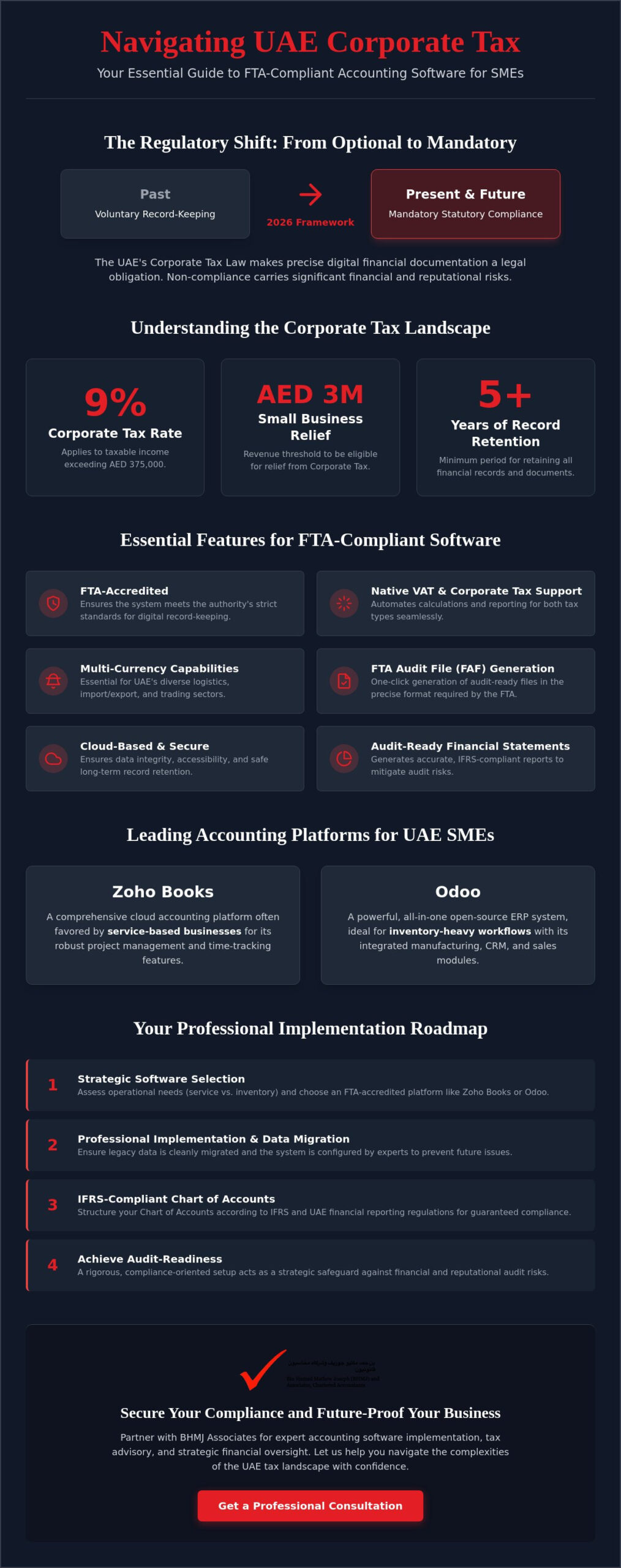
The year 2026 represents a definitive turning point for financial transparency across the Emirates. With the standard corporate tax rate of 9% applying to taxable income exceeding AED 375,000, the nexus between accurate bookkeeping and tax return filing is now absolute. It’s essential for businesses to maintain a real-time view of their financial position to monitor the AED 3 million revenue threshold for Small Business Relief. The law also mandates a minimum five-year record retention period, a requirement that necessitates a stable, cloud-based repository for all financial evidence and supporting documentation. Without automated systems, the risk of data loss or retrieval failure during an inquiry becomes a significant liability.
Mitigating Penalties Through FTA-Accredited Systems
The FTA defines acceptable digital records with extreme precision, and the failure to produce these records upon request can result in severe administrative penalties. Utilizing accounting software for small business uae that is accredited by the authority acts as a primary line of defense during a tax audit. These platforms provide a structured audit trail that is difficult to replicate in manual systems. They allow users to generate the FTA Audit File (FAF) at the touch of a button, ensuring that the data is presented in the exact format required by the authorities. This capability reduces the risk of human error and demonstrates a commitment to ethical, organized financial management, providing peace of mind for stakeholders and creditors alike.
Essential Features of Accounting Software for Small Business in the UAE
Identifying the technical specifications of a robust digital infrastructure is the first step toward establishing a compliant fiscal environment. For an enterprise to thrive in 2026, the chosen accounting software for small business uae must transcend basic ledger entries, providing native support for the 5% VAT regime and the 9% Corporate Tax mandate. This requires the automated generation of tax invoices that strictly adhere to FTA guidelines, ensuring every transaction is captured with the granular detail necessary for statutory reporting.
The following features represent the mandatory baseline for any small business operating within the Emirates:
- Multi-currency functionality: Essential for handling complex exchange rate fluctuations within the UAE’s diverse import-export and logistics landscape.
- IFRS Alignment: Ensuring all financial statements are produced in accordance with UAE accounting standards.
- Cloud-based Accessibility: Providing management with real-time visibility while maintaining robust data encryption and considering local hosting protocols.
- WPS Integration: Facilitating seamless payroll management in strict alignment with Ministry of Human Resources and Emiratisation (MOHRE) guidelines.
Technical security remains a paramount concern for modern enterprises. Systems must be configured to provide a methodical investigative trail for every entry, mirroring the structured nature of rigorous industry frameworks. This level of meticulousness is vital for maintaining the confidence of financial institutions and potential investors. It’s a strategic necessity to move beyond fragmented records toward a centralized, secure repository of financial truth.
VAT and Corporate Tax Automation Modules
Automated tax calculation modules are indispensable for eliminating the human error often associated with manual filing. These systems must be configured to handle complex scenarios such as the reverse charge mechanism for imported services and the treatment of exempt supplies. As the regulatory landscape matures, ensuring your software supports the specific UAE Corporate Tax registration and reporting formats is a prerequisite for audit-readiness. Organizations seeking to optimize these workflows often benefit from professional bookkeeping services to ensure their digital architecture remains perfectly aligned with current legislation.
WPS Payroll and Employee Benefit Management
Compliance with MOHRE guidelines is facilitated through direct integration with the Wages Protection System (WPS). A sophisticated accounting framework automates the generation of SIF files and provides precise calculations for end-of-service gratuity, which is a significant liability for any UAE-based entity. By maintaining a clean audit trail for all staff-related disbursements, management can demonstrate a commitment to ethical governance and regulatory adherence. This methodical oversight ensures that no aspect of the employment relationship is left to chance, providing security to both the employer and the workforce.
Zoho Books vs. Odoo: Selecting the Optimal Platform for Your Operations
The selection of an optimal accounting software for small business uae is a decision that demands a meticulous evaluation of an organization’s functional requirements and its long-term strategic trajectory. This process isn’t merely an IT procurement exercise but a fundamental alignment with the rigorous tax environment codified in Federal Decree-Law No. 47 of 2022. While the market provides various options, Zoho Books and Odoo have emerged as the primary contenders, each offering a distinct approach to managing the sensitive financial data of a modern UAE enterprise. Identifying which platform mirrors your specific industry framework is essential for maintaining the meticulousness required for statutory audit-readiness.
Licensing structures and implementation methodologies vary significantly between these two leaders. Zoho’s predictable, tiered pricing model offers transparency for annual budgeting, which is often a priority for conservative management. Conversely, Odoo’s modular system rewards organizations that require deep, cross-departmental integration, though it necessitates a more disciplined approach to system configuration. Whether you manage an in-house finance team or utilize outsourced expertise, the learning curve of your chosen system will dictate the efficiency of your monthly closing cycles and the accuracy of your real-time reporting.
Zoho Books: Streamlined Compliance for Service Sectors
Zoho Books has solidified its position as a preferred solution for consulting firms, educational institutions, and small-scale traders within the Emirates. Its primary strength lies in its direct accreditation by the Federal Tax Authority, which provides stakeholders with a high degree of confidence during the VAT return preparation process. The platform’s ecosystem allows for a seamless integration between CRM and expense tracking, creating a unified data environment that reduces the risk of fragmented reporting. For service-based startups, the intuitive interface facilitates rapid adoption, though professional Zoho Books Implementation is recommended to ensure the initial Chart of Accounts is structured for long-term compliance.
Odoo ERP: Modular Flexibility for Logistics and F&B
Odoo ERP represents a more complex, albeit highly flexible, alternative for SMEs operating in the logistics, manufacturing, and Food & Beverage sectors. Its modular nature allows a business to begin with a core accounting application and progressively activate additional modules for warehouse management and manufacturing resource planning. This open-source architecture is particularly advantageous for firms with bespoke operational requirements that standard off-the-shelf software can’t satisfy. However, the sophistication of Odoo necessitates a structured Odoo Implementation process to avoid the common pitfalls of misconfigured workflows that could compromise the integrity of financial statements during a statutory audit.
The Professional Implementation Roadmap: Ensuring Audit-Readiness
The deployment of even the most sophisticated accounting software for small business uae does not, in itself, guarantee compliance or fiscal integrity. Many organizations fall into the trap of an “out-of-the-box” setup, assuming that default configurations will satisfy the complex demands of the Federal Tax Authority. This approach is inherently risky. Without professional accounting oversight, the underlying structure often fails to capture the nuances of UAE Corporate Tax or VAT regulations. A flawed initial setup can lead to systemic errors that are both costly and time-consuming to rectify during a statutory audit. Management must view implementation as a rigorous investigative process rather than a simple software installation.
Meticulousness during the data migration phase is another critical component of the implementation roadmap. Transitioning historical records from legacy systems or manual spreadsheets requires a methodical strategy to ensure data integrity isn’t compromised. Every opening balance must be verified, and every historical transaction must be mapped with precision to the new framework. This investigative process is essential for maintaining a continuous financial narrative that can withstand the scrutiny of a tax inspector. Additionally, the role of ongoing staff training can’t be overstated. A system is only as accurate as the data entered into it, and ensuring your team understands the technical requirements and ethical implications of the software is a strategic necessity for long-term sustainability. It’s a refusal to cut corners that provides a sense of security to the organization’s leadership.
Configuring the Chart of Accounts for Statutory Audit
The Chart of Accounts serves as the fundamental architectural blueprint of an audit-ready system. Structuring these ledgers requires a deep understanding of both IFRS and local regulations to facilitate a clean independent examination of financial statements. It’s vital that all asset classes and liabilities are correctly categorized to ensure balance sheet accuracy. This level of detail provides the transparency required by auditors and financial institutions, reinforcing the brand’s image as a disciplined and highly organized partner. By aligning the chart with statutory requirements, you ensure that no aspect of the financial relationship is left to chance.
Establishing Rigorous Internal Controls
Implementing segregation of duties within the software is a primary defense against financial mismanagement and fraud risks. By establishing user permission protocols, management can ensure that no single individual has total control over a financial transaction from initiation to approval. Automated audit logs are equally important, as they provide a permanent record of every transaction adjustment for future review. Utilizing professional accounting services in dubai provides the necessary oversight during this setup phase to ensure these controls are robust. Organizations that prioritize these rigorous internal controls often find themselves better positioned for growth and stakeholder confidence. To ensure your digital infrastructure is fully optimized for compliance, consider engaging our experts for a comprehensive management consultancy review.
Partnering with BHMJ Associates for Software Implementation and Advisory
The successful deployment of accounting software for small business uae requires a synthesis of technical proficiency and the disciplined oversight characteristic of high-stakes consultancy. At BHMJ Associates, we don’t view implementation as an isolated IT task but as a fundamental component of your organization’s long-term sustainability. Our methodology blends the technical nuances of modern software with the rigorous standards of Chartered Accountancy, ensuring that every configuration choice is made with an eye toward future statutory obligations. This compliance-first approach ensures that your digital infrastructure is seamlessly integrated with our statutory audit processes, providing a continuous investigative trail that withstands regulatory scrutiny.
Establishing a collaborative relationship with a seasoned mentor allows your business to move with quiet confidence through the complexities of the 2026 fiscal environment. We provide ongoing support and periodic reviews, ensuring that your system evolves in strict alignment with the latest UAE financial regulations. By refusing to cut corners during the setup phase, we provide a sense of security to your stakeholders, demonstrating a commitment to integrity and meticulousness. Selecting an accounting software for small business uae is a significant investment; our role is to ensure that investment translates into a strategic advantage for your enterprise’s growth and stability.
Expert Implementation of Zoho and Odoo
Our team specializes in Zoho Books Implementation and Odoo Implementation, tailoring these modular platforms to the unique operational demands of the education, logistics, and F&B sectors. We recognize that a standard configuration is often inadequate for capturing the specific nuances of these industries. Our commitment extends beyond the initial technical setup, as we prioritize the empowerment of your finance team through structured staff training. This methodical process bridges the gap between software functionality and the increasingly complex federal tax authority expectations, ensuring your team is prepared for any investigative inquiry.
Strategic Advisory and Financial Due Diligence
The data generated by a professionally implemented accounting system serves as a powerful lever for strategic management consultancy. We utilize software-generated financial records to conduct rigorous Feasibility Studies and produce accurate business valuations that reflect the true health of your organization. When an enterprise maintains audit-ready digital records, it significantly enhances its position during Financial Due Diligence, providing potential partners or creditors with a clear, reliable financial narrative. This transition from simple bookkeeping to data-driven strategic insight allows your organization to pursue expansion with a stable, conservative foundation built on ethical governance and professional excellence.
Securing Your Enterprise’s Financial Future through Rigorous Digital Transformation
The transition to a sophisticated digital environment has evolved into a strategic necessity for maintaining strict alignment with the Federal Tax Authority’s mandates. It’s clear that the integration of specialized accounting software for small business uae serves as the bedrock of your organization’s audit-readiness, ensuring that every recorded transaction mirrors the meticulous standards of IFRS. By prioritizing a structured implementation roadmap over fragmented record-keeping, management can effectively mitigate the risks of administrative penalties and foster a culture of transparent, ethical governance. This methodical approach doesn’t just satisfy legal requirements but provides a stable foundation for long-term organizational development.
As Approved Auditors for major UAE Free Zones and expert implementers of Zoho Books and Odoo, our firm is uniquely positioned to bridge the gap between technical software functionality and statutory compliance. We invite you to consult with our Chartered Accountants for a compliant software implementation that leverages the specialized expertise of our dedicated VAT and Corporate Tax advisory team. Establishing this collaborative relationship today ensures your enterprise remains resilient, organized, and fully prepared for the evolving fiscal landscape of the Emirates.
Frequently Asked Questions
Is accounting software mandatory for small businesses in the UAE in 2026?
Digital record-keeping has become a mandatory statutory obligation under the UAE Corporate Tax Law, which imposes a 9% tax on income exceeding AED 375,000. While entities with revenue below AED 3 million may elect for Small Business Relief, the Federal Tax Authority still requires the maintenance of precise financial records for a minimum period of five years. Implementing a robust accounting system is the only reliable method to ensure these records remain accessible and compliant with the required documentation standards.
Which accounting software is officially accredited by the Federal Tax Authority (FTA)?
Zoho Books is among the most prominent platforms that have received official FTA accreditation for its capacity to generate the mandatory FTA Audit File (FAF). The authority maintains a registry of tax accounting software that meets the specific technical specifications required for VAT and Corporate Tax reporting. Utilizing an accredited solution provides management with the assurance that their digital infrastructure is pre-configured to handle the complexities of the UAE’s fiscal regime.
Can I use QuickBooks or Xero for my UAE-based business?
QuickBooks and Xero are frequently utilized by local enterprises, though they require meticulous manual configuration to ensure full alignment with the UAE’s VAT and Corporate Tax mandates. Unlike Zoho or Odoo, which offer native modules specifically tailored for the Emirates, global platforms may lack pre-built features for local statutory reporting. It’s essential to verify that any chosen accounting software for small business uae can produce the localized reports necessary for filing through the EmaraTax portal.
What is the cost of implementing a professional accounting system like Zoho or Odoo?
Software licensing costs for Zoho Books typically range from $15 to $240 per month, while Odoo’s standard plans are approximately $31.10 per user per month when billed annually. These subscription fees represent the baseline cost for the digital tools themselves. Professional implementation is a separate, strategic investment that ensures the software is configured for audit-readiness and that your finance team is technically empowered to maintain the system’s integrity.
How does accounting software assist with UAE Corporate Tax registration and filing?
Sophisticated accounting software for small business uae automates the tracking of the AED 375,000 taxable income threshold and monitors the AED 3 million revenue limit for Small Business Relief. These systems ensure that all financial statements are produced in strict accordance with IFRS, which simplifies the process of Corporate Tax return filing. By maintaining a real-time ledger, the software provides the transparent data trail required for accurate registration and timely submission on the EmaraTax portal.
Do I need a professional accountant to set up my accounting software?
While the software itself may be user-friendly, the initial configuration of the Chart of Accounts requires the disciplined oversight of a professional accountant to ensure statutory compliance. A flawed setup can lead to systemic errors in tax calculation and financial reporting that are difficult to rectify during a later audit. Professional implementation ensures that your internal controls and ledger structures are designed to withstand the scrutiny of an independent examination.
Can accounting software handle WPS payroll requirements in the UAE?
Integrated payroll modules within platforms like Zoho and Odoo are specifically designed to generate the SIF files required by the Wages Protection System. This automation ensures that salary disbursements are recorded in strict alignment with Ministry of Human Resources and Emiratisation (MOHRE) guidelines. By centralizing payroll within your accounting framework, you maintain a clean audit trail for all employee-related disbursements and end-of-service gratuity calculations.
What happens if my business fails to maintain digital financial records during an FTA audit?
The failure to maintain adequate financial records can result in severe administrative penalties, such as the AED 10,000 fine for late VAT registration or substantial penalties for non-compliant record-keeping. During a tax audit, the absence of a verifiable digital audit trail may lead the FTA to reject your tax filings or reassess your tax liability based on their own estimates. Maintaining a compliant digital infrastructure is a critical safeguard against the financial and reputational risks of regulatory non-compliance.

Article by
Joseph Mathew
Joseph is a finance and audit professional currently serving as an Audit Manager at Bin Hamad and Mathew Joseph and Associates Chartered Accountants Est., a role he has held since 2022. With a strong background in accounting, compliance, and financial analysis, he brings a detail-oriented and analytical approach to auditing engagements across a range of industries.
In his position at BHMJ Associates, Joseph is responsible for leading audit assignments, overseeing audit teams, and ensuring that financial statements comply with applicable standards and regulatory requirements. He works closely with clients to assess internal controls, identify risks, and provide practical recommendations that enhance financial transparency and operational efficiency.
Known for his professionalism and commitment to accuracy, Joseph has developed a reputation for delivering high-quality audit outcomes within tight deadlines. His ability to interpret complex financial data and communicate insights clearly makes him a valuable advisor to both clients and colleagues.
Joseph continues to build his expertise in auditing and financial management, staying updated with evolving industry standards and best practices, while contributing to the growth and reputation of his firm.
Disclaimer
The content shared and published by Bin Hamad and Mathew Joseph and Associates Chartered Accountants Est. is intended solely for general informational and educational purposes. While every effort is made to ensure the accuracy, completeness, and timeliness of the information provided, the firm makes no guarantees or warranties, express or implied, regarding its reliability or suitability for any particular purpose.
All posts, articles, insights, and commentary do not constitute professional advice, including but not limited to accounting, auditing, tax, legal, or financial advice. Readers are advised to seek appropriate professional consultation before making any decisions based on the information provided.
Bin Hamad and Mathew Joseph and Associates Chartered Accountants Est. shall not be held liable for any direct, indirect, incidental, or consequential loss or damage arising from the use of, or reliance on, the content shared through its platforms.
Any views or opinions expressed in posts are those of the respective authors and do not necessarily reflect the official policy or position of the firm.
By accessing and using this content, you acknowledge and agree to the terms of this disclaimer.