


The impending expiration of Small Business Relief on December 31, 2026, is not merely a calendar event but a transformative shift that demands an immediate and rigorous re-evaluation of your organizational fiscal strategy. You’re likely aware that the increasing technical complexity of transfer pricing and the strict de minimis requirements for Free Zone entities have created a landscape where minor oversights can lead to substantial administrative penalties. This authoritative guide serves as a strategic manual for corporate tax planning uae, offering the technical depth required to optimize your position while maintaining strict alignment with Federal Decree-Law No. 47 of 2022.
By reading this analysis, you’ll gain clarity on maintaining Qualifying Free Zone Person status and establishing a seamless bridge between your tax filings and annual statutory audits. We’ll explore the specific criteria for the 0% rate on taxable income up to AED 375,000 and the methodical steps necessary to ensure your 2026 fiscal year is defined by both compliance and competitive advantage. Our objective is to provide the expert oversight needed to transform these regulatory obligations into a sustainable platform for long-term growth.
Key Takeaways
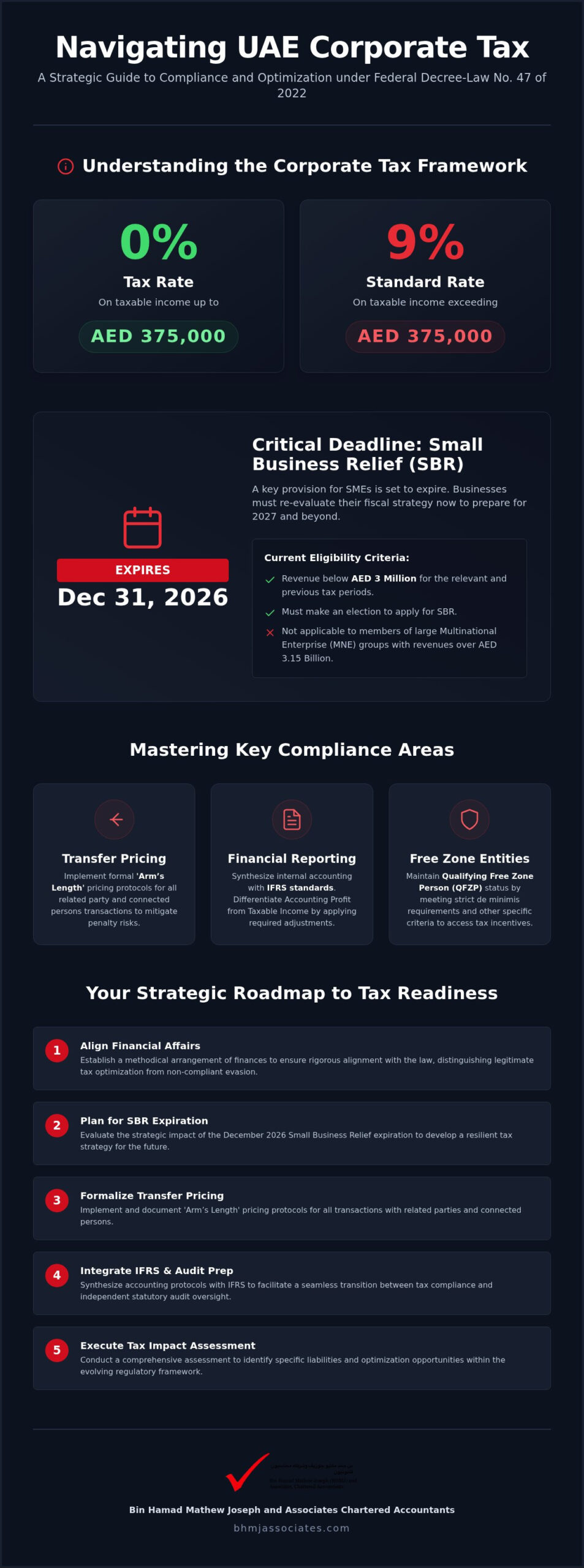
- Establish a methodical arrangement of financial affairs to ensure rigorous alignment with Federal Decree-Law No. 47 of 2022 while distinguishing between legitimate optimization and non-compliant evasion.
- Evaluate the strategic implications of the December 2026 expiration of Small Business Relief to develop a resilient corporate tax planning uae strategy for entities currently below the AED 3 million revenue threshold.
- Implement formal ‘Arm’s Length’ pricing protocols for all related party transactions to mitigate the risk of administrative penalties and ensure compliance with national transfer pricing regulations.
- Synthesize internal accounting protocols with IFRS standards to facilitate a seamless transition between tax compliance and independent statutory audit oversight.
- Execute a comprehensive tax impact assessment to identify specific liabilities and optimization opportunities within the evolving national regulatory framework.
Strategic Framework of Corporate Tax Planning in the UAE
Corporate tax planning in the UAE involves the methodical arrangement of an entity’s financial affairs to ensure strict alignment with the provisions of Federal Decree-Law No. 47 of 2022. It’s a proactive discipline that distinguishes legitimate tax optimization, which leverages available legislative reliefs, from non-compliant tax evasion. Evasion involves the intentional misrepresentation of financial data to circumvent legal obligations, a practice that risks severe administrative penalties under Cabinet Decision No. 129 of 2025. For a historical perspective on the region’s fiscal evolution, an Overview of UAE Taxation illustrates the transition from a no-tax environment to a sophisticated, internationally aligned regime.
The 2026 fiscal year represents a critical juncture for organizations as they move beyond the initial implementation phase into a steady-state compliance environment. Financial modeling must now be anchored in the standard 9% corporate tax rate applicable to taxable income exceeding AED 375,000, ensuring that growth projections account for these mandatory fiscal outflows. Effective corporate tax planning uae requires a granular understanding of how these thresholds influence cash flow and long-term investment strategies.
To better understand the nuances of the current regime, watch this helpful video:
Legislative Basis and the Role of the Federal Tax Authority
The Federal Tax Authority (FTA) serves as the primary regulator, overseeing the administration, collection, and enforcement of federal taxes. Ministerial Decisions provide the granular detail necessary for corporate tax planning uae, clarifying specific aspects of the law such as the treatment of interest expenses or the criteria for tax groups. Every legal entity must obtain and maintain a valid Tax Registration Number (TRN) to fulfill its legal obligations. The FTA utilizes the EmaraTax digital portal for all submissions, demanding that annual tax returns and supporting documentation be uploaded with meticulous accuracy to avoid automated red flags during the review process.
Taxable Income vs. Accounting Profit: A Meticulous Distinction
Achieving fiscal precision requires a deep understanding of the adjustments necessary to move from net profit per financial statements to taxable income. IFRS provides the essential baseline for financial reporting, but the tax base often diverges due to specific legislative mandates. Taxable income is defined as the net profit adjusted for specific exemptions and non-deductible expenses per the UAE Corporate Tax Law. These adjustments include the exclusion of dividends received from domestic entities and the limitation of interest deductions based on the 30% EBITDA rule. Maintaining a clear audit trail of these reconciliations is vital for ensuring the integrity of the tax base during a statutory audit.
Optimizing Liabilities through Small Business Relief and Free Zone Incentives
Strategic corporate tax planning uae necessitates a rigorous evaluation of available legislative reliefs that can materially reduce an entity’s fiscal burden. For many small and medium-sized enterprises, Small Business Relief (SBR) serves as the primary mechanism for optimization. Under the current framework, eligible taxable persons with revenue below the AED 3,000,000 threshold for the relevant and previous tax periods can elect to be treated as having no taxable income. This election effectively negates the 9% tax liability, provided the entity isn’t a member of a multinational enterprise group with consolidated revenues exceeding AED 3.15 billion or a Qualifying Free Zone Person.
The 2026 fiscal year is the definitive horizon for this relief. The Official UAE Corporate Tax Guide specifies that SBR is currently scheduled to expire for tax periods ending on or before December 31, 2026. This creates a strategic cliff for businesses approaching the revenue threshold; those projected to exceed AED 3,000,000 in 2027 must begin restructuring their financial models now. Preparing for this transition through professional management consultancy ensures that the shift from relief to standard taxation doesn’t compromise organizational liquidity or operational stability.
The Strategic Window for Small Business Relief
Eligible entities must actively elect for SBR within their annual corporate tax return filing. It isn’t an automatic designation. Documentation is paramount; the Federal Tax Authority (FTA) requires meticulous records that substantiate revenue claims and verify that the business hasn’t artificially fragmented its operations to stay below the threshold. If your business is on a growth trajectory, 2026 is the final year to optimize your position under the current SBR regime. This requires an immediate audit of revenue recognition policies to ensure full compliance before the relief period concludes.
Navigating the Complexities of Free Zone Taxation
Entities operating within designated Free Zones can maintain a 0% tax rate on qualifying income, provided they achieve Qualifying Free Zone Person (QFZP) status. This status is contingent upon meeting strict criteria, including the maintenance of adequate substance within the zone. You must demonstrate that core income-generating activities are performed in the Free Zone, supported by adequate physical assets and qualified full-time employees. The risk of “tainting” qualifying income is significant; non-qualifying revenue must not exceed the de minimis threshold, which is the lower of 5% of total revenue or AED 5,000,000. Failure to adhere to these limits results in the loss of QFZP status for five years, subjecting all income to the standard 9% rate. Maintaining IFRS-compliant audited financial statements is a mandatory prerequisite for Free Zone entities seeking to uphold their 0% tax advantage.
Managing Transfer Pricing Compliance and Related Party Transactions
Within the rigorous architecture of the UAE Corporate Tax Law, transfer pricing emerges as one of the most technically demanding facets of regulatory compliance. It’s not a mere administrative exercise but a fundamental component of corporate tax planning uae, designed to ensure that profits aren’t artificially shifted between related entities to minimize tax liabilities. The Federal Tax Authority (FTA) mandates that all transactions between related parties and connected persons must be conducted at ‘Arm’s Length’, reflecting terms and conditions that would’ve been agreed upon by independent parties under similar circumstances. This requirement directly impacts the overall effective tax rate of a corporate group, as the mispricing of inter-company loans, management fees, or intellectual property royalties can lead to significant tax base erosions.
Identifying Related Parties and Connected Persons
Scrutiny begins with the precise identification of related parties, typically triggered when there’s an ownership interest of 50% or more, or where one entity exercises significant control over the financial and operational policies of another. Connected persons include natural persons such as owners, directors, and officers, along with their relatives up to the fourth degree of kinship. The Arm’s Length Principle is the global standard adopted by the UAE for valuing inter-company transactions to ensure they reflect market realities. Transactions involving individual shareholders and their corporate entities are particularly sensitive, as any deviation from market value can lead to the disallowance of expenses or the deemed distribution of dividends, complicating the entity’s fiscal position.
Documentation and Disclosure Requirements
Organizations must navigate a tiered documentation framework to substantiate their pricing methodologies. For high-revenue organizations, specifically those with annual revenue exceeding AED 200 million in the relevant tax period or those that are members of a multinational enterprise group with consolidated revenues of at least AED 3.15 billion, the maintenance of a Master File and a Local File is mandatory. These documents provide a comprehensive overview of the group’s global operations and a detailed analysis of local inter-company transactions, respectively.
Each annual corporate tax return must include a Disclosure Form that summarizes all related party transactions. Strategies for benchmarking inter-company fees, interest rates, and service charges must rely on robust economic analysis and comparable data from independent sources. In the absence of such documentation, the FTA reserves the authority to make unilateral adjustments to the taxable income. Such adjustments often result in increased liabilities and administrative penalties, making the integration of transfer pricing protocols a non-negotiable element of corporate tax planning uae.
A Methodical Implementation Roadmap for National Tax Readiness
Transitioning from a legacy tax-exempt status to a sophisticated taxable environment requires more than mere compliance; it demands a structured, chronological roadmap to safeguard organizational value. The initial phase must involve a rigorous tax impact assessment to quantify potential liabilities and uncover specific optimization opportunities within the existing corporate structure. Central to this process is the alignment of internal accounting protocols with IFRS, which serves as the mandatory baseline for determining the tax base. Without IFRS-compliant financial statements, the integrity of the tax calculation remains vulnerable to challenge during an FTA audit, making this alignment the bedrock of any successful corporate tax planning uae strategy.
Operationalizing these strategies necessitates the adoption of advanced ERP solutions to ensure precise transaction tracking and reporting. Utilizing platforms through professional Zoho Books Implementation or Odoo Implementation allows for the automation of tax engines, significantly reducing the risk of material misstatements. Following this technical setup, organizations must establish a formal transfer pricing policy for all related party engagements, ensuring every transaction is defensible under the Arm’s Length Principle. Finally, engaging in quarterly tax provisioning and reviews ensures the business remains agile, effectively avoiding the year-end compliance shocks that result from unmonitored fiscal shifts. To ensure these steps are executed with professional precision, engaging experts for your corporate tax return filing provides a critical strategic safeguard.
Aligning Financial Systems with Tax Requirements
Modern accounting software provides the technical infrastructure required for real-time compliance through automated tax engines. These systems must be configured with a meticulously designed chart of accounts that distinguishes between taxable, exempt, and non-deductible items at the point of entry. This granular categorization is essential for producing accurate tax reconciliations and maintaining the data residency standards required for long-term record-keeping. By embedding tax logic directly into the financial system, organizations achieve a level of meticulousness that manual processes cannot match, ensuring every AED is correctly accounted for under the current regime.
Internal Control Frameworks for Tax Integrity
The sustainability of an effective corporate tax planning uae framework depends heavily on the robustness of internal control systems. Protocols must be established for the multi-level review and approval of tax-sensitive transactions, ensuring that every financial decision is vetted for its tax implications before execution. Training finance teams on the nuances of the UAE Corporate Tax Law is equally vital, as it empowers personnel to identify potential risks before they manifest in official filings. A disciplined approach to record-keeping creates a digital audit trail that links every tax return figure back to a verified source document, providing the transparency required for successful statutory audits.
Synergy Between Corporate Tax Planning and Statutory Audit Oversight
The efficacy of corporate tax planning uae isn’t fully realized until it survives the rigorous scrutiny of an independent statutory audit. This formal examination serves as the ultimate validation of an organization’s fiscal strategy, ensuring that every legislative position taken aligns with both the precise letter and the underlying intent of Federal Decree-Law No. 47 of 2022. Auditors play an indispensable role in identifying potential tax contingencies and determining the accurate valuation of deferred tax assets or liabilities, which are essential components of IFRS-compliant financial reporting. By integrating these two distinct yet related disciplines, businesses establish a robust defense against potential Federal Tax Authority (FTA) inquiries and the subsequent risk of significant administrative penalties.
A disciplined audit process moves methodically through the financial records, mirroring the investigative thoroughness required to maintain compliance in a sophisticated taxable economy. It’s during this phase that any technical discrepancies in transfer pricing methodologies or the application of Free Zone exemptions are identified and rectified before they manifest as systemic failures in tax filings. Bin Hamad Mathew Joseph and Associates Chartered Accountants positions itself as the guardian of these professional standards, offering a protective layer of oversight that ensures your tax planning isn’t just a theoretical exercise but a verified operational reality that withstands regulatory inspection.
Enhancing Shareholder Value through Rigorous Oversight
There’s a direct and measurable correlation between the transparency of an entity’s tax positions and the overall credibility of its financial statements in the eyes of lenders, investors, and regulatory bodies. Professional audit services serve to mitigate the risk of material misstatements in tax reporting, providing stakeholders with the quiet confidence that the entity’s fiscal liabilities are accurately stated and managed. For a deeper analysis of these requirements, consult our Professional Accounting Services: A Strategic Guide for UAE Business Compliance in 2026. This level of meticulousness transforms a mandatory compliance task into a strategic advantage for long-term organizational development.
Ensuring Long-term Sustainability with Bin Hamad Mathew Joseph and Associates Chartered Accountants
Our commitment to providing meticulous financial oversight extends through every stage of the tax lifecycle, from initial registration to the final submission of returns. The strategic advantage of a collaborative relationship between auditors and tax consultants lies in the seamless flow of information, which prevents the operational silos that often lead to oversight and ensures that corporate tax planning uae strategies are consistently applied across all financial statements. By aligning your internal controls with the expectations of the national regulatory body, you secure the sustainability of your growth and protect your assets from unnecessary exposure. For further insights into regulatory expectations, refer to our guide on Understanding the Federal Tax Authority: A Comprehensive Guide to UAE Tax Compliance in 2026. Bin Hamad Mathew Joseph and Associates Chartered Accountants remains a stable, conservative partner, dedicated to the ethical standing and fiscal health of your enterprise through every fiscal period.
Securing Your Organizational Legacy through Disciplined Fiscal Oversight
The transition toward a mature taxable economy in the United Arab Emirates demands a departure from reactive compliance in favor of a rigorous, forward-looking strategy. As the December 2026 expiration of Small Business Relief approaches, the integration of IFRS-compliant financial examination with robust transfer pricing documentation becomes the only viable path to mitigating the risk of material misstatement and subsequent administrative penalties. BHMJ Associates serves as a protective advisor, leveraging our status as approved auditors for major national free zones and our specialized expertise in Zoho and Odoo financial implementation to ensure your operations remain resilient through every regulatory shift. Effective corporate tax planning uae is no longer an optional administrative task; it’s a fundamental pillar of organizational growth that requires the methodical oversight of seasoned experts.
To ensure your entity is prepared for the complexities of the 2026 fiscal year and beyond, Engage our Chartered Accountants for a strategic corporate tax planning consultation. We remain committed to the long-term sustainability of your interests, providing the ethical guardianship and technical precision necessary to navigate this evolving regulatory landscape with absolute certainty. Your path to fiscal optimization is a collaborative journey, and we’re prepared to guide your enterprise toward a future of stable, compliant growth.
Frequently Asked Questions
Is corporate tax planning mandatory for all businesses in the UAE?
While the law doesn’t explicitly mandate a formal “planning” document, the rigorous compliance requirements established by Federal Decree-Law No. 47 of 2022 make strategic foresight a practical necessity for every taxable person. Failure to arrange financial affairs methodically can result in the loss of available exemptions or the inadvertent triggering of administrative penalties. Every legal entity must register for tax and file an annual return, regardless of their profit levels, which necessitates a disciplined approach to fiscal management.
What are the primary benefits of engaging a professional tax consultant in 2026?
Engaging a professional consultant provides the expert oversight required to navigate the technical complexities of the national tax regime, particularly as the Federal Tax Authority increases its focus on enforcement. Consultants ensure that internal accounting protocols are strictly aligned with IFRS standards, which is the mandatory baseline for taxable income calculation. This collaborative relationship serves as a protective layer, identifying potential tax contingencies and optimizing liabilities through a methodical investigation of the entity’s operational structure.
How does the expiration of Small Business Relief at the end of 2026 affect my planning?
The expiration of Small Business Relief on December 31, 2026, represents a significant fiscal cliff for entities currently benefiting from the AED 3,000,000 revenue threshold. Organizations must immediately incorporate corporate tax planning uae into their 2027 financial modeling to account for the transition to the standard 9% tax rate on income exceeding AED 375,000. This shift requires a re-evaluation of cash flow projections and a rigorous update of internal reporting systems to ensure readiness for the first taxable period following the relief’s conclusion.
Can a company in a Free Zone benefit from a 0% tax rate indefinitely?
A Free Zone entity can maintain a 0% tax rate on qualifying income indefinitely, provided it consistently satisfies the criteria for Qualifying Free Zone Person status. This includes maintaining adequate physical substance within the zone, such as dedicated office space and qualified personnel, while ensuring non-qualifying revenue doesn’t exceed the de minimis threshold. This threshold is strictly defined as the lower of 5% of total revenue or AED 5,000,000, and exceeding it results in the loss of tax incentives for a period of five years.
What documentation is required to support transfer pricing at arm’s length?
Taxable persons must maintain a comprehensive suite of documentation, including a Master File and a Local File, if they meet the revenue thresholds specified by the Ministry of Finance. Every annual tax return must include a Disclosure Form that details all transactions with related parties and connected persons. These documents must provide a methodical analysis of the pricing methodologies used, substantiating that inter-company charges reflect market-aligned terms that would’ve been agreed upon by independent entities.
What happens if a business fails to register for corporate tax before the deadline?
Failure to complete the registration process before the deadlines established by the Federal Tax Authority triggers administrative penalties under Cabinet Decision No. 129 of 2025. These penalties are designed to be non-compounding but represent a significant financial and reputational risk that can complicate future interactions with the regulator. Beyond the immediate fine, non-registered entities lose the ability to file returns or claim legitimate reliefs, which can lead to an even greater effective tax burden once the non-compliance is identified.
How do IFRS standards impact the calculation of taxable income in the UAE?
IFRS serves as the mandatory accounting framework for determining the accounting profit, which is the starting point for all corporate tax calculations. The corporate tax planning uae process involves making specific adjustments to this accounting profit to account for non-deductible expenses, such as certain entertainment costs, and exempt income like domestic dividends. This meticulous reconciliation ensures that the final taxable income figure is defensible during a statutory audit and aligns with the technical requirements of the national tax law.
Can tax losses be carried forward to offset future taxable profits?
Taxable persons are permitted to carry forward tax losses to offset up to 75% of the taxable income in subsequent tax periods, providing a vital mechanism for long-term fiscal stability. This provision is subject to strict conditions regarding the continuity of ownership, where at least 50% of the entity must be owned by the same persons. If ownership changes by more than 50%, the losses can only be carried forward if the entity continues to conduct the same or a similar business activity following the change in control.

Article by
Joseph Mathew
Joseph is a finance and audit professional currently serving as an Audit Manager at Bin Hamad and Mathew Joseph and Associates Chartered Accountants Est., a role he has held since 2022. With a strong background in accounting, compliance, and financial analysis, he brings a detail-oriented and analytical approach to auditing engagements across a range of industries.
In his position at BHMJ Associates, Joseph is responsible for leading audit assignments, overseeing audit teams, and ensuring that financial statements comply with applicable standards and regulatory requirements. He works closely with clients to assess internal controls, identify risks, and provide practical recommendations that enhance financial transparency and operational efficiency.
Known for his professionalism and commitment to accuracy, Joseph has developed a reputation for delivering high-quality audit outcomes within tight deadlines. His ability to interpret complex financial data and communicate insights clearly makes him a valuable advisor to both clients and colleagues.
Joseph continues to build his expertise in auditing and financial management, staying updated with evolving industry standards and best practices, while contributing to the growth and reputation of his firm.
Disclaimer
The content shared and published by Bin Hamad and Mathew Joseph and Associates Chartered Accountants Est. is intended solely for general informational and educational purposes. While every effort is made to ensure the accuracy, completeness, and timeliness of the information provided, the firm makes no guarantees or warranties, express or implied, regarding its reliability or suitability for any particular purpose.
All posts, articles, insights, and commentary do not constitute professional advice, including but not limited to accounting, auditing, tax, legal, or financial advice. Readers are advised to seek appropriate professional consultation before making any decisions based on the information provided.
Bin Hamad and Mathew Joseph and Associates Chartered Accountants Est. shall not be held liable for any direct, indirect, incidental, or consequential loss or damage arising from the use of, or reliance on, the content shared through its platforms.
Any views or opinions expressed in posts are those of the respective authors and do not necessarily reflect the official policy or position of the firm.
By accessing and using this content, you acknowledge and agree to the terms of this disclaimer.