


In the current UAE fiscal landscape, viewing an external audit as a mere administrative burden is a strategic oversight that can compromise an enterprise’s long-term viability and institutional integrity. You likely recognize that the implementation of the UAE Corporate Tax Law on June 1, 2023, has fundamentally shifted the regulatory environment, necessitating a level of financial precision that exceeds traditional reporting standards. It’s common for leadership teams to feel a sense of anxiety regarding potential compliance penalties and the difficulty of identifying a consultancy that offers both technical rigor and high-level strategic insight.
This article provides a meticulous examination of independent audit methodologies and the specific regulatory requirements that now govern mainland enterprises and Qualifying Free Zone Persons. We promise to deliver a comprehensive roadmap for navigating IFRS compliance and the upcoming transition to IFRS 18, ensuring your organization secures the credibility required by banks and investors. By moving methodically through the statutory landscape, we will preview how independent financial assurance transforms from a mandatory filing into a strategic advantage that identifies internal control weaknesses before they escalate into systemic operational risks.
Key Takeaways
- Comprehend the specific regulatory mandates governing mainland and free zone entities to ensure your financial reporting aligns with the latest International Financial Reporting Standards.
- Learn the methodological phases of a rigorous external audit to systematically identify internal control deficiencies and safeguard the accuracy of your financial disclosures.
- Recognize the strategic distinction between internal oversight and independent verification to improve the overall effectiveness of your corporate governance protocols.
- Discover how independent financial assurance serves as a vital instrument for institutional maturity, facilitating enhanced trust with stakeholders and credit providers.
- Establish a framework for selecting a consultancy partner that possesses the technical depth and industry expertise necessary to support your long-term organizational objectives.
Defining the Scope and Regulatory Significance of External Audit in the UAE
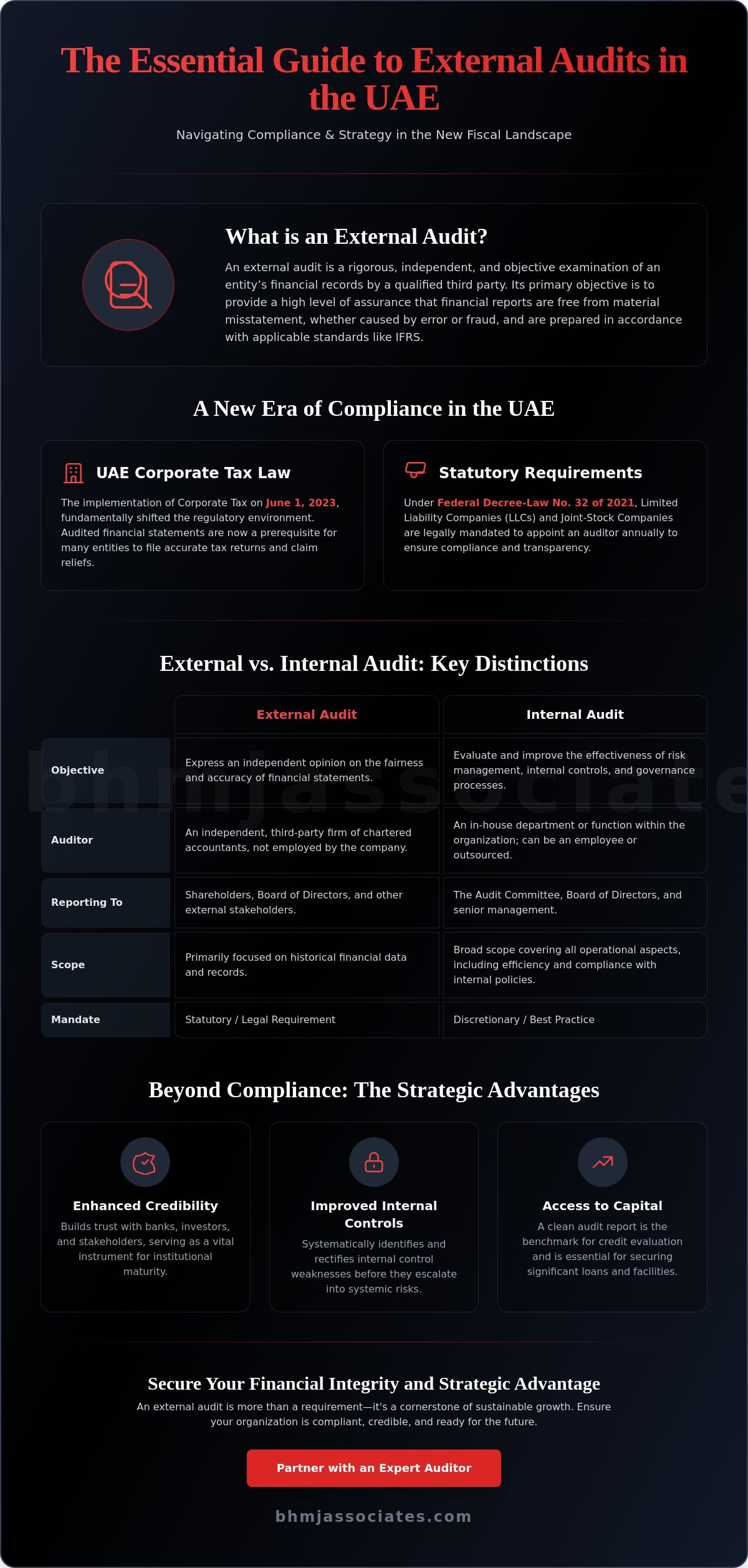
An external audit represents a rigorous, independent, and objective examination of an entity’s financial records, conducted by a qualified third-party professional known as an external auditor. This process serves as a critical verification mechanism, ensuring that the financial statements presented to stakeholders are prepared in strict accordance with the applicable reporting framework. It’s a disciplined undertaking that moves methodically through an organization’s ledgers to confirm that the financial narrative reflects operational reality.
To better understand the specific functional differences between various oversight roles, please watch this informative presentation:
The primary objective of this exercise is to provide a high level of assurance that financial reports remain free from material misstatement, whether caused by error or intentional fraud. Within the United Arab Emirates, the performance of an external audit is governed by the International Standards on Auditing (ISA), alongside a complex layer of local statutory requirements that demand unwavering precision. Independent verification acts as the foundational pillar of transparency for shareholders, creditors, and government authorities, establishing a climate of accountability that’s essential for modern corporate governance.
Statutory Requirements under UAE Commercial Companies Law
Under the UAE Commercial Companies Law, specifically Federal Decree-Law No. 32 of 2021, limited liability companies are legally mandated to appoint an auditor on an annual basis. This requirement isn’t just a formality; it’s a vital component of ensuring compliance with federal tax authority regulations. Since the introduction of Corporate Tax in 2023, audited financial statements have become a prerequisite for many entities to file accurate tax returns and claim specific reliefs. Public joint-stock companies and entities operating within national free zones face even more stringent oversight protocols to maintain their operational licenses and uphold the integrity of the local business environment.
The Role of Independent Assurance in the National Economy
Beyond legal necessity, independent financial verification facilitates institutional trust within the UAE’s rapidly maturing financial markets. It’s the benchmark for credit evaluation. Banks and financial institutions rarely extend significant facilities without the security provided by a clean audit report. This scrutiny protects minority shareholders by ensuring that the financial health of the organization is represented accurately, preventing the obfuscation of systemic risks. By providing an objective lens on fiscal performance, the audit process supports the long-term sustainability of the national investment climate and encourages foreign direct investment through a commitment to international reporting standards.
The Methodological Framework of a Comprehensive External Audit Process
The external audit is not a static event but a methodical, multi-phased investigative journey designed to maximize the accuracy of financial disclosures while minimizing institutional risk. This structured approach ensures that high-risk areas receive the necessary level of scrutiny through a disciplined undertaking that leaves no account unexamined. Throughout this process, a high degree of procedural transparency is maintained between the auditor and the client, ensuring that the investigative rhythm remains logical and that all complex matters are addressed with professional skepticism. The ultimate objective is the formulation of a rigorous audit opinion that communicates the reliability of the organization’s financial statements to external stakeholders.
Phase I: Planning, Risk Assessment, and Internal Control Evaluation
The initial phase of a comprehensive audit involves establishing a precise scope and identifying the specific areas where the potential for material misstatement is highest. To facilitate an efficient and effective company audit, the planning stage must include a deep evaluation of the entity’s existing internal controls. This assessment determines the level of reliance the auditor can place on the company’s own systems, which in turn dictates the extent and depth of the subsequent substantive testing. By developing an audit strategy that aligns with the specific operational complexity of the enterprise, the auditor ensures that the focus remains on high-value risk zones, such as revenue recognition and complex asset valuations.
Phase II: Substantive Testing and Evidence Gathering
During this phase, the auditor moves into the rigorous verification of account balances, transaction cycles, and the underlying supporting documentation. This stage requires the auditor to gather “sufficient appropriate audit evidence” to support their eventual conclusion, utilizing both detailed testing and advanced analytical procedures to identify anomalies within the financial data. For entities navigating the nuances of the UAE fiscal environment, this level of detail is essential to confirm that all records strictly adhere to IFRS requirements. Organizations seeking to strengthen their financial oversight often find that engaging in a professional Statutory Audit provides the necessary rigor to satisfy both internal governance and external regulatory demands.
Phase III: Reporting and the Issuance of the Auditor’s Opinion
The final phase involves synthesizing the gathered evidence into a formal report addressed to the shareholders. This document provides one of four primary opinions:
- Unqualified Opinion: A clean report stating the financial statements present a true and fair view.
- Qualified Opinion: Issued when the auditor encounters specific limitations or minor departures from IFRS.
- Adverse Opinion: A serious indication that the financial statements are materially misstated and unreliable.
- Disclaimer of Opinion: Issued when the auditor is unable to obtain enough evidence to form a conclusion.
This report also includes management recommendations for improving internal controls, transforming the audit from a compliance requirement into a catalyst for organizational development.
Differentiating External Audit from Internal Audit Functions
While both functions are designed to examine the financial health of an organization, their underlying objectives and reporting structures differ significantly. The primary distinction lies in the intended audience and the fiduciary responsibility of the professional conducting the review. An external audit is primarily concerned with the accuracy and fairness of historical financial data, providing a high level of assurance to external stakeholders such as shareholders, creditors, and regulatory bodies. Conversely, the Internal Audit function serves as a critical management tool designed to enhance operational efficiency, evaluate risk management protocols, and ensure ongoing compliance with internal policies. It’s essential to recognize that the synergy between these two functions is a prerequisite for robust corporate governance and long-term institutional stability.
Variations in Objectives, Scope, and Reporting Lines
The reporting hierarchy of each function defines its level of institutional authority. External auditors are appointed by and report directly to the shareholders or the audit committee, ensuring their findings remain untainted by management influence. In contrast, internal auditors typically report to the board of directors or senior management, acting as a protective advisor to improve internal processes from within. While the external audit scope is largely fixed by statute and focused on financial reporting, the internal audit scope remains flexible and project-based. It can be tailored to address specific operational vulnerabilities, such as supply chain risks or the effectiveness of a Zoho Books Implementation, providing a more granular view of the entity’s daily activities.
Ensuring Independence: The External Auditor’s Statutory Mandate
A critical requirement for the external auditor is the maintenance of absolute independence from the client organization. This independence is the cornerstone of the audit’s credibility, preventing conflicts of interest that could compromise the integrity of the financial opinion. Ethical frameworks and international standards strictly prohibit external auditors from performing management functions or making executive decisions on behalf of the client. By remaining a neutral third party, the auditor provides an objective lens that internal teams, by their very nature, cannot achieve. This separation ensures that the resulting report is a reliable instrument for external parties who rely on the entity’s financial disclosures to make informed investment or lending decisions. It’s this rigid adherence to professional ethics that reinforces the brand’s role as a guardian of standards within the UAE’s complex regulatory environment.
Beyond Compliance: The Strategic Advantages of Independent Financial Verification
Sophisticated enterprises recognize that an external audit is far more than a mandatory administrative hurdle; it’s a strategic asset that validates institutional maturity and financial health. This process offers an objective lens that internal perspectives often lack, providing a rigorous assessment of an entity’s financial and operational standing through the eyes of a neutral third party. By engaging in this disciplined undertaking, leadership teams can identify latent vulnerabilities and structural inefficiencies before they escalate into significant financial losses or reputational damage. A consistent history of clean audit reports serves as a testament to an organization’s commitment to integrity, ultimately enhancing its long-term valuation and reinforcing its position as a stable partner within the UAE’s competitive marketplace.
Enhancing Shareholder Value and Facilitating Capital Access
Audited financial statements are the primary instrument of trust between an organization and its external capital providers. Banks and financial institutions in the UAE typically require a rigorous external audit as a prerequisite for granting or renewing credit facilities, as it provides the necessary assurance that the entity’s debt-service capacity is accurately represented. Beyond traditional lending, the audit plays a pivotal role in attracting foreign direct investment (FDI) and institutional partners who demand high-stakes transparency before committing resources. In the context of mergers and acquisitions, a history of independent verification provides a reliable basis for business valuation, significantly smoothing the path for successful exits or strategic expansions. For organizations preparing for such transitions, conducting thorough Financial Due Diligence alongside statutory requirements ensures that all financial narratives are defensible and transparent.
Mitigating Systemic Risk and Improving Operational Transparency
The investigative nature of the audit process is designed to uncover weaknesses in the financial reporting chain that could lead to fraud or material error. By scrutinizing transaction cycles and internal control frameworks, the auditor provides a roadmap for improving the quality of management information, which is essential for making informed strategic decisions. This oversight ensures that the organization isn’t just reacting to current conditions but is also prepared for future regulatory changes in the evolving UAE fiscal landscape. The insights gained from this process allow management to refine their internal protocols, ensuring that the organization’s growth is built upon a foundation of operational transparency and strict alignment with international standards. To translate these technical findings into a sustainable competitive advantage, enterprises often leverage professional Management Consultancy to bridge the gap between compliance and strategic optimization.
Selecting an External Audit Partner for Long-Term Organizational Sustainability
The selection of an appropriate firm to conduct your organization’s external audit is a decision of profound consequence, as the resulting report acts as the definitive statement of your financial integrity to the global market. A partner in this capacity must be viewed as a guardian of standards, possessing the technical depth required to navigate the high-stakes environment of UAE consultancy. This relationship is built upon a foundation of quiet confidence and reliability, ensuring that complex financial matters are managed with the meticulousness they deserve. The right firm doesn’t merely fulfill a statutory requirement; it acts as a stable, conservative advisor that supports the sustainable growth of the enterprise through rigorous oversight and unyielding ethical standards.
Criteria for Evaluating Professional Competence and Industry Expertise
Identifying a suitable partner requires a methodical evaluation of several non-negotiable criteria. First, leadership teams must verify the firm’s registration and standing with national regulatory bodies, ensuring they are licensed by the UAE Ministry of Economy to perform such high-level functions. Beyond basic licensure, the depth of experience the firm possesses within your specific industry sector is paramount. A firm with a proven history in your field will understand the nuances of your transaction cycles and the specific risks inherent to your operations. Additionally, you should evaluate the firm’s investigative methodology and their integration of modern accounting services in dubai to enhance the accuracy and thoroughness of the audit process. A partner who utilizes sophisticated technical frameworks ensures that no aspect of your financial records is overlooked or left to chance.
How BHMJ Associates Ensures Rigorous Compliance and Strategic Oversight
BHMJ Associates operates with a disciplined commitment to IFRS standards and the highest levels of professional integrity, positioning ourselves as a seasoned mentor to the organizations we serve. Our approach to external audit blends technical meticulousness with a deep, nuanced understanding of UAE business dynamics, ensuring that every engagement delivers tangible value to shareholders. We maintain a collaborative yet independent process, allowing us to identify internal control weaknesses while providing the strategic insight necessary for organizational development. Our role extends beyond the issuance of an opinion; we provide the oversight required to ensure your Corporate tax return filing and other statutory obligations are beyond reproach. By aligning our rigorous investigative rhythm with your long-term interests, we protect the sustainability of your enterprise and reinforce your credibility within the national economy.
Securing Future Institutional Resilience Through Independent Verification
The evolution of the UAE fiscal landscape necessitates a fundamental shift in how leadership teams perceive financial oversight. An external audit is no longer merely a statutory requirement; it’s a critical instrument for institutional maturity and stakeholder trust. By embracing a methodological framework that prioritizes risk assessment and internal control evaluation, organizations secure a strategic advantage that facilitates capital access and long-term valuation. The transition to IFRS 18 and the complexities of the Corporate Tax Law demand a partner who possesses the technical depth and ethical commitment to safeguard your enterprise’s integrity.
BHMJ Associates offers the seasoned mentorship and meticulous oversight required to navigate these complex regulatory waters with absolute confidence. Our firm’s Statutory Audit expertise is built upon a profound understanding of international reporting standards and a refusal to cut corners in the pursuit of accuracy. We invite you to Consult with BHMJ Associates for Professional External Audit Services to ensure your organization remains resilient and fully aligned with the highest professional ethics. Establishing a relationship grounded in integrity today provides the stability your enterprise requires to flourish in the decades ahead.
Frequently Asked Questions
What is the primary difference between a statutory audit and an external audit?
A statutory audit is a legally mandated external audit required by specific legislation, such as the UAE Commercial Companies Law, which dictates that certain entities must undergo an independent review. While all statutory audits are external in nature, the term external audit is a broader category that includes voluntary engagements performed to satisfy investor requirements or internal governance protocols even when not strictly required by law.
How often is a company required to rotate its external audit firm in the UAE?
Under the UAE Commercial Companies Law, public joint-stock companies are typically required to rotate their audit firm every six years to maintain objectivity and prevent the risks associated with over-familiarity. While private limited liability companies don’t face the same rigid federal rotation mandate, many free zone authorities and financial institutions recommend periodic rotation as a best practice to ensure the continued independence and rigor of the financial verification process.
Can an external auditor also provide bookkeeping or tax advisory services to the same client?
Ethical frameworks and international independence standards generally prohibit an auditor from providing bookkeeping or management-level tax advisory services to the same client if such services compromise their objectivity. For Public Interest Entities, these prohibitions are absolute; however, for private enterprises, certain non-audit services may be permissible provided that rigorous safeguards are implemented to ensure the auditor doesn’t audit their own work or assume management responsibilities.
What documents are typically required for the commencement of an external audit?
The commencement of an external audit requires the provision of a comprehensive set of financial and legal records, including the final trial balance, year-end bank reconciliations, and a detailed fixed asset register. Additionally, auditors require access to material contracts, board meeting minutes, and legal documents such as the Memorandum of Association to ensure the financial narrative aligns with the entity’s underlying legal and operational obligations.
How long does a standard external audit process take from planning to report issuance?
The duration of a standard audit engagement typically spans four to eight weeks, though this timeline is heavily influenced by the complexity of the organization and the readiness of its financial records. This methodical process moves through the distinct phases of planning, substantive testing, and final reporting, requiring a steady and logical investigative rhythm to ensure that all material areas are scrutinized with the necessary level of technical detail.
What happens if an external auditor issues a qualified opinion on financial statements?
If an auditor issues a qualified opinion, it indicates that the financial statements are fairly presented except for specific, identified matters that don’t satisfy the applicable reporting framework. This outcome can significantly impact an organization’s credibility with creditors and investors, often necessitating immediate remedial action to address the underlying internal control weaknesses or accounting departures identified during the investigative process.
Is an external audit mandatory for small and medium-sized enterprises (SMEs) in the UAE?
An external audit is mandatory for SMEs in the UAE if they are registered as mainland limited liability companies or if their annual revenue exceeds AED 50 million under Corporate Tax regulations. Furthermore, many free zone authorities mandate annual audits regardless of revenue size, making it essential for SMEs to verify the specific compliance requirements of their respective licensing jurisdictions to avoid potential penalties.
How does an external audit help in detecting and preventing corporate fraud?
While the primary objective of an audit is to provide assurance on financial statements, the process assists in fraud detection by evaluating the effectiveness of internal controls and identifying anomalies through substantive testing. The presence of a rigorous, independent oversight function acts as a powerful deterrent against corporate irregularities, encouraging a culture of accountability and ensuring that management remains strictly aligned with established ethical and professional protocols.

Article by
Joseph Mathew
Joseph is a finance and audit professional currently serving as an Audit Manager at Bin Hamad and Mathew Joseph and Associates Chartered Accountants Est., a role he has held since 2022. With a strong background in accounting, compliance, and financial analysis, he brings a detail-oriented and analytical approach to auditing engagements across a range of industries.
In his position at BHMJ Associates, Joseph is responsible for leading audit assignments, overseeing audit teams, and ensuring that financial statements comply with applicable standards and regulatory requirements. He works closely with clients to assess internal controls, identify risks, and provide practical recommendations that enhance financial transparency and operational efficiency.
Known for his professionalism and commitment to accuracy, Joseph has developed a reputation for delivering high-quality audit outcomes within tight deadlines. His ability to interpret complex financial data and communicate insights clearly makes him a valuable advisor to both clients and colleagues.
Joseph continues to build his expertise in auditing and financial management, staying updated with evolving industry standards and best practices, while contributing to the growth and reputation of his firm.
Disclaimer
The content shared and published by Bin Hamad and Mathew Joseph and Associates Chartered Accountants Est. is intended solely for general informational and educational purposes. While every effort is made to ensure the accuracy, completeness, and timeliness of the information provided, the firm makes no guarantees or warranties, express or implied, regarding its reliability or suitability for any particular purpose.
All posts, articles, insights, and commentary do not constitute professional advice, including but not limited to accounting, auditing, tax, legal, or financial advice. Readers are advised to seek appropriate professional consultation before making any decisions based on the information provided.
Bin Hamad and Mathew Joseph and Associates Chartered Accountants Est. shall not be held liable for any direct, indirect, incidental, or consequential loss or damage arising from the use of, or reliance on, the content shared through its platforms.
Any views or opinions expressed in posts are those of the respective authors and do not necessarily reflect the official policy or position of the firm.
By accessing and using this content, you acknowledge and agree to the terms of this disclaimer.