


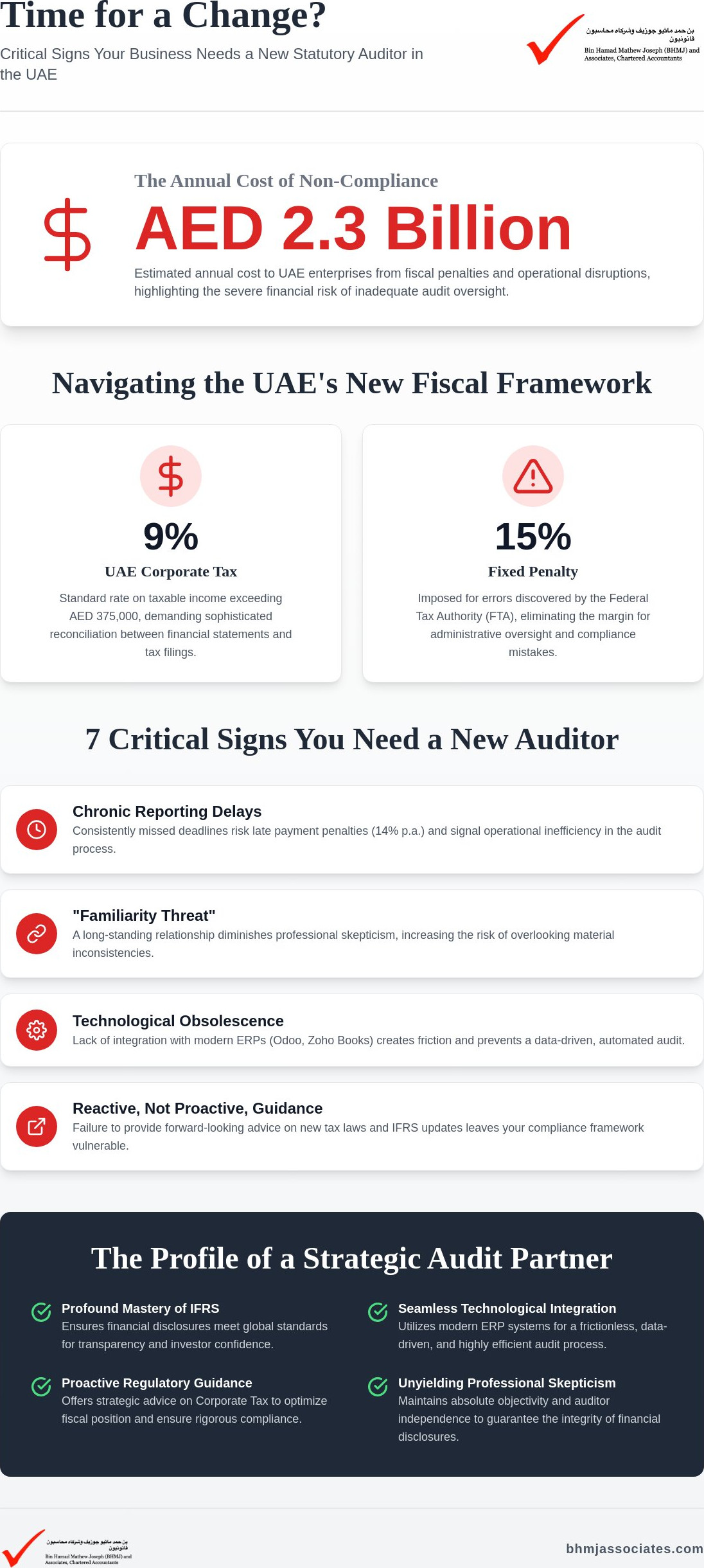
Recent data from the Dubai Chamber of Commerce indicates that non-compliance fiscal penalties and operational disruptions have cost UAE enterprises an estimated AED 2.3 billion annually as of 2026. You likely recognize that within a regulatory landscape now governed by a 15% fixed penalty for errors discovered by the Federal Tax Authority, the margin for administrative oversight has effectively vanished. Identifying the critical signs you need a new auditor is no longer a matter of administrative preference. It’s a fundamental necessity for safeguarding your corporate integrity and shareholder value against the rising tide of regulatory scrutiny.
This article provides a meticulous framework to help you evaluate the professional, technical, and strategic indicators that necessitate a transition to a more authoritative and technologically integrated statutory audit partner. We will examine the urgency of aligning with firms that offer proactive guidance on UAE Corporate Tax updates and demonstrate a profound mastery of the latest IFRS standards. You’ll understand how a rigorous audit relationship serves as a strategic advantage for your organization’s long-term sustainability and growth through diligent oversight and professional excellence.
Key Takeaways
- Comprehend the heightened necessity for rigorous statutory audit assurance as the UAE’s fiscal landscape evolves with increasingly complex Corporate Tax and IFRS frameworks.
- Recognize the critical signs you need a new auditor, specifically focusing on chronic reporting delays and the absence of proactive, industry-specific guidance within management letters.
- Assess the importance of technological integration with modern ERP systems such as Odoo and Zoho Books to ensure a frictionless, automated, and data-driven audit process.
- Establish a methodical approach for transitioning to a more capable audit partner through disciplined internal reviews and the definition of clear technical and regulatory priorities.
- Leverage professional oversight as a strategic tool to fortify corporate governance and maximize long-term shareholder value through rigorous compliance and ethical standards.
The Evolving Role of Audit Assurance in the National Regulatory Environment
A statutory audit constitutes a formal and independent examination of an entity’s financial records to ensure that all declarations accurately reflect the fiscal reality and strictly adhere to International Financial Reporting Standards (IFRS) and national mandates. In the current UAE environment, this process has transitioned from a routine compliance exercise into a critical pillar of corporate governance. As the Federal Tax Authority (FTA) intensifies its data-driven enforcement, the necessity for a partner who maintains absolute objectivity becomes paramount. One of the subtle but dangerous signs you need a new auditor is the presence of a “familiarity threat,” where a long-standing relationship diminishes the professional skepticism required for auditor independence. When an auditor becomes too embedded in a client’s internal culture, the risk of overlooking material inconsistencies increases, potentially exposing the business to severe regulatory scrutiny.
To better understand the professional standards expected from a modern assurance partner, watch this helpful video:
The Impact of the 2026 UAE Corporate Tax Regime on Audit Standards
The 2026 UAE Corporate Tax regime, featuring a standard 9% rate on taxable income exceeding AED 375,000, requires a sophisticated reconciliation between financial statements and tax returns. Auditors must now possess an intricate understanding of Cabinet Decision No. 129 of 2025, which imposes a 15% fixed penalty on errors discovered by the FTA during an audit. If your current firm demonstrates a reactive rather than a proactive stance toward these protocols, it’s a clear indicator that your compliance framework is at risk. A capable partner provides strategic advice on tax planning within ethical boundaries, ensuring that your organization doesn’t just meet the minimum legal requirements but optimizes its fiscal position through rigorous oversight.
Maintaining Alignment with International Financial Reporting Standards (IFRS)
Global markets demand transparency, and rigorous adherence to IFRS remains the primary mechanism for securing international investor confidence and enhancing shareholder value. When an audit firm fails to update its methodology in alignment with evolving IFRS interpretations, it compromises the integrity of financial disclosures. A stagnant approach to these standards is a significant red flag, suggesting that the auditor is no longer capable of providing the high-level assurance necessary for organizational growth. Effective audit assurance enhances the transparency of financial reports, providing stakeholders with the confidence that the entity’s financial health is being monitored with meticulous attention to detail and professional ethics.
Primary Indicators That Your Current Auditor No Longer Meets Professional Standards
Identifying the primary signs you need a new auditor often begins with observing operational lapses that jeopardize your entity’s compliance status. Professional skepticism is the necessary critical assessment of audit evidence, necessitating a questioning mind that probes beyond surface-level representations to ensure the integrity of every financial disclosure. When an audit firm consistently delivers reports behind schedule, it places your organization at risk of incurring late payment penalties of 14% per annum under the revised fiscal framework of 2026. If your internal finance team frequently identifies technical errors in the auditor’s own working papers, or if the management letters provided are generic and devoid of industry-specific insights, the firm’s technical utility has reached its limit.
Deficiencies in Technical Precision and Regulatory Alignment
Auditors who fail to challenge management’s underlying assumptions engage in “rubber-stamping,” a practice that leaves the organization vulnerable during Federal Tax Authority investigations. A modern statutory partner must possess forensic accounting capabilities to detect irregularities before they escalate into material liabilities. Many businesses overlook specific triggers that signal it may be time to change auditors, including a firm’s inability to provide robust support during an official tax audit. Ensuring that your statutory audit is conducted with meticulous precision is essential for mitigating the 15% fixed penalty now associated with discovered tax errors. A lack of technical depth often manifests as a failure to reconcile financial statements with the specific requirements of the 2026 Corporate Tax regime.
Erosion of Professional Communication and Advisory Proactivity
Effective auditing has evolved from a reactive exercise in historical correction to a proactive discipline of risk identification and strategic oversight. A clear warning sign of professional decline is an audit team that remains indifferent to the nuances of your specific business model or fails to provide timely updates on upcoming mandates, such as the e-invoicing transitions expected by 2027. This lack of proactivity often results in a communication gap where confusing jargon replaces clarity, leaving shareholders without actionable intelligence. If your current firm cannot scale its oversight to match your organizational growth, the resulting friction suggests a fundamental misalignment of strategic interests. Reliable partners act as seasoned mentors, guiding you through complex regulatory updates rather than merely reporting on past performance.
Assessing Technological Obsolescence and Operational Friction in Audit Procedures
The persistent reliance on manual document requests and static, historical data represents one of the most definitive signs you need a new auditor in the current fiscal year. Within the 2026 UAE regulatory environment, where the Federal Tax Authority (FTA) employs advanced risk-driven analytics to identify inconsistencies across VAT and Corporate Tax filings, your assurance partner must possess a commensurate level of technological sophistication. A firm’s inability to interface seamlessly with modern ERP environments creates significant operational friction, as your internal staff is forced to divert valuable resources toward repetitive data extraction tasks that should be handled through direct system integration. Technological proficiency is no longer a peripheral advantage; it’s a core requirement for ensuring the speed and accuracy of the statutory audit process.
When an audit relationship is characterized by an incessant demand for physical records or manually compiled spreadsheets, it indicates a failure to adopt the digital audit trails necessary for modern transparency. This reliance on outdated methodologies doesn’t just increase the risk of human error; it also limits the auditor’s ability to provide the real-time insights required for agile corporate governance. A disciplined partner utilizes automated data access to ensure that financial statements are grounded in the most current transactional evidence, effectively transforming the audit from a historical post-mortem into a strategic instrument for organizational development.
The Role of Odoo and Zoho Books in Modern Audit Efficiency
Auditors who possess specialized expertise in Odoo and Zoho Books implementation provide a distinct strategic advantage by extracting data more reliably and with greater granularity. When your assurance partner understands the underlying architecture of your accounting software, they can establish read-only access to general ledgers, which significantly reduces the administrative burden on your finance department. This level of software familiarity allows for the implementation of automated ledger management, a process that minimizes the risk of material misstatements in financial statements. If your current auditor views your accounting software as an operational bottleneck rather than a source of actionable intelligence, it’s a clear indicator that their methodology is no longer aligned with your organization’s growth trajectory.
Identifying Inefficient Audit Methodologies
A primary marker of professional stagnation is the continued use of traditional sampling methods instead of comprehensive, full-population data analytics. A 2026 study estimates that UAE firms utilizing AI-powered audit tools have reduced fraud detection time by up to 70% and increased coverage by 90%, highlighting the severe limitations of manual oversight. Unnecessary disruption to your daily operations often signals a poorly planned audit execution where the firm lacks the technical capacity to conduct a non-invasive examination of your records. By contrast, a technologically advanced partner maintains a disciplined and ethical record-keeping system through digital audit trails, ensuring that every transaction is verifiable and that your entity remains prepared for any sudden regulatory inquiry or business restructuring.
Methodology for a Seamless Transition to a New Statutory Auditor
Once an organization identifies the definitive signs you need a new auditor, it must initiate a disciplined transition strategy that prioritizes the integrity of historical financial data while maintaining strict alignment with national regulatory mandates. This process begins with a rigorous internal review where the current firm’s performance is measured against established Key Performance Indicators (KPIs), such as the technical accuracy of their advice regarding UAE Corporate Tax and their adherence to reporting deadlines. A failure to address the signs you need a new auditor early in the fiscal year can lead to compressed timelines that jeopardize the quality of the successor’s initial assessment. Establishing a clear communication protocol between the outgoing firm, the successor firm, and the board of directors is essential for maintaining a transparent and professional atmosphere throughout the changeover.
A formal “Professional Clearance” process must be conducted to ensure a disciplined transfer of financial records and to identify any professional or ethical reasons that might prevent the new firm from accepting the appointment. This procedure involves the successor firm communicating directly with the outgoing auditor to obtain a comprehensive understanding of the entity’s financial history and internal control environment. A formal resignation letter from the outgoing auditor is a mandatory legal requirement that must be obtained and filed to permit the board to appoint a new statutory partner officially. This structured approach ensures that no aspect of the transition is overlooked and that the organization’s reputation for ethical conduct remains unblemished.
Due Diligence: Selecting a Successor Firm with Expert Oversight
When evaluating a potential successor, it’s vital to verify their standing with the Federal Tax Authority (FTA) and other national regulatory bodies to ensure they possess the authoritative representation required for 2026 compliance. You should interview the specific engagement partner who’ll lead the audit rather than relying solely on the firm’s business development team, as this allows you to assess their technical expertise and commitment to IFRS rigor. A firm’s reputation for ethical conduct and its ability to provide seasoned mentorship are critical factors that will influence the long-term sustainability of your partnership. Assessing their previous experience with complex organizational structures will provide the assurance that your sensitive financial matters are in expert hands.
Managing the Transition to Minimise Operational Disruption
Establishing a transition timeline that avoids peak audit seasons ensures that the new firm can dedicate maximum attention to reviewing opening balances and historical tax filings without the pressure of competing deadlines. This meticulous approach is essential for identifying any latent risks inherited from the previous auditor’s oversight and for establishing a robust baseline for future assurance activities. For a comprehensive understanding of the selection criteria within the broader national context, consult our guide on professional accounting services in the UAE. If you’re prepared to enhance your corporate governance through a more rigorous assurance framework, you may initiate a statutory audit consultation to evaluate your organization’s specific requirements.
Optimising Corporate Governance with BHMJ Associates’ Audit Framework
Bin Hamad Mathew Joseph and Associates Chartered Accountants establishes itself as a disciplined and ethical partner for entities navigating the complexities of the 2026 UAE regulatory environment with a high degree of professionalism. By addressing the technical and strategic signs you need a new auditor, our firm provides a rigorous framework for statutory audit and assurance that transcends the limitations of mere administrative compliance. We view the audit process as a collaborative relationship designed to enhance shareholder value through meticulous oversight and strict alignment with established protocols. Our approach is defined by a quiet confidence that reassures stakeholders that sensitive financial matters are in expert hands, ensuring that no aspect of a project or relationship is overlooked or left to chance.
The firm’s proficiency in International Financial Reporting Standards (IFRS) and authoritative representation before the Federal Tax Authority (FTA) ensures that every financial statement is prepared with extreme attention to detail. This professional rigor is particularly critical as businesses manage Corporate Tax registration and ongoing VAT return filing requirements under the scrutiny of risk-based enforcement. By moving methodically through information and mirroring a thorough investigative process, Bin Hamad Mathew Joseph and Associates Chartered Accountants reinforces its role as a guardian of standards and professional ethics within the national business community.
A Strategic Advantage for Long-Term Growth
Bin Hamad Mathew Joseph and Associates Chartered Accountants frames the statutory audit not as a stagnant requirement but as a strategic tool for identifying operational efficiencies and facilitating necessary business restructuring. Our specialization in Zoho Books implementation and Odoo implementation allows for the creation of a technologically advanced financial ecosystem where data is extracted with precision and reliability. This technological mastery reduces operational friction and provides the real-time insights required for agile corporate governance. We invite you to experience a measured and logical approach to financial due diligence, where our seasoned mentors provide the oversight necessary for your organization’s long-term sustainability and growth.
Commitment to Professional Ethics and Integrity
As a stable and conservative entity that values integrity and long-term relationships, Bin Hamad Mathew Joseph and Associates Chartered Accountants serves as a protective advisor for businesses across diverse sectors, including logistics and education. We understand that the weight of professional responsibilities requires a serious demeanor and a refusal to cut corners, providing a sense of security to the boards we serve. Our commitment to professional ethics ensures that your entity remains in strict alignment with national mandates while optimizing its fiscal position through rigorous investigation. If your organization is prepared to transition to a more authoritative and technologically advanced audit partner, we invite you to initiate a formal consultation regarding your statutory audit and assurance requirements to secure your organizational interests for 2026 and beyond.
Securing Your Organization’s Fiscal Future Through Disciplined Oversight
The 2026 fiscal landscape demands a transition from traditional assurance to a more technologically integrated model of corporate governance. Recognizing the professional and technical signs you need a new auditor is the first step toward mitigating the significant financial risks associated with the current penalty structure for tax errors. By prioritizing a partner who demonstrates absolute adherence to International Financial Reporting Standards and possesses authoritative representation before the Federal Tax Authority, your organization can transform the audit into a strategic asset for growth. This proactive approach ensures that your financial statements aren’t just accurate but serve as a foundation for sustainable organizational development.
Bin Hamad Mathew Joseph and Associates Chartered Accountants provides the meticulous oversight and advanced proficiency in Odoo and Zoho Books digital environments required for long-term operational efficiency. This disciplined approach offers the reliability and quiet confidence necessary to navigate complex regulatory updates with professional excellence. We invite you to Consult with Bin Hamad Mathew Joseph and Associates Chartered Accountants for Rigorous Statutory Audit Services to ensure your business remains resilient in an era of heightened transparency. Your organization’s path to enduring compliance and strategic advantage begins with a commitment to professional rigor.
Frequently Asked Questions
What are the legal requirements for changing a statutory auditor in the UAE?
The appointment of a successor statutory auditor requires a formal resolution passed by the board of directors or shareholders during an Annual General Meeting. This administrative action must be supported by a formal resignation letter from the outgoing firm and the completion of a professional clearance process. This disciplined protocol ensures that the transition adheres to national regulatory frameworks and preserves the ethical integrity of the organization’s financial oversight.
How often should a company consider rotating its audit firm to maintain independence?
Rotating an audit firm every five to seven years is recognized as a global best practice to mitigate familiarity threats that compromise auditor independence. While mandatory rotation varies by jurisdiction, regular assessment is one of the proactive signs you need a new auditor to ensure objectivity remains uncompromised. This periodic renewal reinforces professional skepticism and provides a fresh perspective on the entity’s internal control environment and financial reporting accuracy.
Will changing my auditor trigger a Federal Tax Authority investigation or audit?
Transitioning to a new audit firm doesn’t inherently trigger a Federal Tax Authority investigation or audit. The FTA utilizes a single, risk-driven analytics system that prioritizes businesses based on filing inconsistencies and compliance indicators rather than administrative changes. Engaging a more technically advanced partner actually reduces the risk of an inquiry by ensuring that all VAT and Corporate Tax submissions are rigorously reconciled and error-free.
How long does the transition process to a new audit firm typically take for a mid-sized business?
The transition to a new statutory partner typically requires two to four weeks for a mid-sized enterprise, provided that the outgoing firm facilitates a disciplined transfer of records. This timeline encompasses the professional clearance phase, the review of opening balances, and the establishment of new communication protocols. Identifying the signs you need a new auditor well before the peak audit season ensures that the successor has sufficient time for a thorough investigation.
What documents must the outgoing auditor provide to the successor firm during the transition?
The outgoing auditor is professionally obligated to provide the successor firm with a comprehensive transfer file, including the prior year’s final trial balances and lead schedules. They must also deliver a formal professional clearance letter and any relevant tax reconciliation statements that support historical filings. This meticulous exchange of information is essential for maintaining a continuous audit trail and ensuring that no material financial details are overlooked during the changeover.
Can a new auditor help correct errors made by a previous firm in VAT or Corporate Tax filings?
A new auditor can facilitate the correction of historical errors in VAT or Corporate Tax filings through the formal voluntary disclosure process. Under the 2026 penalty framework, it’s significantly more cost-effective for businesses to disclose errors voluntarily before they’re discovered by the FTA during a risk-based review. A capable partner will conduct a rigorous review of past returns to identify and rectify discrepancies, thereby safeguarding the entity from the 15% fixed penalty.
How does an auditor’s expertise in Odoo or Zoho Books improve the quality of the audit?
An auditor’s proficiency in Odoo or Zoho Books significantly enhances audit quality by enabling direct, read-only access to the general ledger for automated data extraction. This technological integration eliminates the operational friction associated with manual document requests and reduces the likelihood of material misstatements caused by human error. By utilizing full-population data analytics instead of traditional sampling, the auditor provides a more comprehensive and accurate assessment of the organization’s financial health.

Article by
Joseph Mathew
Joseph is a finance and audit professional currently serving as an Audit Manager at Bin Hamad and Mathew Joseph and Associates Chartered Accountants Est., a role he has held since 2022. With a strong background in accounting, compliance, and financial analysis, he brings a detail-oriented and analytical approach to auditing engagements across a range of industries.
In his position at BHMJ Associates, Joseph is responsible for leading audit assignments, overseeing audit teams, and ensuring that financial statements comply with applicable standards and regulatory requirements. He works closely with clients to assess internal controls, identify risks, and provide practical recommendations that enhance financial transparency and operational efficiency.
Known for his professionalism and commitment to accuracy, Joseph has developed a reputation for delivering high-quality audit outcomes within tight deadlines. His ability to interpret complex financial data and communicate insights clearly makes him a valuable advisor to both clients and colleagues.
Joseph continues to build his expertise in auditing and financial management, staying updated with evolving industry standards and best practices, while contributing to the growth and reputation of his firm.
Disclaimer
The content shared and published by Bin Hamad and Mathew Joseph and Associates Chartered Accountants Est. is intended solely for general informational and educational purposes. While every effort is made to ensure the accuracy, completeness, and timeliness of the information provided, the firm makes no guarantees or warranties, express or implied, regarding its reliability or suitability for any particular purpose.
All posts, articles, insights, and commentary do not constitute professional advice, including but not limited to accounting, auditing, tax, legal, or financial advice. Readers are advised to seek appropriate professional consultation before making any decisions based on the information provided.
Bin Hamad and Mathew Joseph and Associates Chartered Accountants Est. shall not be held liable for any direct, indirect, incidental, or consequential loss or damage arising from the use of, or reliance on, the content shared through its platforms.
Any views or opinions expressed in posts are those of the respective authors and do not necessarily reflect the official policy or position of the firm.
By accessing and using this content, you acknowledge and agree to the terms of this disclaimer.