


Could the perceived savings of an entry-level accounting solution actually represent the most significant financial risk your organization faces in 2026? As the Federal Tax Authority continues to intensify its oversight through rigorous Corporate Tax and VAT audits, many enterprises are discovering that the actual cost of outsourced bookkeeping in uae is measured not by the monthly retainer alone, but by the absolute integrity and IFRS compliance of the underlying financial records. We recognize the operational strain caused by unpredictable accounting expenses and the legitimate concern regarding substantial penalties that may arise from improper record-keeping under the mandates of Federal Decree-Law No. 47 of 2022.
This guide serves to provide the meticulous clarity required to evaluate the strategic investment necessary for professional bookkeeping that guarantees strict adherence to evolving regulatory frameworks. You’ll gain a comprehensive overview of the current pricing structures, the critical distinction between administrative data entry and audit-ready financial oversight, and the methods by which structured reporting provides the transparency and peace of mind your stakeholders demand for sustainable growth.
Key Takeaways
- Assess the critical necessity of maintaining IFRS-compliant financial records to navigate the complexities of the UAE’s multi-tax landscape and ensure total alignment with Federal Tax Authority mandates.
- Analyze the primary variables influencing the cost of outsourced bookkeeping in uae, specifically regarding the volume of monthly transactions and the intricate requirements of consolidated reporting for multi-branch entities.
- Perform a detailed financial comparison between the significant overheads of internal accounting departments and the predictable, transparent structure of professional retainer services.
- Establish rigorous criteria for selecting a bookkeeping partner by prioritizing firms with registered tax agent status and a proven history of facilitating successful statutory audits.
- Leverage high-quality management reporting as a strategic asset to enhance shareholder value and streamline the procurement of institutional financing.
The Regulatory Imperative: Why Professional Bookkeeping is Essential in the UAE
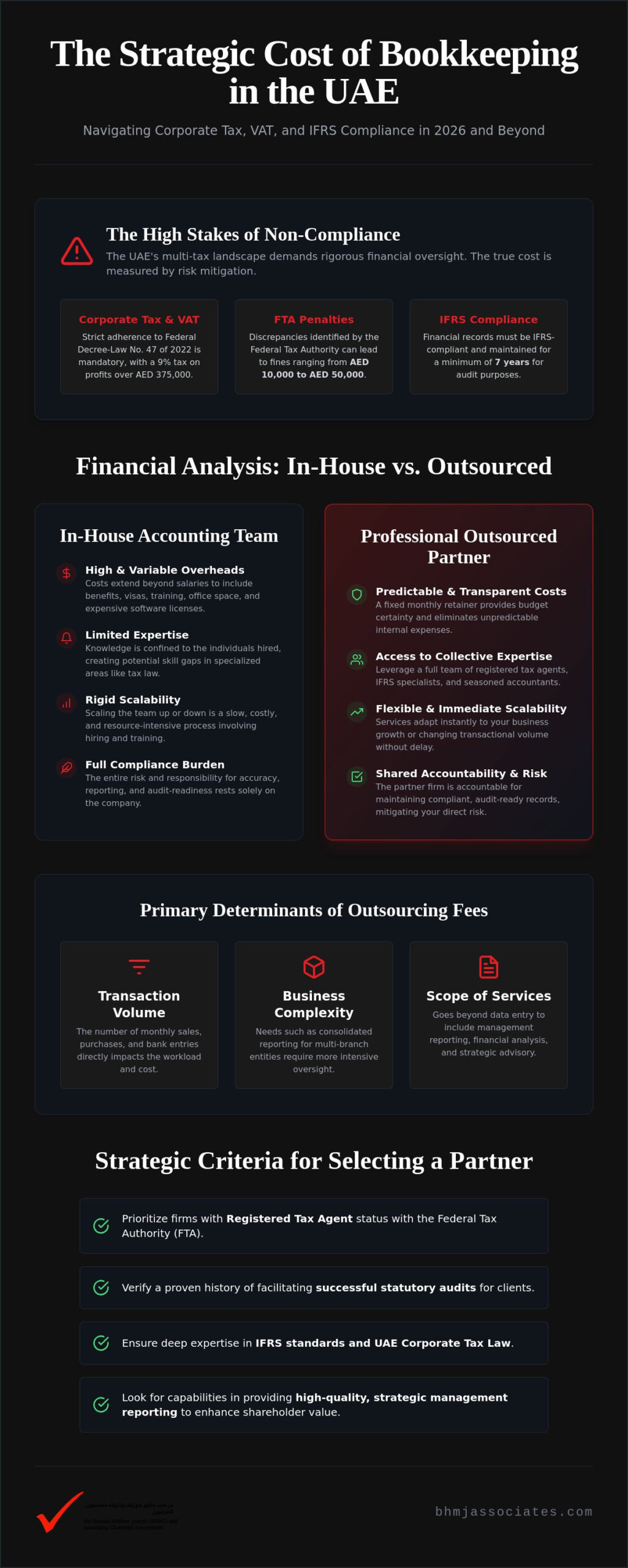
The transition of the United Arab Emirates from a historically tax-neutral jurisdiction to a robust, multi-tax landscape has fundamentally redefined the operational requirements for every registered entity, necessitating a shift toward rigorous financial oversight. Compliance isn’t an elective administrative task; it’s a legal mandate enforced by the UAE Commercial Companies Law and subsequent fiscal decrees that demand absolute precision in financial reporting. Organizations must recognize that the true cost of outsourced bookkeeping in uae is intrinsically linked to the mitigation of risk, as the Federal Tax Authority (FTA) now utilizes sophisticated data-matching protocols to identify discrepancies in VAT and Corporate Tax filings that could lead to penalties ranging from AED 10,000 to AED 50,000.
To better understand the strategic value of professional financial oversight within the local market, watch this helpful video:
Navigating Corporate Tax and VAT Compliance
Precision in ledger management is the only reliable defense against the severe penalties associated with inaccurate tax reporting in the 2026 regulatory environment. Under the UAE Corporate Tax Law, specifically Federal Decree-Law No. 47 of 2022, businesses are required to maintain IFRS-compliant financial records for a minimum of seven years to ensure full transparency during potential inspections. This mandate necessitates a transition from basic data entry to standard methods of bookkeeping that ensure every transaction is categorized with tax-ready accuracy. When calculating the cost of outsourced bookkeeping in uae, executives must account for the technical complexity of managing a 9% tax on profits exceeding AED 375,000 alongside quarterly VAT obligations. Professional oversight ensures that input tax recovery is maximized while ensuring that taxable income is calculated with the meticulousness required to survive a formal FTA inquiry.
Statutory Audit Readiness as a Standard
A significant gap in common business practice is treating bookkeeping as a standalone function isolated from the year-end audit, which often leads to costly reconciliations at the 11th hour. We maintain that effective bookkeeping must be performed with the statutory audit in mind from the first day of the fiscal year, ensuring that every balance sheet item is substantiated by verifiable evidence. Maintaining a transparent, chronological audit trail isn’t merely about following protocols; it’s about providing the primary assurance needed for stakeholders to trust the organization’s financial health. High-quality record-keeping enhances the credibility of financial statements for shareholders and financial institutions, effectively transforming your accounts into a strategic tool for business valuation. By ensuring that every journal entry is supported by documentation, firms eliminate the chaotic and expensive “catch-up” work that often precedes a formal audit process.
Primary Determinants Influencing Outsourced Bookkeeping Fees
The determination of professional fees within the UAE financial landscape is not a standardized process; rather, it’s a meticulous calculation based on several distinct operational variables. Primary among these is the monthly volume of transactions and the subsequent complexity of bank reconciliations. A high-frequency business model, such as a retail chain or a high-volume logistics firm, requires significantly more intensive oversight than a holding company with minimal transactional activity. When evaluating the cost of outsourced bookkeeping in uae, stakeholders must also consider whether the scope involves multiple business entities or branches, as consolidated reporting necessitates a more sophisticated aggregation of data to meet Federal Tax Authority (FTA) guidelines.
Specific industries carry unique regulatory burdens that influence the level of expertise required. For instance, the food and beverage sector often involves high-volume inventory management and complex cost-of-goods-sold calculations, while the education sector requires precise handling of exempt and taxable supplies. The frequency of management reporting also dictates the fee structure. Monthly financial analysis provides a more granular view of organizational health than quarterly summaries but requires a more consistent commitment of professional resources. Furthermore, the seniority of the assigned accounting team remains a critical factor. Engaging chartered accountants for oversight ensures that complex matters, such as inter-company loans or deferred tax assets, are handled with the precision necessary for statutory audit assurance.
The Impact of Accounting Software Integration
Modern ERP systems like Odoo and Zoho Books have revolutionized financial management, yet their initial implementation requires a high degree of technical precision. While these platforms offer significant long-term cost benefits through automation and real-time data access, the initial phase involves professional fees for setup, configuration, and rigorous staff training. A correctly configured system ensures that data flows seamlessly into financial statements, reducing the manual effort required for month-end closings and minimizing the risk of human error during data migration. Organizations that prioritize these robust digital foundations often find that the cost of outsourced bookkeeping in uae is offset by the enhanced accuracy and speed of their financial reporting.
Transactional vs. Advisory-Led Bookkeeping
There is a fundamental distinction between basic data entry and high-level financial oversight. Transactional bookkeeping focuses on the historical recording of events, whereas advisory-led services integrate VAT advisory, tax planning, and strategic financial analysis into the retainer. Including value-added services such as feasibility studies or financial due diligence transforms the accounting function from a compliance requirement into a strategic advantage for growth. For organizations seeking this level of meticulous oversight, engaging with specialists in Bookkeeping Services ensures that every financial decision is backed by expert analysis and rigorous industry frameworks.
Financial Analysis: Outsourced vs. In-House Accounting Functions
The decision to internalize accounting functions or engage an external consultancy is a fundamental strategic choice that significantly impacts an organization’s long-term fiscal resilience. While a monthly salary for an in-house practitioner might appear predictable, the aggregate cost of outsourced bookkeeping in uae often presents a more favorable economic profile when accounting for the exhaustive list of secondary expenditures. These expenditures encompass mandatory employment benefits, including employee visas, comprehensive medical insurance, and the accrual of end-of-service gratuities, all of which are governed by the stringent labor regulations of the Emirates. When these hidden overheads are quantified, the perceived economy of a full-time staff member often dissipates, revealing a higher true cost per transaction than a professional retainer.
Beyond these direct personnel costs, the rapid evolution of the fiscal environment, guided by the UAE Ministry of Finance, necessitates a continuous investment in professional development to maintain technical proficiency in current tax laws. An in-house department requires consistent budgetary allocations for training and the procurement of specialized software licenses and hardware infrastructure. Conversely, an outsourced model provides immediate access to a pre-equipped, highly trained team, allowing for the seamless scaling of service levels in response to business growth or seasonal fluctuations without the administrative burden of HR restructuring. This inherent flexibility allows leadership to reallocate capital toward core revenue-generating activities rather than administrative maintenance.
Direct and Indirect Cost Comparison
A comprehensive financial analysis reveals that the total expenditure required to sustain a single junior accountant, when factoring in office space allocation and management supervision, frequently exceeds the comprehensive retainer fee of a multidisciplinary professional firm. The investment in robust internal accounting systems often entails high upfront costs and ongoing maintenance fees that are typically absorbed by an external partner within their service delivery framework. Perhaps most critically, the opportunity cost associated with senior management dedicating valuable hours to the oversight of an internal department can detract from core strategic initiatives, whereas an outsourced arrangement shifts the burden of operational supervision to the service provider. By optimizing the cost of outsourced bookkeeping in uae, an organization effectively converts a variable risk into a fixed, manageable professional expense.
Risk Mitigation and Professional Liability
Entrusting financial records to a firm of Chartered Accountants provides a layer of professional indemnity and institutional accountability that a single employee simply cannot offer. This structured oversight significantly reduces the probability of internal fraud and financial mismanagement by implementing rigorous internal controls and segregated duties. Organizations gain the collective intelligence of a team of specialists who bring diverse sector experience to every engagement, ensuring that complex accounting treatments are handled with the meticulousness required for Statutory Audit readiness. This collaborative approach effectively positions the external firm as a guardian of the partner’s ethical and financial standards, providing a level of security that is essential for long-term sustainability.
Strategic Criteria for Selecting a Bookkeeping Partner
Selecting a fiscal partner requires a methodical evaluation that extends far beyond a cursory comparison of monthly service fees. While the cost of outsourced bookkeeping in uae remains a significant consideration for budgetary planning, the long-term viability of the partnership depends on the firm’s credentials as approved auditors and registered tax agents. A partner possessing these specific designations ensures that the foundation of your financial records is robust enough to withstand the scrutiny of a Statutory Audit. It’s essential to assess the depth of a firm’s experience within your specific commercial sector, as the nuances of revenue recognition and cost allocation vary significantly between industries. Additionally, an evaluation of the provider’s technology stack, specifically their proficiency in Zoho Books Implementation or Odoo Implementation, is vital to ensuring that your financial data is integrated into a secure, scalable ERP environment.
Compliance and Ethical Standards
Strict alignment with International Financial Reporting Standards (IFRS) is a non-negotiable requirement for any entity seeking to maintain its reputation with the Federal Tax Authority and local regulatory bodies. A firm’s standing with these authorities serves as a primary indicator of their commitment to professional ethics and technical accuracy. It’s imperative to verify that the service provider maintains rigorous internal controls to safeguard the integrity of your sensitive financial data and prevent unauthorized entries. By prioritizing these ethical benchmarks, organizations ensure that their financial reporting remains a reliable instrument for both internal management and external stakeholders. This disciplined approach to compliance provides the quiet confidence needed to focus on core organizational development.
Communication and Reporting Rigour
The value of a bookkeeping partner is fundamentally reflected in the quality and transparency of their financial reporting templates. Stakeholders should expect the consistent delivery of monthly management accounts accompanied by detailed variance analysis that highlights deviations from projected budgets. These regular financial reviews are not merely administrative formalities; they serve as critical inputs for strategic business decision-making and long-term planning. The chosen provider must demonstrate the capacity to support more complex organizational requirements, such as Financial Due Diligence, Feasibility Studies, or Company Liquidation, should the business trajectory demand such specialized oversight. To ensure your organization benefits from this level of professional excellence, we invite you to explore our comprehensive Bookkeeping Services.
Conclusion: Enhancing Corporate Value Through Rigorous Oversight
The culmination of a rigorous financial strategy lies in the transformation of the accounting function from a mandatory compliance burden into a significant driver of corporate value. In the current 2026 fiscal environment, maintaining meticulous financial records is a fundamental pillar of sustainable business growth, providing the transparency required to secure institutional financing and attract sophisticated investors. When an organization demonstrates strict adherence to IFRS standards, it effectively increases shareholder value by reducing the perceived risk profile of the entity. While the cost of outsourced bookkeeping in uae remains a primary consideration for executive leadership, its ultimate worth is found in the peace of mind afforded by partnering with disciplined experts who act as guardians of your professional ethics and institutional stability.
Transitioning from a compliance-only mindset to a strategic financial partnership allows leadership to leverage historical data for future-focused decision-making. High-quality management reports don’t just record the past; they illuminate the path toward capital optimization and operational efficiency. By entrusting these sensitive matters to expert hands, organizations ensure that their financial infrastructure is robust enough to support rapid scaling and complex market entries without the friction of administrative mismanagement.
The BHMJ Approach to Financial Excellence
Bin Hamad Mathew Joseph and Associates Chartered Accountants provides a uniquely integrated service model that aligns daily Bookkeeping Services with the exacting requirements of Statutory Audit readiness. This proactive methodology ensures that every ledger entry is substantiated by verifiable evidence, facilitating a seamless transition when the period for Corporate Tax return filing or VAT Return Filing arrives. The strategic advantage of engaging a single, authoritative partner for your accounting, tax, and Management Consultancy needs lies in the continuity of oversight and the elimination of data silos. We encourage a proactive approach to the 2026 financial year, positioning your organization to thrive within the UAE’s rigorous regulatory framework through meticulous planning and expert advisory.
Commencing Your Professional Accounting Journey
For enterprises seeking to transition to a more sophisticated outsourced model, the initial steps involve a comprehensive diagnostic of current financial health and the resolution of any existing accounting backlogs. Establishing a clean, reconciled slate before the commencement of the next tax period is essential for maintaining the integrity of future filings and preventing the carry-forward of historical errors. Our team of specialists is prepared to guide you through this transition, ensuring that your digital foundations, including Zoho Books Implementation or Odoo Implementation, are configured for maximum accuracy. To begin this collaborative relationship and secure your organization’s financial future, we invite you to Consult with our expert Chartered Accountants in the UAE today.
Establishing a Resilient Financial Foundation for 2026 and Beyond
The transition toward a sophisticated fiscal infrastructure in the UAE necessitates a departure from rudimentary record-keeping in favor of a disciplined, audit-ready framework that prioritizes long-term institutional stability. We’ve established that the cost of outsourced bookkeeping in uae represents a strategic allocation of resources, providing the meticulous oversight required to navigate the complexities of IFRS and UAE Corporate Tax Law with absolute certainty. By prioritizing transparency and technical precision, your enterprise effectively mitigates the risk of regulatory penalties while simultaneously enhancing its credibility among institutional stakeholders and potential financial partners.
Our firm serves as a dedicated guardian of your ethical standards, leveraging our status as Approved Auditors for both UAE Free Zones and Mainland jurisdictions to deliver unparalleled financial clarity. As certified partners for Odoo and Zoho Books implementation, we ensure that your digital accounting systems are configured for maximum efficiency and strict alignment with current Federal Tax Authority protocols. We invite you to Secure your business’s financial future with professional accounting services in the UAE, ensuring your organization remains positioned for sustainable growth in an increasingly rigorous global market. Your commitment to financial excellence today provides the stability required for the commercial opportunities of tomorrow.
Frequently Asked Questions
What is the average monthly cost for outsourced bookkeeping in the UAE in 2026?
The market-wide cost of outsourced bookkeeping in uae is fundamentally determined by the operational complexity of the entity and the depth of compliance oversight required. While entry-level solutions for micro-entities exist, established enterprises typically invest in comprehensive retainers that reflect the professional commitment needed for IFRS-compliant reporting. This investment ensures that all financial activities are recorded with the meticulousness required to survive a formal Federal Tax Authority inspection or a statutory audit.
Does the cost of bookkeeping include VAT return filing and Corporate Tax compliance?
Comprehensive professional retainers frequently integrate VAT return filing and Corporate Tax compliance to ensure a unified approach to an organization’s fiscal obligations. This integrated model prevents data discrepancies between the daily ledger and periodic tax submissions, effectively mitigating the risk of administrative penalties. By consolidating these functions, businesses benefit from a holistic view of their tax position and ensure that all filings are substantiated by accurate, real-time financial data.
Are software licenses like Zoho Books or Odoo typically included in the service fee?
Software license fees for cloud-based platforms are generally treated as direct costs to the business and are not typically bundled into the professional service fee. However, the initial configuration and ongoing optimization of these ERP systems are specialized services provided by the accounting partner. This ensures that the digital infrastructure is correctly aligned with the organization’s reporting requirements and provides the necessary transparency for stakeholder reviews.
How does transaction volume specifically impact the monthly accounting retainer?
Transaction volume serves as a primary determinant of the professional commitment required for meticulous data entry and the subsequent complexity of bank reconciliations. A higher frequency of financial events necessitates more intensive oversight to maintain the chronological audit trail required under UAE law. As the volume of invoices and payments increases, the time required for accurate categorization and ledger maintenance scales, which is reflected in the structure of the monthly retainer.
Can an outsourced bookkeeping firm help with my year-end statutory audit?
Engaging a professional firm ensures that your financial records are maintained with statutory audit readiness as a standard from the first day of the fiscal year. This disciplined approach provides the necessary evidence and schedules required by auditors to verify the accuracy of the year-end financial statements. By maintaining an audit-ready ledger, businesses eliminate the chaotic and expensive reconciliations that often occur when records are not managed to professional standards.
Is it more cost-effective for a small business to hire a part-time accountant or outsource?
Outsourcing often proves more economically viable than hiring a part-time practitioner because it eliminates the hidden overheads of employment, such as visa costs, medical insurance, and end-of-service gratuities. It also provides access to a multidisciplinary team of specialists rather than relying on the limited technical expertise of a single individual. This model allows small businesses to benefit from high-level financial oversight without the long-term liabilities associated with internal staff.
What happens if there are errors in my books—who is liable for FTA penalties?
Legal responsibility for the accuracy of financial records and the timely submission of tax returns remains with the business entity and its management. While a professional firm provides a critical layer of technical oversight to prevent errors, the Federal Tax Authority holds the taxpayer accountable for any non-compliance. Partnering with a firm of Chartered Accountants significantly reduces this risk by ensuring that all records strictly adhere to the latest regulatory mandates.
How often will I receive financial reports from an outsourced provider?
Standard professional engagements provide for the delivery of comprehensive management reports on a monthly basis to facilitate real-time strategic decision-making. These reports typically include a detailed profit and loss statement, a balance sheet, and a variance analysis against established budgets. This regular reporting cycle ensures that leadership has a transparent view of the organization’s financial health and can respond proactively to any emerging fiscal trends.

Article by
Joseph Mathew
Joseph is a finance and audit professional currently serving as an Audit Manager at Bin Hamad and Mathew Joseph and Associates Chartered Accountants Est., a role he has held since 2022. With a strong background in accounting, compliance, and financial analysis, he brings a detail-oriented and analytical approach to auditing engagements across a range of industries.
In his position at BHMJ Associates, Joseph is responsible for leading audit assignments, overseeing audit teams, and ensuring that financial statements comply with applicable standards and regulatory requirements. He works closely with clients to assess internal controls, identify risks, and provide practical recommendations that enhance financial transparency and operational efficiency.
Known for his professionalism and commitment to accuracy, Joseph has developed a reputation for delivering high-quality audit outcomes within tight deadlines. His ability to interpret complex financial data and communicate insights clearly makes him a valuable advisor to both clients and colleagues.
Joseph continues to build his expertise in auditing and financial management, staying updated with evolving industry standards and best practices, while contributing to the growth and reputation of his firm.
Disclaimer
The content shared and published by Bin Hamad and Mathew Joseph and Associates Chartered Accountants Est. is intended solely for general informational and educational purposes. While every effort is made to ensure the accuracy, completeness, and timeliness of the information provided, the firm makes no guarantees or warranties, express or implied, regarding its reliability or suitability for any particular purpose.
All posts, articles, insights, and commentary do not constitute professional advice, including but not limited to accounting, auditing, tax, legal, or financial advice. Readers are advised to seek appropriate professional consultation before making any decisions based on the information provided.
Bin Hamad and Mathew Joseph and Associates Chartered Accountants Est. shall not be held liable for any direct, indirect, incidental, or consequential loss or damage arising from the use of, or reliance on, the content shared through its platforms.
Any views or opinions expressed in posts are those of the respective authors and do not necessarily reflect the official policy or position of the firm.
By accessing and using this content, you acknowledge and agree to the terms of this disclaimer.