


The integrity of a UAE enterprise’s financial reporting is fundamentally anchored in the rigor of its finalisation procedures, where even a minor oversight in VAT reconciliation or accrual accounting can precipitate significant audit discrepancies and regulatory penalties. You’ve likely observed that as the Federal Tax Authority intensifies its enforcement through mandatory e-invoicing and the recent adoption of IFRS 18, the margin for error in your fiscal documentation has effectively vanished.
By implementing this definitive monthly accounting closing process checklist, you’ll secure a disciplined framework that facilitates faster closing cycles and ensures your financial statements remain perpetually audit-ready and compliant with the 9% corporate tax threshold requirements. This article delineates the essential protocols for comprehensive ledger validation, accurate tax provisioning, and the strategic integration of FTA-certified software to elevate your accounting function from a back-office necessity to a driver of organizational growth and enhanced shareholder value.
Key Takeaways
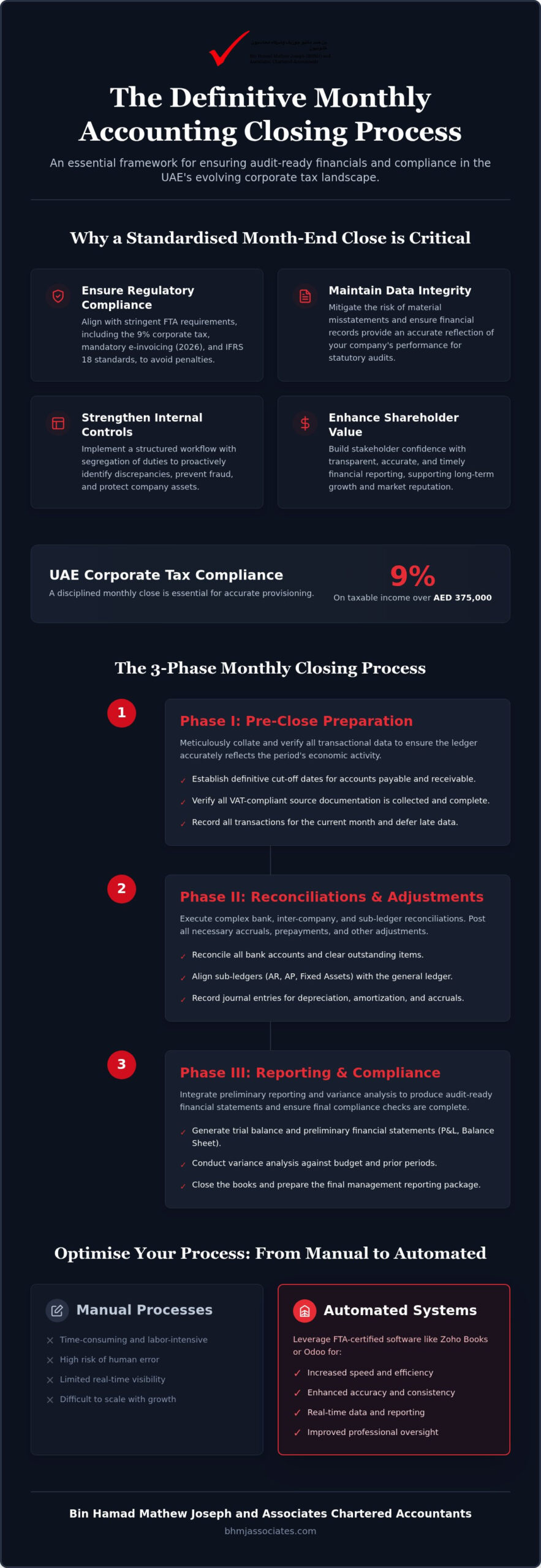
- Understand the critical role of a standardized month-end close in ensuring statutory audit compliance and mitigating risks associated with the UAE’s evolving corporate tax landscape.
- Implement a rigorous monthly accounting closing process checklist to maintain data integrity through precise cut-off dates and comprehensive verification of VAT-compliant source documentation.
- Master the execution framework for complex bank and sub-ledger reconciliations to ensure that all financial adjustments align with international reporting standards and local regulatory protocols.
- Discover how to integrate preliminary reporting and variance analysis into your workflow to produce audit-ready financial statements that enhance overall shareholder value.
- Explore the strategic advantages of transitioning from manual processes to automated systems such as Zoho Books or Odoo for greater efficiency and professional oversight.
The Strategic Significance of a Standardised Month-End Close
The evolution of the United Arab Emirates from a historically tax-neutral jurisdiction to a sophisticated regulatory environment necessitates a fundamental shift in how local enterprises approach their fiscal finalisation. A robust monthly accounting closing process checklist serves as the primary mechanism for transitioning from the simplistic cash-basis methodologies of the past toward the rigorous accrual-basis precision demanded by International Financial Reporting Standards (IFRS). This transition isn’t merely a clerical adjustment; it’s a strategic imperative that ensures every transaction is recognized in the appropriate period. Such precision provides a transparent and accurate reflection of the entity’s financial health to stakeholders and potential investors alike.
Maintaining high-fidelity records begins with the process of recording financial transactions with absolute accuracy, as this data forms the bedrock of the entire reporting cycle. When management prioritizes a standardized close, they effectively mitigate the risk of material misstatements that could otherwise compromise the integrity of the annual statutory audit. This systematic approach fosters an environment of quiet confidence. It reassures shareholders that the organization’s growth is supported by a foundation of meticulous oversight and ethical financial stewardship, which are essential for securing long-term capital and maintaining market reputation.
To better understand the practical application of these concepts within a digital environment, watch this helpful video:
Ensuring Regulatory Alignment with UAE Standards
The Federal Tax Authority (FTA) has established stringent requirements for financial record-keeping, particularly following the implementation of the 9% corporate tax rate on taxable income exceeding AED 375,000. It’s no longer sufficient to reconcile accounts on an annual basis. Instead, businesses must maintain audit-ready books throughout the fiscal year to ensure that tax provisions are accurate and all deductible expenses are properly documented. The introduction of mandatory e-invoicing in July 2026 further underscores the necessity for real-time compliance. This makes the monthly close a critical checkpoint for verifying that all B2B and B2G transactions align with the latest FTA protocols and the presentation standards of IFRS 18.
Internal Control and Fraud Prevention
A disciplined closing framework functions as a vital component of a firm’s internal audit and control systems by proactively identifying discrepancies before they escalate into systemic failures. By enforcing a structured workflow that mandates the segregation of duties, enterprises can effectively prevent financial irregularities and unauthorized transactions. This methodical oversight doesn’t just protect assets. It reinforces the brand’s role as a guardian of professional standards. It ensures that every entry in the general ledger is subject to rigorous validation and collaborative review, ultimately securing the long-term sustainability of the partner’s interests through deliberate and logical oversight.
Phase I: Pre-Close Preparation and Data Integrity Verification
The initial phase of any rigorous monthly accounting closing process checklist involves the meticulous collation and verification of transactional data to ensure that the ledger reflects a complete and accurate representation of the period’s economic activity. This preparatory stage acts as a primary safeguard against the common pitfalls of omitted expenses or prematurely recognized revenue, both of which can distort perceived financial performance and lead to significant complications during a statutory audit. It’s essential to establish a definitive cut-off for accounts payable and receivable, ensuring that only transactions occurring within the current month are recorded and that any late-arriving data is deferred to the subsequent period. This precision is particularly vital for maintaining compliance with Federal Tax Authority (FTA) regulations, where the standard 5% VAT must be captured on all qualifying invoices issued or received before the month-end deadline.
Maintaining the integrity of these records requires a disciplined approach to document management, where every entry in the general ledger is supported by a verifiable primary source document. This methodical verification process ensures that the organization remains in a state of perpetual audit-readiness, reflecting a commitment to transparency and ethical financial stewardship. By establishing these protocols early, management can mitigate the risk of manual processing errors that often lead to delayed reporting and stakeholder dissatisfaction. If your internal team finds it challenging to manage these granular requirements alongside daily operations, engaging professional bookkeeping services can provide the necessary oversight to maintain a clean and compliant ledger.
Transaction Cut-off and Documentation
Implementing a firm deadline for interdepartmental data submission prevents the bottleneck of late-arriving documentation that often plagues the finalization cycle. Every primary source document, including petty cash vouchers and corporate credit card statements, must be accounted for and verified for VAT compliance, as even minor omissions can lead to significant reconciliation errors. Management should also review open purchase orders and pending expense reimbursements to identify necessary accruals, ensuring that the financial statements adhere to the matching principle of IFRS and provide a true reflection of the month’s liabilities.
WPS and Payroll Alignment
Payroll represents a significant portion of operating expenses and requires a specialized reconciliation process to align with the UAE Wages Protection System (WPS). Accountants must reconcile monthly payroll journals against WPS bank files to ensure zero variance, as any discrepancy can trigger regulatory inquiries from the Ministry of Human Resources and Emiratisation. Beyond immediate salary payments, the closing process must account for end-of-service gratuity provisions in strict accordance with UAE Labour Law. These long-term liabilities must be recalculated monthly to reflect changes in employee tenure and salary levels, ensuring that the balance sheet remains a reliable instrument for strategic planning.
Phase II: The Execution Framework for Reconciliations and Adjustments
Once the foundational data integrity is verified, the monthly accounting closing process checklist transitions into a rigorous execution phase defined by the substantiation of every balance sheet account. This stage demands more than a superficial review. It requires a methodical reconciliation of all corporate bank accounts held within the UAE to ensure that every dirham is accounted for and that timing differences are documented with precision. Accountants must perform a comprehensive validation of sub-ledgers against the general ledger for both accounts receivable and accounts payable, as these reconciliations are vital for identifying discrepancies that could otherwise obscure the firm’s true liquidity position or vendor obligations.
The complexity of this phase increases when addressing fixed assets and intercompany relationships. Management must execute monthly depreciation runs based on a meticulously maintained asset register, ensuring that the carrying values of all tangible and intangible assets align with IFRS requirements. For organizations with multiple entities, the reconciliation and subsequent elimination of intercompany balances are essential for accurate consolidated reporting. By adhering to a comprehensive monthly accounting closing process checklist, businesses ensure these internal transactions are eliminated, preventing the artificial inflation of revenue or assets that often creates significant friction during the annual statutory audit process.
Balance Sheet Substantiation
A disciplined approach to balance sheet substantiation involves the continuous review of prepaid expenses and the amortisation of deferred revenue to ensure that income and costs are recognized in strict alignment with the periods to which they relate. It’s a process that remains critical for businesses in the retail or manufacturing sectors, where physical inventory counts must be reconciled against the digital stock ledger. Management must also evaluate the aging reports for accounts receivable to adjust provisions for doubtful debts, ensuring that the financial statements reflect a conservative and realistic valuation of expected cash inflows.
UAE VAT and Tax Provisioning
In the current regulatory landscape, the reconciliation of Value Added Tax (VAT) is a non-negotiable component of the monthly close. This involves a granular comparison between the ledger’s Input and Output VAT accounts and the figures reported on the Federal Tax Authority (FTA) portal to prepare for periodic return filing. Beyond VAT, the introduction of the 9% corporate tax on taxable income exceeding AED 375,000 requires the calculation and recording of monthly tax provisions. Accountants must ensure that all zero-rated and exempted supplies are correctly categorized according to FTA standards, as these classifications directly impact the accuracy of the tax provisioning and the entity’s ultimate fiscal liability.
Phase III: Post-Close Reporting and Compliance Integration
The successful completion of the monthly accounting closing process checklist transitions the finance function from a state of transactional processing to one of strategic oversight. This phase commences with the extraction of a preliminary Trial Balance, providing a comprehensive overview of the ledger’s equilibrium and acting as the final diagnostic tool before reporting. It’s during this stage that management performs a high-level variance analysis to identify any residual anomalies. This ensures that the subsequent financial statement package, comprising the Income Statement, Balance Sheet, and Cash Flow Statement, accurately reflects the entity’s economic reality. A formal management review meeting follows, where leadership scrutinises budget versus actual performance to ensure that all significant deviations are understood and documented with meticulous detail.
To preserve the integrity of these verified reports, it’s an absolute requirement to lock the accounting period within the ERP system. This technical safeguard prevents any unauthorized retrospective entries that could inadvertently alter the reconciled balances and compromise the audit trail. Such discipline is essential for maintaining the quiet confidence of shareholders and ensuring that the organization’s fiscal history remains immutable and transparent. It’s a process that moves methodically through information, mirroring a thorough investigative process that refuses to cut corners.
Management Reporting and Variance Analysis
Effective management reporting goes beyond the mere presentation of numbers. It involves a deep investigation into significant fluctuations in monthly operating expenses to determine if they represent temporary timing differences or permanent shifts in the cost structure. By providing context for revenue variances against the annual financial forecast, the finance team enables leadership to drive strategic decision-making and operational efficiency. These reports don’t just fulfill a requirement. They serve as a strategic advantage for growth, blending technical precision with the aspirational goals of organizational development.
Finalising the Audit Trail
The closing cycle is only truly complete when all reconciliation workpapers are organised into a centralised, audit-ready digital folder. Every adjusting journal entry must be supported by appropriate documentation and formal approvals to withstand the scrutiny of external examiners. This level of meticulousness is what separates standard bookkeeping from the high-stakes accuracy provided by professional accounting services in Dubai. By maintaining this rigorous standard, businesses ensure that their annual statutory audit is a predictable and efficient process rather than a source of organizational stress.
Ensure your organization’s financial integrity remains beyond reproach by engaging our experts for a comprehensive Statutory Audit and compliance review.
Optimising the Close Process Through Professional Oversight
While a monthly accounting closing process checklist provides the necessary structural integrity for financial finalisation, the efficiency of its execution is significantly influenced by the underlying technological infrastructure of the enterprise. The transition from manual, spreadsheet-dependent workflows to sophisticated, automated systems represents a pivotal advancement for UAE businesses seeking to mitigate the risks associated with human error and data fragmentation. By integrating a rigorous close framework within an enterprise resource planning (ERP) environment, organizations can facilitate a move toward a ‘continuous close’ model. This methodical approach allows for the real-time reconciliation of transactions, which substantially reduces the traditional month-end pressure on finance teams and ensures that leadership possesses a perpetually accurate view of the firm’s fiscal position.
The implementation of periodic internal audits further refines this cycle by identifying systemic bottlenecks and ensuring that the closing protocols remain aligned with evolving regulatory requirements, such as the 9% corporate tax regime. This proactive oversight doesn’t just fulfill a compliance requirement. It serves as a strategic advantage, transforming the finance function into a stable and conservative entity that values integrity and long-term growth. It’s a process that moves methodically through information, mirroring a thorough investigative process that refuses to cut corners and provides a profound sense of security to all stakeholders involved.
Leveraging Accounting Software Implementation
For UAE-based SMEs and large enterprises, the adoption of Zoho Books or Odoo offers a significant strategic advantage, particularly given these platforms’ robust capabilities in managing local VAT requirements and the mandatory e-invoicing standards effective July 2026. These systems utilise automated bank feeds and integrated VAT modules to drastically reduce manual reconciliation errors, ensuring that every dirham is accounted for with precision. However, the true value of these digital tools is only fully realised through professional Zoho Books Implementation or Odoo Implementation. Such specialized setup ensures the software is configured to mirror the specific operational complexities of the business while providing the internal finance team with the technical expertise required to maintain a high-stakes reporting environment.
The Role of BHMJ Associates in Financial Excellence
Professional accounting consultancy services provide the authoritative oversight necessary to elevate a firm’s financial reporting from standard record-keeping to a foundation for organizational development. BHMJ Associates presents itself as a disciplined and ethical partner, offering a comprehensive suite of services that includes recurring Bookkeeping Services, Statutory Audit, and tailored Management Consultancy for process restructuring. By engaging with seasoned chartered accountants, businesses can ensure that their monthly accounting closing process checklist is not merely a task but a rigorous framework for maintaining year-round compliance and audit-readiness. This collaborative relationship reinforces the brand’s role as a guardian of standards, committed to the sustainability and growth of its partners’ interests through meticulous oversight and a refusal to overlook any aspect of the fiscal relationship.
Securing Your Financial Future Through Rigorous Compliance
Adopting a standardized monthly accounting closing process checklist is no longer a matter of internal preference but a fundamental requirement for navigating the UAE’s increasingly complex fiscal landscape. By moving beyond manual spreadsheets toward automated, IFRS-aligned frameworks, your organization ensures that every transaction is validated, every tax provision is accurate, and every financial statement is ready for the scrutiny of a statutory audit. This methodical approach doesn’t just satisfy regulatory mandates; it provides the transparency and stability required to drive sustained organizational growth and shareholder confidence.
As specialists in IFRS and UAE Tax Law, BHMJ Associates stands ready to serve as your disciplined partner in maintaining these high standards of financial excellence. Whether you require expert Odoo and Zoho Implementation to streamline your operations or need the authoritative oversight of Approved Auditors for UAE Free Zones, our team provides the meticulous attention to detail your business deserves. Request a consultation with BHMJ Associates for professional accounting and audit support to ensure your enterprise remains at the forefront of regulatory compliance and operational efficiency. Your commitment to financial integrity today is the most reliable investment in your firm’s long-term sustainability.
Frequently Asked Questions
How long should a standard month-end close process take in the UAE?
A standard month-end close process for a UAE enterprise typically spans five to ten business days, depending on the complexity of the organizational structure and the maturity of the digital accounting systems in place. While some agile firms aim for a fast close within three days, the rigorous requirements of UAE regulatory compliance often necessitate a more measured pace to ensure absolute accuracy in the monthly accounting closing process checklist.
What are the most common errors found during the monthly closing process?
The most frequent discrepancies identified during the execution of a monthly accounting closing process checklist include misclassified VAT transactions, omitted accruals for end-of-service benefits, and unreconciled timing differences in bank statements. These errors often arise from manual data entry or a lack of synchronization between sub-ledgers and the general ledger, which can ultimately lead to material misstatements during a statutory audit if not rectified promptly.
Do I need to reconcile VAT every month if I file quarterly returns?
Maintaining a monthly VAT reconciliation protocol is an essential best practice even for entities that file returns on a quarterly basis. This disciplined frequency allows the finance team to identify and correct documentation gaps or classification errors in real-time, thereby ensuring that the final quarterly submission to the Federal Tax Authority is based on verified data and remains entirely audit-ready. It’s a proactive measure that prevents the accumulation of errors over a longer period.
How does the UAE Corporate Tax affect my monthly accounting entries?
The UAE Corporate Tax regime necessitates the introduction of monthly tax provisioning entries to reflect the 9% liability on taxable income exceeding AED 375,000. Accountants must distinguish between accounting profit and taxable profit each month, accounting for permanent and temporary differences to ensure that the balance sheet accurately represents the entity’s current and deferred tax obligations. This ensures that the organization remains prepared for annual corporate tax return filing requirements.
What is the difference between a month-end close and a year-end close?
A month-end close focuses on the periodic substantiation of accounts to provide management with timely performance data, whereas a year-end close is a more exhaustive procedure that culminates in the production of audited financial statements. The annual process includes permanent ledger adjustments, comprehensive inventory valuations, and the finalization of tax liabilities, requiring a higher level of scrutiny and external verification from approved auditors to ensure full statutory compliance.
Can Odoo or Zoho Books fully automate the closing process?
While Zoho Books and Odoo provide significant automation for bank feeds and standard journal entries, they don’t entirely replace the need for professional oversight during the closing cycle. Complex adjustments such as asset impairment reviews, specialized tax provisioning, and the interpretation of IFRS 18 presentation standards still require the analytical expertise of a seasoned accountant. These systems function best when managed by professionals who understand the nuances of UAE regulatory frameworks.
What documents are essential for an audit-ready month-end folder?
An audit-ready month-end folder must contain all primary bank reconciliation statements, verified payroll journals aligned with the Wages Protection System, and a comprehensive fixed asset register. Additionally, it should include schedules for prepaid expenses, deferred revenue, and detailed VAT workpapers that reconcile the internal ledger with the figures reported on the FTA portal. Maintaining this documentation in a centralized digital environment ensures that the annual statutory audit proceeds without unnecessary delays.
Why is intercompany reconciliation critical for UAE groups?
Intercompany reconciliation is critical for UAE groups to ensure that internal transactions are eliminated upon consolidation, preventing the artificial inflation of revenue or assets. This process is particularly vital for entities operating within Free Zones to accurately assess Qualifying Income and ensure that transactions between related parties are conducted at arm’s length. Without rigorous intercompany oversight, a group risks significant discrepancies that can compromise the integrity of its consolidated financial reporting and tax positioning.

Article by
Joseph Mathew
Joseph is a finance and audit professional currently serving as an Audit Manager at Bin Hamad and Mathew Joseph and Associates Chartered Accountants Est., a role he has held since 2022. With a strong background in accounting, compliance, and financial analysis, he brings a detail-oriented and analytical approach to auditing engagements across a range of industries.
In his position at BHMJ Associates, Joseph is responsible for leading audit assignments, overseeing audit teams, and ensuring that financial statements comply with applicable standards and regulatory requirements. He works closely with clients to assess internal controls, identify risks, and provide practical recommendations that enhance financial transparency and operational efficiency.
Known for his professionalism and commitment to accuracy, Joseph has developed a reputation for delivering high-quality audit outcomes within tight deadlines. His ability to interpret complex financial data and communicate insights clearly makes him a valuable advisor to both clients and colleagues.
Joseph continues to build his expertise in auditing and financial management, staying updated with evolving industry standards and best practices, while contributing to the growth and reputation of his firm.
Disclaimer
The content shared and published by Bin Hamad and Mathew Joseph and Associates Chartered Accountants Est. is intended solely for general informational and educational purposes. While every effort is made to ensure the accuracy, completeness, and timeliness of the information provided, the firm makes no guarantees or warranties, express or implied, regarding its reliability or suitability for any particular purpose.
All posts, articles, insights, and commentary do not constitute professional advice, including but not limited to accounting, auditing, tax, legal, or financial advice. Readers are advised to seek appropriate professional consultation before making any decisions based on the information provided.
Bin Hamad and Mathew Joseph and Associates Chartered Accountants Est. shall not be held liable for any direct, indirect, incidental, or consequential loss or damage arising from the use of, or reliance on, the content shared through its platforms.
Any views or opinions expressed in posts are those of the respective authors and do not necessarily reflect the official policy or position of the firm.
By accessing and using this content, you acknowledge and agree to the terms of this disclaimer.